



Use Wozber and land your dream job
Create Resume
No registration required
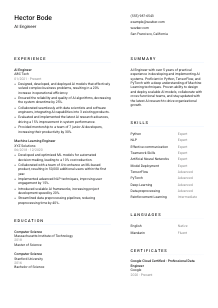
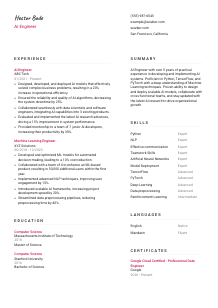
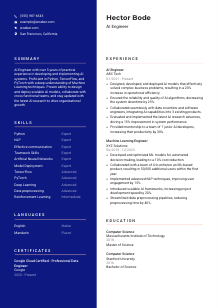
Blending neural nets, but your resume seems binary? Check out this AI Engineer resume example, created with Wozber free resume builder. It shows how you can layer your artificial intelligence acumen to match job specifics, guiding your career through the data maze!
AI Engineer hiring tends to move quickly from broad interest to very specific technical questions. A resume has to make your model work visible in practical terms: what you built, how it was deployed, how you improved reliability, and where your work changed a product, workflow, or business metric. General claims about innovation are easy to skim past. Concrete examples of scalable systems, experimentation, monitoring, and cross-functional delivery are what keep an application in the stack.
When an AI resume is tailored well, reviewers can quickly separate research-heavy profiles from engineers who can ship production models and support them after launch. Wozber's free resume builder helps you align that story with ATS optimization by matching your wording to the job description, organizing technical content cleanly, and keeping the resume easy to parse. That matters when a team needs to see Python, TensorFlow or PyTorch, model deployment, and collaboration history without digging for them.
For AI Engineer roles, the top of the resume should remove friction immediately. Hiring teams should be able to confirm who you are, how to reach you, and whether you match any practical requirements before they get into model architecture, ML pipelines, or production impact.
Use your full name as the main header in a clean, readable format. Keep it slightly larger than the rest of the text so it anchors the page without looking stylized. In technical hiring, clarity wins over design flourishes because recruiters and engineering leaders often scan dozens of resumes in one sitting.
Place "AI Engineer" beneath your name if that is the role you are pursuing. This creates immediate alignment with the opening and avoids leaving reviewers to infer whether you are coming from a machine learning, data science, or software engineering track. If your recent title was adjacent, such as Machine Learning Engineer, you can still use the target title when your experience supports it.
Include a working phone number and a professional email address, ideally a simple format based on your name. If you also link a portfolio, GitHub, or personal site, make sure it supports the same story as the resume, such as model deployment work, experiments, publications, or production-ready code rather than unfinished side projects.
Some AI roles are flexible, others are tightly tied to a specific office or team setup. Here, the San Francisco, California requirement is explicit, so listing that location in your header helps clear a basic screening point right away. Treat location this way when it is clearly stated, not as a universal rule for every AI Engineer application.
A LinkedIn profile is useful, but for AI roles, a strong GitHub, project page, or personal website can add real weight if it shows deployed applications, reproducible experiments, notebooks, APIs, or research implementation. Only include links you would be comfortable having discussed in an interview.
Your header should answer the practical first-pass questions in seconds: who you are, what role you do, how to contact you, and whether you meet obvious requirements such as location. Then the reviewer can focus on your model work and engineering depth.




Experience is where AI Engineer resumes usually separate themselves. Hiring teams want to see applied machine learning work tied to deployment, system quality, and measurable outcomes, not just a list of algorithms or libraries you have touched.
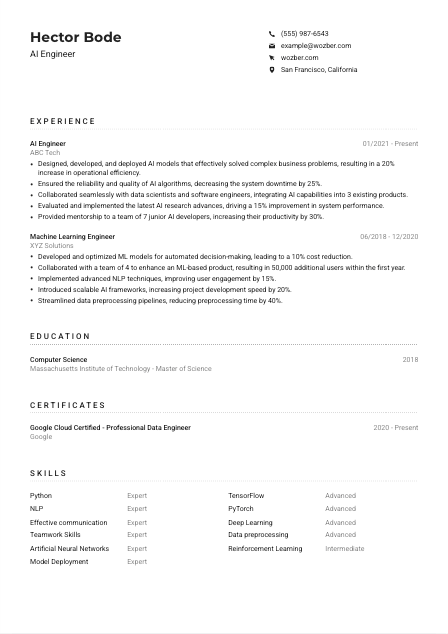
Pull the main technical responsibilities from the posting and reflect them in your bullet points using your own real results. For this role, that means designing and deploying AI models, improving reliability and quality, integrating capabilities into products, and contributing to research-informed improvements. The sample resume does this well by using language close to the posting while still grounding each point in actual outcomes.
List jobs in reverse chronological order and include title, company, and dates. Then use bullets to clarify what kind of AI work you owned. Good bullets often reveal the production setting, the team interface, or the business problem, such as model deployment into existing products, NLP feature development, or pipeline improvements that reduced preprocessing time.
AI teams are rarely hiring for experimentation alone. Quantify what changed after your work shipped. Useful metrics include latency reduction, uptime improvement, inference efficiency, user growth, cost reduction, throughput, preprocessing speed, or gains in model performance that mattered in production. In the example, metrics like a 20% increase in operational efficiency and a 25% drop in system downtime make the engineering impact easy to understand.
Prioritize experience that supports the role's actual demands: machine learning systems, deep learning, NLP, reinforcement learning, MLOps, model optimization, testing, monitoring, and integration with software products. If you have broader software or analytics experience, keep it only when it strengthens the story, such as data pipeline ownership or backend integration for ML services.
AI Engineers rarely work in isolation. Show where you partnered with data scientists, product managers, software engineers, or platform teams to move models into production. If you mentored junior engineers, reviewed model approaches, or guided implementation decisions, include that too. The sample resume's bullet about mentoring 7 junior AI developers is a strong example because it adds leadership without losing technical relevance.
By the end of this section, a reviewer should understand the kinds of AI systems you have built, the environments where they ran, the teams you worked with, and the business or product results your work produced. That is the level of detail that gets interviews for AI engineering roles.
Education matters in AI hiring because it signals the technical base behind your work, especially in areas like machine learning, optimization, statistics, and computer science. Keep this section straightforward, then let your experience carry the heavier proof if you already have solid production work.
If the posting asks for a Bachelor's degree in Computer Science, Engineering, or a related field, make sure that degree is easy to spot. If you also hold a Master's degree, list it clearly, especially when the employer states it as preferred. In the example, the Master's in Computer Science strengthens alignment without needing extra explanation.
Include school name, degree, field of study, and graduation year or date. This section does not need heavy design or long descriptions. Reviewers should be able to scan it quickly and confirm your academic background before moving back to the experience that shows how you applied it.
If your degree title naturally matches the language in the job ad, use that exact wording. "Computer Science" is a clear fit here. This helps with ATS matching and removes ambiguity, especially for interdisciplinary backgrounds where the degree name may not immediately read as relevant to AI engineering.
Early-career candidates can use this space to show relevant coursework, thesis work, research labs, or capstone projects in deep learning, NLP, reinforcement learning, distributed systems, or applied ML. If you already have several years of production experience, keep these extras brief or leave them out unless they are unusually relevant.
Honors, publications, competitive research programs, or technically demanding graduate work can help when they relate to the role. For experienced AI Engineers, they should support the story rather than compete with professional achievements. Keep the emphasis on material that adds technical credibility.
Your education should confirm that you have the academic grounding for AI engineering work. Once that is clear, the resume should move quickly back to the systems, models, and outcomes you have delivered in practice.
Certifications are not mandatory for most AI Engineer roles, but the right ones can strengthen your resume when they support deployment, cloud infrastructure, data engineering, or specialized tooling. Keep this section selective and relevant to the work you want to do.
Focus on certificates that connect to real engineering tasks, such as cloud platforms, ML infrastructure, data engineering, or model operations. A certification like "Google Cloud Certified - Professional Data Engineer" fits well because it supports the deployment and production side of AI work, not just theory.
A short, relevant certificate section is stronger than a long list of loosely related courses. Pick credentials that reinforce the requirements in the posting or the technical direction of your experience, especially when they help explain platform knowledge that your bullet points only mention briefly.
Technical certificates age differently depending on the platform and domain. Adding the date earned, and renewal period when relevant, shows whether your cloud or tooling knowledge is recent enough to matter for current production environments.
AI changes quickly, and employers notice candidates who keep their stack current. Certificates can help show that you are staying engaged with deployment practices, infrastructure, or emerging tooling, especially if your degree was earned several years ago and your recent roles do not fully capture that learning.
Treat certifications as support for your main case, not the centerpiece. They work best when they reinforce the engineering environment you can already demonstrate through experience, projects, or platform work.
The skills section should read like a precise inventory of the tools and capabilities you can use on the job. For AI Engineer roles, that usually means programming, ML frameworks, model domains, deployment-related strengths, and collaboration skills that matter in product environments.
Start with the technologies and methods the employer named, then add adjacent skills you genuinely use. For this role, that includes Python, TensorFlow, PyTorch, deep learning, NLP, and reinforcement learning. If your background also includes model serving, MLOps, data preprocessing, or experimentation frameworks, add them when they are supported elsewhere in the resume.
Order matters. Lead with the skills most likely to be scanned by recruiters, hiring managers, and ATS filters. Core programming languages, frameworks, and model specialties usually belong near the top. Soft skills such as communication and teamwork are worth including for AI roles too, especially when the job emphasizes cross-functional collaboration.
A single mixed list can work, but many AI Engineers benefit from light grouping such as Programming, Frameworks, ML Domains, Deployment, and Collaboration. That makes it easier to read and gives hiring teams a quicker map of your capabilities. The example resume combines technical and interpersonal strengths, but you can make the section even sharper by organizing those categories more explicitly.
A reviewer should be able to scan your skills and immediately recognize the stack you can work in, the ML areas you know best, and whether you can contribute in a production team setting. Keep every listed skill tied to real experience.
Language skills are usually a supporting section for AI Engineers, but they still matter when a role calls for clear written and spoken communication. That is especially true when you will explain technical tradeoffs, document model behavior, or work across teams.
If the posting specifically asks for strong oral and written English, list English with an honest proficiency level such as Native or Fluent. This is a simple but useful detail for roles that involve collaboration with product teams, technical documentation, stakeholder updates, or mentoring.
Extra languages can help if the company works across regions, supports multilingual products, or handles language-specific AI use cases such as NLP systems. They are usually a secondary advantage, so keep them concise and clearly rated.
Terms like Native, Fluent, Intermediate, and Basic are easy to understand and scan quickly. Avoid vague descriptions. Clear ratings set the right expectation for meetings, writing, and cross-team communication.
If you work with multilingual datasets, localization, international user bases, or language models across markets, an additional language can strengthen your technical story. Without that context, it still has value, but it should remain a supporting detail rather than a major selling point.
For most AI Engineer applications, languages should stay short unless multilingual communication is central to the job. Put the emphasis where hiring decisions are usually made: model development, deployment, reliability, and team delivery.
Handled well, the languages section quietly reinforces that you can communicate with clarity in the environments where AI work gets built, reviewed, documented, and shipped.
The summary sits at the top of the resume, so it should quickly tell a hiring team what kind of AI Engineer you are. Keep it tight, technically grounded, and focused on the work you can deliver rather than broad claims about passion or innovation.
Start with your title and years of experience, then define your main area of strength. For example, an AI Engineer with 5+ years building and deploying machine learning systems gives a clearer picture than a broad statement about working in AI. This instantly sets expectations for scope and seniority.
Name the stack and domains that the employer is likely screening for first, such as Python, TensorFlow, PyTorch, deep learning, NLP, or reinforcement learning. Choose the capabilities that best match the role instead of trying to cover your full technical history in four lines.
A summary becomes far more convincing when it includes a concrete result. You might reference scalable model deployment, reliability gains, product integration, or measurable improvements such as operational efficiency or system performance. The sample summary works because it combines stack, experience level, and applied impact without becoming too long.
Adjust the final line so it echoes the position you want now. If the job emphasizes scalable AI systems, cross-functional integration, and mentorship, those themes should appear in your summary if they are true of your background. This is one of the fastest ways to make the top of the resume feel specific rather than generic.
After reading your summary, a hiring manager should already understand your experience level, technical stack, and the kind of AI engineering impact you bring. That creates the right frame for the detailed evidence in the rest of the resume.
An effective AI Engineer resume shows far more than familiarity with machine learning terms. It clarifies what you have built, how those systems performed, and how you worked with product and engineering teams to move models into production.
Use Wozber's free resume builder to tighten that alignment, improve ATS readability, and shape your content around the language the role actually uses. Features like an ATS resume scanner and ATS-friendly resume format help surface missing requirements, sharpen keyword alignment, and present your experience in a structure hiring teams can review quickly.
When the resume is tailored this way, it becomes much easier to judge whether you can design, deploy, and improve AI systems in a real production setting. That is the standard your next application should meet.




