



Use Wozber and land your dream job
Create Resume
No registration required
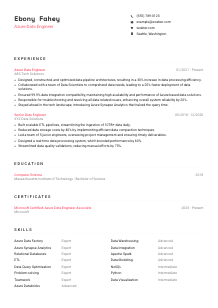
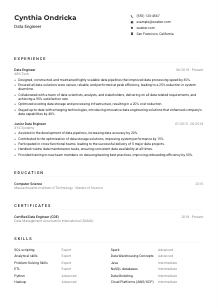
Building cloud solutions but feel your resume is floating in the data lake? Check out this Azure Data Engineer resume example, built with Wozber free resume builder. Learn how to showcase your big data skills and match your experience to job requirements, making your career as scalable as the cloud!
Azure Data Engineer hiring usually turns on one practical question fast: can you build and keep data pipelines running at production scale without losing reliability, performance, or trust in the data. A resume for this work needs to show more than cloud familiarity. It should make your ETL design, platform decisions, data quality checks, and collaboration with analysts or data scientists easy to understand.
When your resume mirrors the language of the role, reviewers can quickly separate hands-on Azure pipeline engineers from broader data professionals whose work was lighter on implementation. Wozber's free resume builder helps you shape that experience into an ATS-compliant resume, so tools, platforms, and outcomes like Azure Data Factory, Databricks, Synapse, integration performance, and troubleshooting work are clear from the first scan.
For Azure Data Engineer roles, the top of the resume should remove friction immediately. Hiring teams should be able to confirm who you are, how to reach you, and whether basics like title and location line up with the opening before they move on to your pipeline and platform experience.
Use your full name as the most visible text in the header. Keep the formatting clean and readable. In technical hiring, this section does not need design flair. It needs to make your document easy to identify in an ATS, email thread, or interview panel review.
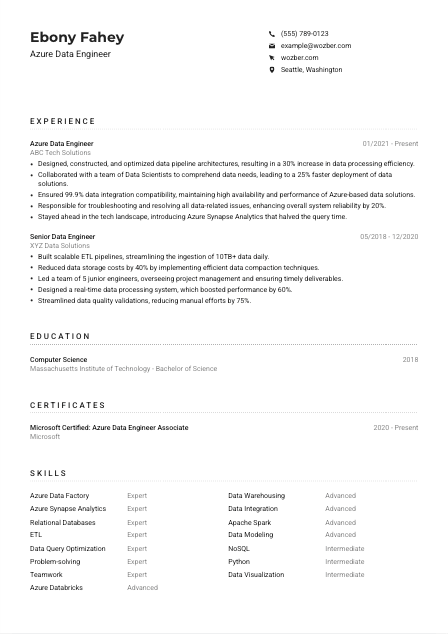
Place the role title directly under your name when it matches your background. For this opening, "Azure Data Engineer" is the right choice because it aligns with the posting and sets expectations around Azure-native data engineering rather than general BI or analytics work.
List a working phone number and a professional email address with no formatting errors. Small mistakes here can undercut the credibility of a resume that is otherwise full of technical detail, especially in a role where precision matters across pipeline logic, data validation, and production support.
If the job calls for Seattle, Washington, and you already live there or are prepared to relocate, say so in the header. In the example resume, listing Seattle, Washington resolves that requirement right away. Treat this as targeted tailoring to the posting, not a standard line for every Azure Data Engineer resume.
A LinkedIn profile or personal site can help if it reinforces your data engineering background with consistent titles, dates, and project detail. If you include one, make sure it reflects the same Azure tools, pipeline work, and career timeline shown on the resume.
A well-built header gives reviewers the basics without making them hunt for information. Once title, contact details, and any required location are clear, the rest of the resume can stay focused on data engineering depth.




This section carries the most weight for Azure Data Engineer roles. Teams want to see what you built, what platforms you used, how much data moved through your systems, and what changed because of your work, whether that meant faster processing, lower storage cost, or fewer failures in production.
Read the job description closely and mark the work that appears repeatedly. Here, the center of gravity is Azure data solutions, ETL pipeline architecture, integration, data quality validation, troubleshooting, and collaboration with Data Scientists and Data Analysts. Those priorities should shape which bullets you keep, rewrite, or move higher.
List roles in reverse chronological order and use titles that accurately reflect your level of responsibility. Azure-focused employers often look for progression from general data engineering into more platform-specific architecture, optimization, or leadership work. Company name, job title, and dates should be easy to scan before the reader gets into your results.
Your strongest bullets should connect the platform work to a measurable result. The example does this well with points like designing and optimizing data pipeline architectures that improved processing efficiency by 30 percent, or introducing Azure Synapse Analytics to cut query time in half. That structure works because it shows what you built, where you built it, and why it mattered.
Numbers matter in data engineering because they describe operating conditions. Include metrics such as processing speed, data volume, latency reduction, uptime, compatibility, cost savings, defect reduction, or manual effort eliminated. Details like ingesting 10TB+ daily, maintaining 99.9 percent compatibility, or reducing storage costs by 40 percent tell a hiring team far more than a generic claim about impact.
Prioritize bullets that match Azure pipeline design, integration performance, storage knowledge, and troubleshooting over adjacent work that is less relevant. If you have broad data platform experience, keep the pieces that support this job first. For example, real-time processing, ETL optimization, data quality checks, and cross-functional delivery all reinforce the requirements here more directly than unrelated reporting or visualization tasks.
A hiring manager should be able to trace your Azure data engineering scope from bullet to bullet. When your experience shows platforms, scale, reliability, and business effect clearly, the match becomes much easier to see.
Education matters here because the posting asks for a bachelor's degree in Computer Science, Information Systems, or a related field. Once that box is checked, the section should stay concise unless you are early in your career and need relevant coursework or projects to reinforce your technical base.
If you hold the degree the employer asks for, present it plainly. In this case, a Bachelor of Science in Computer Science aligns cleanly with the requirement and removes any ambiguity about academic background.
Use a consistent format with degree, field, school, and graduation date. Technical recruiters often skim this section quickly because they are mainly checking whether the educational requirement is met before returning to your platform and delivery experience.
Write the full degree and field rather than abbreviating too aggressively. "Bachelor of Science in Computer Science" does more work than a shortened version because it reflects the language of the posting and supports your foundation in systems, databases, and software-oriented problem-solving.
If you are a newer candidate, coursework or projects in databases, distributed systems, data warehousing, cloud computing, or ETL design can help connect your education to the role. If you already have several years of Azure implementation work, those additions are optional unless they are unusually relevant.
For candidates with 3+ years or more in Azure data engineering, education should confirm the credential without competing with the work history. As your resume grows, projects, pipeline outcomes, and platform depth deserve more space than classroom detail.
This section needs to answer the degree requirement quickly and cleanly. Once it does, let your Azure delivery work carry the weight of the application.
Certifications carry real value in cloud data roles when they sharpen the picture of your platform knowledge. They work best when they support the experience section, especially for employers looking for current familiarity with Azure services, architecture patterns, and data engineering practices.
Choose certifications that directly support Azure data work. The clearest example here is "Microsoft Certified: Azure Data Engineer Associate," which maps neatly to the role's emphasis on Azure data solutions, pipeline design, and platform familiarity.
A short list of well-matched certifications is stronger than a long list of loosely related ones. Keep the focus on cloud data engineering, distributed processing, warehousing, or other credentials that strengthen your fit for pipeline, integration, and performance-focused work.
Cloud platforms change quickly. Listing dates or active periods helps show whether a certification is current. In the example, "2020 - Present" signals ongoing validity and supports the claim that the candidate stays current with Azure tooling.
This role includes staying up to date on new Azure services and recommending improvements. Recent certifications, renewals, or advanced learning can support that part of your profile, especially if your experience section also shows tool adoption, modernization work, or performance improvements tied to newer services.
Well-chosen certifications strengthen your Azure profile when they are current, relevant, and clearly connected to the work you have already done in production environments.
For Azure Data Engineer roles, the skills section should read like a practical inventory of the stack you can work in today. Reviewers are looking for direct overlap with pipeline orchestration, storage technologies, processing frameworks, and the collaboration skills needed to build usable data solutions.
Start with the posting and pull out the must-have skills. Here that includes Azure Data Factory, Azure Databricks, Azure Synapse Analytics, ETL, relational databases, NoSQL, data warehousing, problem-solving, and teamwork. Those are the terms that should anchor the section if they genuinely reflect your background.
Order matters. Lead with the Azure services and core data engineering capabilities that are central to the role, then follow with supporting tools and softer collaboration strengths. The example does this well by putting Azure Data Factory, Azure Synapse Analytics, ETL, relational databases, and data integration ahead of less central items.
A simple structure helps here. You might separate cloud platform tools, data engineering methods, storage technologies, and collaboration skills. That makes it easier to pick out your command of services like Databricks or Synapse, alongside broader strengths such as data modeling, query optimization, troubleshooting, and teamwork with analysts or scientists.
Keep this section tightly aligned to the role and to your real experience. A focused list of Azure services, data technologies, and delivery skills gives the reader a fast technical snapshot before they dive into the bullets.
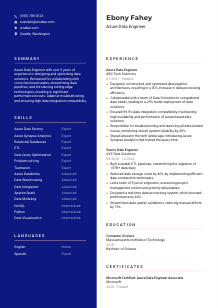
Language requirements are usually straightforward, but they still matter. For a technical role that relies on cross-functional work, clear communication with analysts, scientists, and engineering teammates is part of execution, not just a nice extra.
If the posting says English is mandatory, make sure English appears in this section with an honest proficiency level. "Native" or "Fluent" works when accurate and removes any uncertainty around day-to-day communication.
Extra languages are worth listing if they are real working skills. They may not be central to every Azure Data Engineer job, but they can be useful in globally distributed teams, support rotations, or data organizations working across regions.
Stick to standard terms like Native, Fluent, Intermediate, or Basic so your level is immediately understood. Avoid vague descriptions that make it harder for a hiring team to judge how comfortably you can work in meetings, documentation, or technical discussions.
Some data teams work across time zones, business units, or international stakeholders. In those settings, language range can support smoother requirements gathering, issue resolution, and documentation, especially when projects involve shared datasets or cross-border reporting.
Only include languages you can genuinely use. If you are fluent in another language, it can strengthen your profile, but it should remain secondary to the Azure, ETL, and integration capabilities that define the role.
Meet the stated requirement first, then add any other languages that support collaboration. Keep the section factual and proportional to the role.
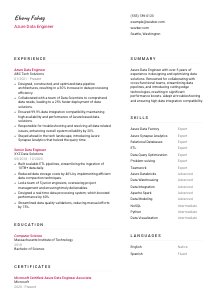
Your summary should give a quick technical read on your background before the reader reaches the detailed experience bullets. For this role, that means leading with Azure data engineering depth, then reinforcing it with the kinds of outcomes teams care about, such as pipeline performance, integration reliability, and cross-functional delivery.
Before writing, isolate the themes that define the job. Here those are Azure data solutions, pipeline design and maintenance, storage knowledge across relational and NoSQL systems, data quality, troubleshooting, and collaboration with analytics stakeholders. Your summary should reflect that mix without turning into a keyword list.
Start with a direct line that states your title and years of relevant experience. The example summary uses this well by identifying the candidate as an Azure Data Engineer with more than 5 years of experience, which immediately sets the level of the profile.
Mention a few Azure-relevant capabilities and connect them to outcomes. Tools like Azure Data Factory, Azure Databricks, or Synapse belong here only if they are central to your background. Pair them with results such as faster deployment, better integration performance, improved query speed, or stronger data reliability so the summary feels grounded in delivery.
Aim for 3 to 5 lines with no filler. A hiring manager should be able to understand your specialization, your level, and your strongest contribution areas in under 15 seconds. That is enough to frame the rest of the resume without repeating your full work history.
A concise, role-specific summary helps the reader place your experience immediately. When it names your Azure strengths and the kind of data engineering results you deliver, the rest of the resume lands with more context.
An Azure Data Engineer resume works best when each section supports the same hiring story: you can design, build, optimize, and support data solutions on Azure in a production setting. That means clear platform alignment, measurable pipeline results, and enough technical specificity for both human reviewers and ATS screening to recognize the match.
Use Wozber's free resume builder and ATS resume scanner to tighten that alignment, surface missing requirements, and present your experience in an ATS-friendly resume format. When the final version makes your Azure tools, data architecture work, troubleshooting range, and collaboration with analytics teams easy to read, you are ready to apply with confidence.




