



Use Wozber and land your dream job
Create Resume
No registration required
Processing petabytes, but your resume feels like kilobits? Check out this Big Data Engineer resume example, created with Wozber free resume builder. Learn how to present your data wizardry so it lines up smoothly with job frameworks, making your career growth as expansive as your datasets!
Big Data Engineer resumes are strongest when they make scale and reliability visible. Hiring teams want to see how you built or improved the systems behind ingestion, processing, storage, and downstream analytics, whether that meant stabilizing Spark jobs, improving data quality in batch pipelines, or keeping Kafka-driven workflows available under production load.
A targeted resume changes how quickly your background reads against the stack and delivery demands in the posting. Using Wozber's free resume builder to shape an ATS-compliant resume helps you mirror the employer's language around Hadoop, Spark, Hive, Kafka, and programming depth in Python, Java, or Scala, so the hiring team can immediately tell where you've already handled comparable data volume, performance tuning, and cross-functional work.
For a Big Data Engineer, the header should remove basic friction. It needs to identify you clearly, align you with the target role, and cover practical details a hiring team checks early, especially when the posting includes location or communication requirements.
Use your full name in the largest text on the page so it stands apart from the rest of the resume. Keep it simple and professional. In technical hiring, the header should be clean and easy to scan, just like the rest of the document.
Place "Big Data Engineer" directly below your name if that is the role you are pursuing. This helps recruiters and ATS systems categorize you quickly, and it sets the frame for the Hadoop, Spark, Kafka, and pipeline experience that follows.
Include one reliable phone number and a professional email address. Use an email format based on your name whenever possible. If a recruiter wants to schedule a technical screen or discuss production-data experience, they should not have to work around outdated or casual contact information.
If the job requires you to be in a specific city, reflect that clearly in your header when it is true for you. In the example, listing "San Francisco, California" directly supports a stated requirement. If you are relocating, say so plainly rather than leaving the employer to guess.
Add your LinkedIn profile, portfolio, GitHub, or personal site if it supports your data engineering work. For this profession, that might mean code samples, architecture notes, data tooling projects, or a profile that reinforces your experience with distributed systems and ETL workflows. Make sure the content matches the resume's dates, titles, and technical scope.
This section does not need personality flourishes. It needs to confirm who you are, how to reach you, and whether you meet practical requirements before the hiring team gets into your platform work and delivery history.




This is where Big Data Engineer resumes usually separate. Employers are not only looking for time spent with certain tools. They want to see what you designed, what you optimized, how reliable the pipelines were, and what changed for analytics, reporting, or system efficiency because of your work.
Start by identifying the technologies and responsibilities that define the role. Here, that includes Hadoop, Spark, Hive, Kafka, Python, Java or Scala, large-scale processing, data quality, and collaboration with analysts and data scientists. Those terms should appear naturally in your experience when they reflect real work, especially in bullets about pipeline design, workflow optimization, and platform maintenance.
List company name, job title, and dates in a consistent format for every position. Big Data Engineer hiring often involves quick comparisons across platform scope, seniority, and years of hands-on work. Clear structure lets the reader move straight into the parts that matter most, such as distributed processing, real-time ingestion, and data infrastructure ownership.
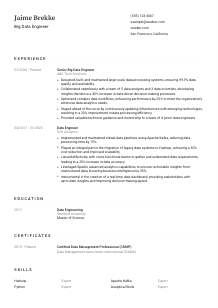
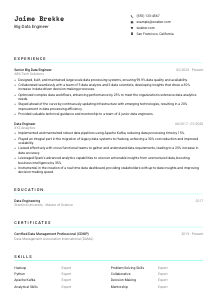
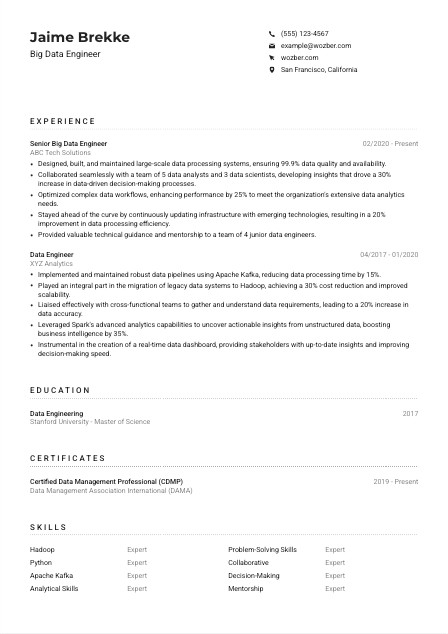
Your bullets should show what changed because of your work. Good Big Data Engineer bullets often include throughput improvements, latency reduction, cost savings, data quality gains, uptime, scalability, or faster access to analytics. The sample resume does this well with results like 99.9% data quality and availability, a 25% workflow performance improvement, and a 15% reduction in processing time after Kafka pipeline work.
Keep the most relevant accomplishments and trim anything that does not support the role. If the posting emphasizes building and maintaining data processing systems, collaboration with analysts and data scientists, and optimizing workflows, lead with bullets that show exactly that. Migration work, dashboard support, and cross-functional requirement gathering can be valuable too when they connect back to platform performance or analytics delivery.
Big data environments change fast, and employers value engineers who improve infrastructure rather than simply maintain it. Include examples of upgrading frameworks, modernizing pipelines, tuning Spark jobs, improving orchestration, or adopting new tooling where it raised efficiency or reliability. In the example, updating infrastructure with newer technologies and improving processing efficiency by 20% is a strong illustration of that mindset.
A Big Data Engineer resume should read like a record of systems delivered and improved. When your bullets show scale, tooling, measurable performance, and collaboration with analytics teams, the hiring team can picture you working in production rather than learning on the job.
Education matters most here as a qualification checkpoint and a credibility marker for technical depth. Keep it clear, relevant, and easy to match against the posting, especially when the employer specifies a degree in Computer Science, Data Science, or a related field.
If the job asks for a Bachelor's or Master's degree in a relevant field, make sure that qualification is impossible to miss. List your highest or most relevant degree first. Degrees in Computer Science, Data Science, Data Engineering, Software Engineering, or similar disciplines all help establish the foundation expected for distributed systems and large-scale data processing work.
Include the degree, field of study, school, and graduation year or date range. Keep formatting consistent with the rest of the resume. This section is usually scanned quickly, so straightforward presentation works best.
If your education lines up closely with the role, let that connection be obvious. In the example, a Master of Science in Data Engineering is highly relevant because it directly supports the kind of pipeline, platform, and analytics infrastructure work described in the posting.
You can include relevant coursework, research, or academic projects if they strengthen your case, especially earlier in your career. For Big Data Engineer roles, useful additions might involve distributed computing, databases, machine learning infrastructure, cloud systems, or large-scale data architecture. If you already have substantial industry experience, keep this selective.
Senior candidates usually do not need a deep education section, but they should still align it with the employer's baseline requirement. Early-career candidates may need education to carry more weight. In either case, focus the wording on what supports your candidacy for data engineering work rather than listing unrelated academic detail.
This section should confirm that you meet the academic requirement and, when applicable, reinforce your grounding in data systems, computation, and engineering fundamentals. Let experience do the heavy lifting after that.
Certifications are secondary to hands-on platform work in big data hiring, but they can still strengthen your resume when they reinforce relevant knowledge areas such as data management, cloud data tooling, or distributed processing practices.
List certifications that connect clearly to the job's data engineering demands. A credential in data management, cloud platforms, streaming systems, or analytics infrastructure is far more helpful than a generic course completion. The sample's Certified Data Management Professional works because it complements pipeline and data quality responsibilities.
For each certification, provide the credential name, issuing organization, and date or active period. This gives the reader enough context to understand its relevance and currency without adding clutter.
A certification has more value when the rest of the resume shows related application. If you list a data management credential, your experience should also show data quality, governance awareness, pipeline reliability, or structured data handling at scale. That connection makes the credential believable and useful.
Big Data Engineers often need to keep pace with changing frameworks, cloud services, storage engines, and orchestration patterns. A few current, relevant certifications can signal that you stay engaged with the field. Just keep the list focused. Quantity matters far less than relevance to the stack and responsibilities in the role.
Well-chosen certifications can reinforce your profile, especially when they match the kind of data platform work the employer needs. Keep this section concise and closely tied to the systems, quality standards, and tooling already shown elsewhere on the resume.
The skills section should give a fast, accurate read on your technical range. For Big Data Engineer roles, that means naming the core frameworks, languages, and working strengths that show up repeatedly in the posting and in your project history.
Pull the must-have tools and languages directly from the job description, then include the ones you genuinely use. In this posting, that means Hadoop, Spark, Hive, Kafka, and one or more of Python, Java, or Scala. These should appear prominently because they shape both ATS matching and the first technical impression.
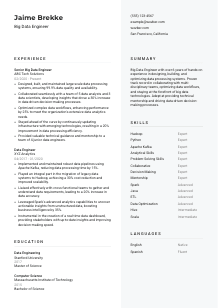
Order your skills around the target role rather than around everything you know. For a Big Data Engineer, distributed processing frameworks, streaming tools, ETL, data workflow optimization, and programming languages should come before broad traits. The example skill list does this well by leading with Hadoop, Python, and Apache Kafka.
Use straightforward naming and avoid padding the section with vague terms. Technical skills should be specific enough to map to production work. Soft skills should only stay if the role explicitly values them and your experience supports them. For example, collaboration and mentorship make sense here because the job involves cross-functional work and guiding junior engineers.
A hiring team should be able to scan this section and understand your likely working environment within seconds. If the tools, languages, and engineering strengths line up with your experience bullets, the resume feels credible and technically grounded.
Language skills are usually a supporting section for Big Data Engineers, but they matter when the posting names communication requirements or when the work involves cross-functional teams, international stakeholders, or distributed engineering environments.
If the job specifies English proficiency, list English clearly with an accurate level such as Native or Fluent. This is especially relevant in roles that involve partnering with data analysts, data scientists, product teams, or engineering leadership on requirements, debugging, and technical handoff.
Additional languages can be useful in global organizations or distributed teams, but they should be listed only when you can actually work in them. In the example, Spanish adds breadth without distracting from the core data engineering profile.
Choose clear levels such as Native, Fluent, Advanced, or Intermediate. Avoid inflating your ability. Technical roles often involve precise discussion of incidents, architecture decisions, and business logic, so accuracy matters here as much as it does in the skills section.
Do not let languages take up more space than your technical content unless multilingual communication is central to the role. For most Big Data Engineer applications, this section should confirm communication capability and then stay out of the way.
If you are actively learning a language that matters to the company or region, you can include it at a basic level. Keep it brief. In most cases, this section works best when it simply confirms your ability to communicate effectively in the environments where data engineering work gets done.
For this profession, language details mainly support collaboration. Once English proficiency and any meaningful additional languages are clear, let the resume return focus to platform engineering, data pipelines, and delivery outcomes.
Your summary should quickly establish the kind of Big Data Engineer you are. It needs to connect years of experience, core platform strengths, and the business or technical outcomes you usually deliver, without turning into a list of keywords.
Read the posting closely before writing this section. If the role centers on large-scale data processing systems, data quality, performance optimization, and collaboration with analysts and data scientists, those are the themes your summary should reflect. Keep the language close to the work you have actually done.
Start with a direct first line that gives your title, years of experience, and core area of work. The sample does this effectively with "Big Data Engineer with over 6 years of hands-on experience in designing, building, and optimizing data processing systems." That opening immediately establishes level and technical domain.
After the opening line, include the technical and delivery strengths that matter most for the target role. Good options here include building data pipelines, improving workflow performance, supporting data-driven decision-making, mentoring junior engineers, or working across analytics teams. Keep the claims specific enough to match the rest of your resume.
Aim for 3 to 5 lines. Skip soft introductions and broad claims about passion. A Big Data Engineer summary works best when it reads like a compact operating profile: level, stack focus, delivery strengths, and the kind of results you consistently produce.
When this section is written well, the reader knows within a few seconds whether your background lines up with the data platform work in the job. Make that judgment easy by leading with scope, tools, and outcomes that belong to real Big Data Engineering work.
A Big Data Engineer resume should make one thing clear fast: you can build, maintain, and improve data systems that other teams rely on. When the document shows the right stack, measurable platform outcomes, and collaboration with analysts, scientists, and engineers, it gives hiring teams a clear picture of how you would operate in their environment.
Use Wozber's free resume builder, ATS-friendly resume templates, and ATS optimization tools to align your experience with the posting and strengthen how your technical background is presented. The finished resume should make it easy to judge your readiness for large-scale data engineering work from the first scan.




