



Use Wozber and land your dream job
Create Resume
No registration required
Digitizing databases, but your resume feels like a Ctrl+Z moment? Check out this Data Entry Analyst resume example, created with Wozber free resume builder. It shows how to line up your meticulous skills with job specifics, so your career path is always on record!
Data entry analysis sits at the point where speed, accuracy, and judgment meet. Hiring teams want to see that you do more than type quickly. They want proof that you can keep records clean, catch duplicates and inconsistencies, and turn raw information into reporting that people can actually use. Your resume should make that operational discipline visible from the first section onward.
When a resume is tailored well, the distinction between routine clerical work and data-focused analysis becomes much easier to spot. Using Wozber's free resume builder to mirror the employer's wording and build an ATS-compliant resume helps surface the details that matter here, such as data quality checks, database updates, Excel strength, and process improvements. That gives the hiring team a clearer read on whether you can protect data integrity in a live business environment.
The header section does quiet but important work for a Data Entry Analyst. It confirms that you are reachable, professionally presented, and, when relevant, already aligned with practical requirements such as location and work environment.
Use your full name as the most visible text in the header. Keep it simple and easy to read. For a role centered on accuracy and clean records, a cluttered or overly styled heading sends the wrong signal before a recruiter reaches your experience.
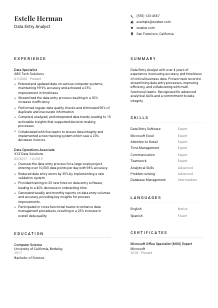
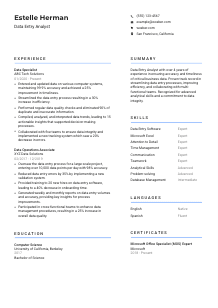
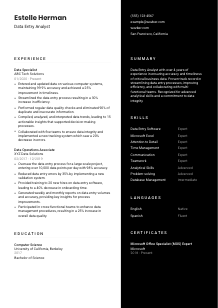
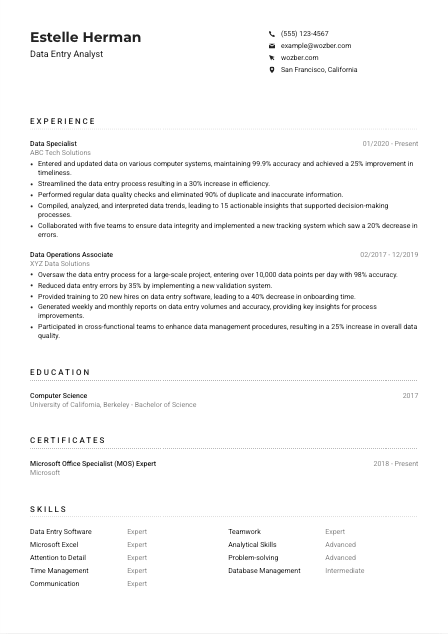
Place "Data Entry Analyst" directly under your name when that matches the role you are pursuing. This keeps your positioning immediate and avoids ambiguity with adjacent titles like Data Entry Clerk, Data Specialist, or Data Operations Associate. In the example resume, that direct title match helps frame the rest of the application around analysis, quality control, and data process work.
List a current phone number and a professional email address, then verify both carefully. For a job built around correct entries and reliable records, small mistakes in your own contact information can undercut confidence fast.
If the employer specifies a city or state requirement, reflect that in your contact details. Here, San Francisco, California is a stated condition, so showing it clearly removes a practical question from the review process. Treat location this way only when it is relevant to the posting, not as a universal rule for every Data Entry Analyst resume.
Include LinkedIn or a professional portfolio link if it supports the same story as your resume. Make sure job titles, dates, and measurable results match. For data-focused roles, consistency across records matters, and recruiters notice when one profile tells a different story from another.
Your personal details should confirm the basics quickly: who you are, how to reach you, and whether you meet practical requirements tied to the role. Keep this section clean, precise, and free of distractions so the hiring team can move straight to your data work.




This section carries the most weight for a Data Entry Analyst because it shows how you handled live data, maintained quality, and improved the way information moved through a system. Titles matter, but hiring teams pay closest attention to what you processed, how accurately you worked, what checks you performed, and whether your reporting or process changes improved operations.
Before editing your bullets, identify the work the employer cares about most. In this job description, the priorities are clear: entering and updating data, running data quality checks, analyzing trends, collaborating across teams, and recommending process improvements. Use those responsibilities as your editing guide so your past work speaks the same language as the opening.
List your positions in reverse chronological order and include job title, employer, and dates for each role. Data teams often review many resumes quickly, and a clean work history helps them understand your progression from entry support to broader ownership of data quality, reporting, or workflow improvements.
Write bullets that show the result of your work, not just the task. Accuracy rate, entry volume, turnaround time, duplicate reduction, reporting cadence, and error reduction are all native measures for this field. The sample resume does this well with points like 99.9% accuracy, a 25% improvement in timeliness, and a 90% reduction in duplicate or inaccurate information.
Data entry roles are often measured by both precision and throughput, so numbers matter. If you improved a validation workflow, reduced manual corrections, increased daily volume, or sped up onboarding through documentation or training, say so directly. Metrics such as a 30% increase in efficiency or 35% fewer errors tell a hiring manager far more than "helped improve processes."
A Data Entry Analyst usually does more than input records. Show where you interpreted trends, generated weekly or monthly reports, used Excel or database tools, coordinated with operations or finance teams, or introduced a tracking method that improved data integrity. In the example, the strongest bullets connect cross-team work with measurable reductions in errors, which is exactly the kind of overlap employers look for when they need analytical support rather than simple keystroke volume.
Your experience section should leave no doubt that you can manage data accurately at working speed, catch quality issues before they spread, and improve the process around the work. If each bullet ties a concrete action to a measurable result, this section will carry real weight.
Education matters here as a qualification check first and a relevance signal second. For many Data Entry Analyst openings, the degree is part of the initial screen, but the field of study can also add context if it supports analytical work, systems thinking, or comfort with structured information.
If the posting asks for a bachelor's degree or equivalent experience, make that easy to confirm. Place your degree, school, and graduation date in a standard format so a recruiter or ATS can identify it without effort.
Use a simple sequence: degree, field of study, institution, and graduation year. Clean formatting matters in every resume, and especially in a profession built on orderly information handling.
If your degree connects to analysis, business operations, information systems, computer science, mathematics, or another data-adjacent area, include the field in full. In the example, a Bachelor of Science in Computer Science supports comfort with databases, systems, and structured data, even though that exact degree is not required for every employer.
You do not need to turn this into a transcript. Still, if you are early in your career, a line on database fundamentals, statistics, spreadsheet modeling, or business analytics can help connect your education to the role's actual work.
If your formal education is older or less directly related, related training can do useful support work here or in the certifications section. Excel courses, database training, or classes in reporting and data analysis all strengthen your case when the role asks for analytical skill alongside accuracy.
For this role, the education section should answer the requirement quickly and add context where it helps. Once the degree box is checked, let your experience and skills carry the deeper argument for why you can handle production data well.
Certifications are not mandatory in every Data Entry Analyst search, but the right one can sharpen your profile quickly. They are most useful when they reinforce a tool, workflow, or quality standard named in the posting.
Start with credentials that relate directly to how you work. If the employer mentions Excel, reporting, or structured data tools, put the most relevant certification first. Here, a Microsoft Office Specialist Expert credential is a strong match because the posting lists Excel certification as a plus.
Choose certifications that support data entry accuracy, spreadsheet work, database handling, reporting, or process discipline. A short list of relevant credentials reads better than a long list of unrelated course completions.
Add the year earned or validity period when applicable. This helps employers understand whether your tool knowledge is current, especially for software-based credentials.
Ongoing learning matters when the role includes process improvement, reporting, or heavier Excel use. Updated certifications in spreadsheets, data analysis, or database tools show that your skills have moved beyond basic entry work and kept pace with current workflows.
Relevant certificates work best when they support the same message already shown in your experience and skills. For a Data Entry Analyst, that usually means stronger proof of Excel depth, data handling discipline, and readiness to work accurately inside real business systems.
A Data Entry Analyst skills section should read like the toolkit behind clean databases and dependable reporting. Focus on the tools, strengths, and working habits that actually shape performance in the role, not a generic list of broad workplace traits.
Start with the skills the employer names directly, then add closely related abilities you genuinely use. In this case, that includes data entry software, database work, Excel, attention to detail, analytical thinking, problem-solving, and collaboration around data integrity.
Show both system-facing skills and the habits that make them effective. Hard skills might include Microsoft Excel, database management, validation workflows, reporting, or data entry software. Pair those with role-relevant strengths like accuracy, time management, and attention to detail, since speed without control creates bad data.
Trim the section to the skills that support your target role most directly. If your experience already proves advanced reporting or cross-team communication, you do not need to overload the list with every software or soft skill you have touched. The sample resume handles this well by combining technical tools with analytical and communication strengths in a way that supports the actual job requirements.
Every skill listed here should connect to work you can back up elsewhere on the page. That connection is what makes the section useful for both ATS screening and human review.
Language ability matters most when it affects day-to-day accuracy, team communication, or reporting. For a Data Entry Analyst, that usually means showing you can work confidently in the language used for instructions, system fields, documentation, and cross-team coordination.
If the posting specifies an English-speaking work environment, list English prominently and state your level clearly. This is especially important when the role involves reading instructions, updating systems, and communicating data issues without confusion.
After the required language, include any additional languages you can use professionally. Extra language ability can be useful in companies handling multilingual records, support requests, customer data, or international operations, even if it is not central to every Data Entry Analyst role.
Choose straightforward levels such as native, fluent, intermediate, or basic. Accurate self-reporting matters in every section of the resume, and this one is no exception.
If another language helped you work with source documents, communicate with regional teams, or manage records across markets, that context can make the skill more meaningful. Otherwise, keep the section concise.
Languages can strengthen a resume, but they should not distract from your core qualifications in data accuracy, reporting, and process improvement. Include them when they add genuine operational value, as English clearly does in this posting.
For this role, language details should confirm that you can work smoothly in the employer's environment and, where relevant, add range to your communication. Present them clearly and let them support the broader case for dependable data work.
The summary is where you establish your level, your specialty, and the type of data work you handle best. For a Data Entry Analyst, the strongest summaries quickly connect years of experience with the outcomes employers care about most: accuracy, timeliness, data integrity, reporting, and process improvement.
Start with a direct line that names your profession and experience level, such as "Data Entry Analyst with 4+ years of experience" or a close equivalent. This immediately tells the reader whether you are likely to meet the baseline for the role.
Mention two or three strengths that map directly to the work, such as maintaining accurate records, performing data quality checks, analyzing trends, or improving entry workflows. The example summary works because it combines accuracy, timeliness, process improvement, and collaboration rather than staying broad.
Aim for a short paragraph that can be scanned in seconds. Replace generic claims with real role language like data integrity, reporting, duplicate reduction, Excel proficiency, or database updates. A summary should sound grounded in actual workflows, not like a template statement.
You do not need personality lines or motivational language. A concise description of how you work, such as being known for careful analysis, reliable turnaround, or process-minded accuracy, gives the section character while staying professional.
A well-written summary should quickly frame you as someone who can handle production data responsibly and improve the quality of the information around you. Once that message is clear, the rest of the resume has a strong foundation to build on.
A targeted Data Entry Analyst resume should show accurate data handling, measurable throughput, quality control habits, and enough analytical range to support reporting or process improvement. When those points are clear across your summary, experience, skills, and certifications, hiring teams can quickly see where you move beyond routine entry work.
Use Wozber's AI resume builder to tailor your wording to the job description, strengthen ATS optimization, and present everything in an ATS-friendly resume format. The finished resume should make one thing easy to judge: whether you can keep business data accurate, usable, and trustworthy from the first day on the job.




