



Use Wozber and land your dream job
Create Resume
No registration required
Trimming hedges, but your resume feels overgrown? Prune through this Landscaper and Groundskeeper resume example, created with Wozber free resume builder. Learn how to show off your green thumb and attention to detail to match job specifications, and watch your career bloom in harmony with the gardens you tend!
Landscaping work is judged in the field long before anyone talks about titles. Crews and clients notice whether lawns stay cleanly edged, shrubs are shaped on schedule, plant health issues are caught early, and equipment is handled without costly breakdowns. Your resume should make that same standard visible by showing the scale of properties you maintained, the outdoor tasks you owned, and the care you brought to plant health and site appearance.
When the resume is tailored to the posting, hiring teams can quickly see whether your background matches the day-to-day work they need covered, from mowing and trimming to client communication and licensed pesticide application. Wozber's free resume builder helps organize that experience into an ATS-compliant resume with the right landscaping language, so the first read makes it clear you can maintain grounds reliably and work well with property owners or clients.
Groundskeeping jobs are practical hires. If your contact details are incomplete, hard to scan, or miss a stated location requirement, your application can lose traction before anyone reaches your work history. Keep this section clean, local when needed, and easy to contact from a phone in the field or an office desk.
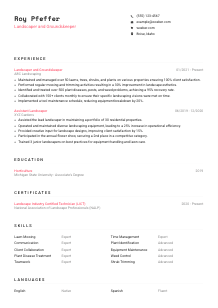
Place your full name at the top in a slightly larger font than the rest of the resume. It should read clearly at a glance, much like a work order header. For a hands-on role like Landscaper and Groundskeeper, simple and legible works better than decorative styling.
Add "Landscaper and Groundskeeper" directly under your name when that is the title in the posting. Matching the employer's wording helps with ATS alignment and immediately frames your background around lawn care, plant maintenance, equipment use, and property upkeep rather than a broader outdoor labor label.
List a reliable phone number and a professional email address. This role often moves quickly when crews need dependable help for seasonal schedules, ongoing contracts, or property routes, so your details need to be accurate and easy to use. If a missed digit prevents a call back, the rest of the resume does not matter.
If the employer specifies a city or state, include it clearly. In the example, Boise, Idaho matters because the job requires someone already located there. That does not mean every landscaping role will ask for the same thing, but when location is named in the posting, make it visible in your personal details.
A website or professional profile can help if it shows project photos, service scope, certifications, or client-facing work. For landscaping, that is useful when it gives hiring managers a better sense of property types, planting work, hardscape support, or maintenance quality. Leave it out if it is empty or unrelated.
This section should answer three questions immediately: who you are, how to reach you, and whether you match any stated location requirement. Clear details let the hiring team move straight to your field experience.




For landscaping and groundskeeping roles, experience matters most when it shows what you maintained, how often you handled it, what equipment you used, and what changed because of your work. Employers are looking for someone who can keep sites healthy, neat, and on schedule without constant direction.
Start by marking the tasks and requirements that drive the role. Here, those include mowing, trimming, edging, plant care, pest and weed treatment, equipment maintenance, and client collaboration. Use those priorities to decide which jobs and bullet points belong near the top of your experience section.
Show your most recent role first, then work backward. For each job, include title, employer, and dates. That format helps hiring managers quickly track your progression from assistant-level support into full property maintenance, crew responsibility, or more independent client-facing work.
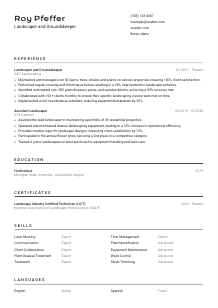
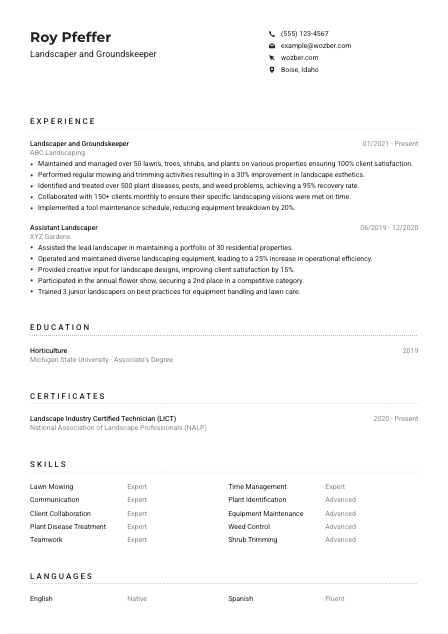
Focus each bullet on a real maintenance responsibility or measurable result. In the example resume, bullets such as managing more than 50 lawns and achieving a 95% recovery rate on plant issues work well because they connect daily grounds work to visible outcomes. Use that approach for your own history, whether you handled residential routes, commercial sites, HOA properties, or municipal grounds.
Numbers make outdoor work easier to understand. Include property counts, client volume, recovery rates, reduction in equipment breakdowns, seasonal workload, or efficiency improvements tied to route coverage and task completion. Metrics like "150+ clients monthly" or "20% fewer breakdowns" show pace, reliability, and ownership better than general claims about hard work.
Keep the section centered on landscaping value. Remove unrelated duties unless they show something useful for the target job, such as customer communication, crew support, safety, or equipment handling. Each bullet should help the reader picture you maintaining lawns, shrubs, trees, and tools effectively on real properties.
A hiring manager should be able to scan your experience and understand the kinds of properties you handled, the outdoor maintenance tasks you owned, and the standard of results you delivered. That is what moves a landscaping resume forward.
Landscaping roles are often won on hands-on experience, but education still adds value when it reinforces plant knowledge, horticulture training, turf care, or related technical understanding. Keep this section direct and make the relevance obvious.
Review the posting for clues about how much formal training matters. Even when a degree is not required, study in horticulture, landscape management, turfgrass science, environmental science, or a related field can strengthen your resume by showing a deeper foundation in plant care and seasonal maintenance.
List the degree, field of study, school, and graduation year or date. Hiring managers do not need a long explanation here. They need to understand quickly whether your education supports the practical work, such as diagnosing plant issues, selecting materials, or understanding growth cycles.
If your education directly connects to the work, make that clear. The sample resume's Associate's Degree in Horticulture is a good example because it supports duties like plant identification, seasonal care, and treatment of diseases or pests. If your background is less direct, use the exact field name and let experience do the heavier lifting.
Relevant coursework can be useful earlier in your career or when you are moving into more plant-focused grounds roles. Classes in plant pathology, soil science, irrigation basics, or pesticide safety can reinforce skills that are also named in the posting. Skip generic coursework that does not strengthen your target role.
Honors, projects, or extracurricular work are worth listing when they connect to landscaping, horticulture, or outdoor maintenance. A greenhouse project, campus grounds work, or a plant care competition is more relevant here than a general school activity. Keep the focus on knowledge that translates to the property.
This section does not need to be long. It simply needs to show any formal training that supports plant care, grounds maintenance, and sound judgment in the field.
Certifications carry real weight in landscaping when they confirm legal eligibility, technical training, or current industry standards. They are especially important when the posting mentions licensing for pesticide application or similar regulated work.
Put the most relevant credentials first. In this case, a state pesticide applicator license is directly connected to treating pests, weeds, and plant diseases safely and legally. Industry credentials such as LICT can also help by showing formal standards in landscape operations and maintenance.
Add the issue date and, if relevant, the current validity period. Landscaping employers need to know whether a license is active before assigning chemical treatment work or regulated site tasks. Current dates also show that your training is not outdated.
Update certifications as you renew them or add new ones. Groundskeeping work can branch into irrigation, pesticide application, arboriculture support, safety training, or equipment operation, and those additions can broaden the roles you qualify for. A current certification list shows you stay ready for the responsibilities you claim.
Do not overcrowd the section with low-value certificates. A short list of credentials tied to plant care, safety, chemical application, or landscape operations will do more for your resume than unrelated training. Choose the certifications that affect the work you can legally or effectively perform.
The right certifications tell an employer whether you can step into regulated tasks, handle treatment work, and meet professional standards from day one. That clarity matters in landscaping.
A landscaping skills section should read like a useful snapshot of what you can do on a property, not a random list of general strengths. Include the tools, plant-care knowledge, and client-facing abilities that show up in actual route work and maintenance schedules.
Start with the skills the employer already named. Here, that includes mowing, trimming, edging, equipment operation, equipment maintenance, plant species knowledge, seasonal care, pest and weed treatment, and communication with clients. Those are the first skills your resume should cover if they reflect your actual background.
Landscaping is physical work, but it is also client-facing work in many settings. Pair technical skills such as plant disease treatment or shrub trimming with practical soft skills like client collaboration and communication. The sample resume does this well by combining lawn care and treatment skills with customer interaction strengths.
Choose skills that support the target role instead of listing every task you have ever touched. A tight group of relevant skills helps the reader quickly connect your background to the posting. If you have strong experience with specific equipment, treatment work, or plant identification, make room for those before generic terms.
When this section is done well, it reads like the capabilities someone would expect from a reliable Landscaper and Groundskeeper stepping onto a property ready to work.
Language ability matters in landscaping because instructions, safety communication, client requests, and property updates all need to be understood clearly. If the posting names a required language level, treat that as a hiring requirement, not a minor detail.
This posting asks for professional-level English, so that should appear clearly in your Languages section. Use a straightforward label such as "Native," "Fluent," or another accurate proficiency level that supports client communication, treatment discussions, and day-to-day coordination.
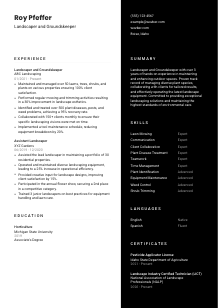
Additional languages can be valuable in landscaping, especially on crews serving varied neighborhoods or working with bilingual teams and clients. In the example, Spanish is listed alongside English, which can be useful in many service environments. Include other languages when you can use them professionally.
Be precise about your level. Overstating language ability can create problems quickly in a role that depends on following instructions, discussing service requests, or explaining plant issues to clients. Clear labels set the right expectation from the start.
If your work involves direct client contact, crew coordination, or recurring service accounts, language range can strengthen your profile. It is particularly useful when the job includes listening to customer preferences and adjusting maintenance accordingly, which this posting does.
If you regularly work with clients or multilingual crews, improving your language skills can open up broader responsibilities, including lead communication, client walk-throughs, and clearer service coordination. Treat language growth as part of your long-term field effectiveness.
This section should make it easy to understand whether you can communicate clearly with supervisors, coworkers, and clients in the environments where landscaping work gets done.
The summary sits near the top of the resume, so it needs to establish your kind of landscaping experience quickly. For this role, that means years in the field, the type of grounds work you handle well, and one or two strengths that match the posting closely.
Look for the requirements and responsibilities that define the job. In this case, hands-on landscaping experience, equipment use, plant care knowledge, treatment of pests and diseases, and client communication are central. Those should guide the wording of your summary.
Start with a clear line that tells the reader who you are and how long you have been doing the work. The sample summary leads with more than 3 years of hands-on experience, which is effective because it answers the experience requirement immediately and frames the candidate as already active in the field.
Include two or three details that reflect the job's daily demands. Good options here include managing diverse plant species, operating landscaping equipment, maintaining property appearance, or working directly with clients on service preferences. Keep the emphasis on practical work, not broad personality traits.
A summary should usually stay within 3 to 5 lines. Use that space to show the kind of sites you maintain, the work you do reliably, and the value you bring. Tight wording is especially important for ATS optimization and for employers who scan resumes quickly between crew needs, service schedules, and interviews.
A useful summary tells the reader, within seconds, that you have the landscaping experience, plant-care knowledge, and field reliability the position requires. That should be clear before they reach the first bullet in your work history.
A Landscaper and Groundskeeper resume works best when it shows real property maintenance, plant care judgment, equipment competence, and dependable client service. Keep every section tied to the work the employer actually needs done, from mowing and seasonal upkeep to treatment work and tool care.
Use Wozber's free resume builder to shape that experience into an ATS-friendly resume format, refine the wording with role-specific terms, and strengthen ATS optimization before you apply. The final result should make it easy to see that you can step onto the property and keep it in excellent condition.




