



Use Wozber and land your dream job
Create Resume
No registration required
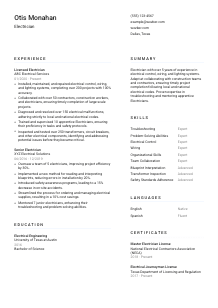
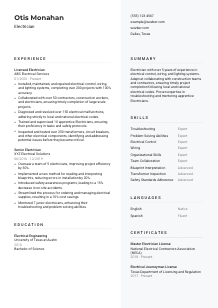
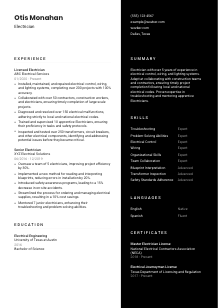
Wiring circuits, but your resume doesn't connect? Shock yourself into action with this Electrician resume example, created with Wozber free resume builder. Learn how to fuse your electrical expertise with job requirements, lighting up your career path!
Electricians are trusted with work that affects safety, uptime, and code compliance every day. Hiring teams look quickly for proof that you can install and repair systems correctly, read plans, troubleshoot faults under pressure, and work cleanly around energized equipment, contractors, and schedule demands.
When your resume is tailored well, that proof shows up fast in the places employers and ATS software check first: license status, years in the trade, scope of electrical work, and code-based accomplishments. Wozber's free resume builder helps you shape an ATS-compliant resume around the language of the posting so a hiring manager can immediately see whether you match the fieldwork, safety, and coordination the job requires.
This section is simple, but it answers a few practical screening questions right away. For electrician roles, that usually means confirming who you are, what trade role you do, how to reach you, and whether you meet any location requirement before anyone studies your project history.
Use your full name as the most visible text on the page. Keep it clean and easy to read so the resume feels professional from the start, much like a clearly labeled panel schedule on a jobsite.
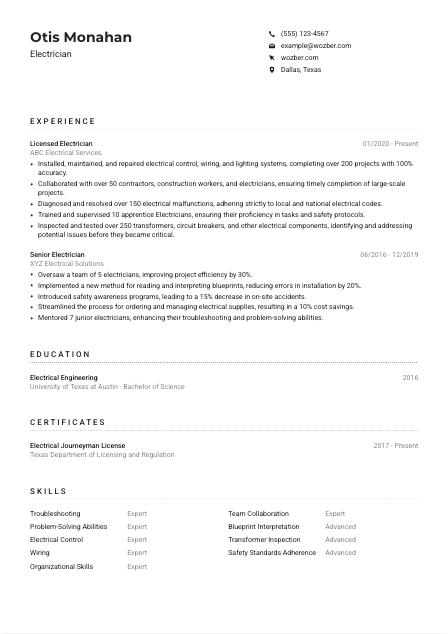
Place "Electrician" directly below your name, or use a more specific version such as "Licensed Electrician" if it reflects your credentials and target role. In the example resume, that immediate match helps connect the candidate to a posting asking for a licensed electrician without making the reader infer it.
Your phone number and email should make it easy for a contractor, service manager, or recruiter to reach you during a fast-moving hiring process.
If a posting names a city or requires local availability, include your city and state. Here, listing Dallas, Texas directly addresses the employer's location requirement and removes doubt about whether you're available for local jobsite work or service calls.
A LinkedIn profile or professional website can help if it reinforces your license, project background, or trade progression. Keep it current and consistent with your resume. If it adds no useful detail beyond your core qualifications, leave it out rather than sending employers to a thin profile.
Personal details should settle the practical questions quickly so the reader can move straight to your licenses, field experience, and electrical scope.




For electrician hiring, experience carries the most weight because it shows how you work in real environments. Employers want to see the systems you handled, the problems you solved, the crews you worked with, and whether you delivered safe, code-compliant work on schedule.
Mark the tasks and conditions the employer repeats: installing wiring and lighting systems, inspecting transformers and breakers, troubleshooting malfunctions, reading blueprints, following electrical code, and supporting apprentices. These are the terms to reflect in your bullets when they match your actual background.
Start with your most recent position and work backward. For each role, include company name, job title, and dates so the reader can follow your trade progression from apprentice-level work to independent or senior responsibility.
Describe the electrical work you performed and the result. Strong bullets mention equipment, volume, jobsite context, and quality of execution. The sample resume does this well by citing installation and repair work across more than 200 projects, plus fault diagnosis tied to code compliance instead of vague statements about being hardworking.
Metrics make your experience concrete. Good examples include number of projects completed, malfunctions resolved, panels or components inspected, apprentices trained, project efficiency improvements, safety reductions, or material cost savings. In the example, figures like 150 malfunctions resolved and 250 components inspected quickly communicate workload and reliability.
Prioritize accomplishments that line up with the job you want now. For this posting, bullets about blueprint interpretation, code adherence, collaboration with contractors, and apprentice training matter more than generic statements about responsibility. If a bullet does not clarify your electrical scope, safety record, troubleshooting ability, or project contribution, replace it.
The best experience sections make it easy to picture you on the job: reading plans, wiring systems correctly, solving faults, coordinating with crews, and finishing work to code.
Electrician roles are usually won on license status and hands-on experience first, but education still adds context. It can show technical foundation, formal training, or continued development in electrical systems, safety practices, and blueprint reading.
If the posting does not require a degree, list education that supports your electrical work rather than trying to make education carry the application. A degree in Electrical Engineering, a technical diploma, or formal trade school training can all strengthen your profile when they connect to the work.
Include the school, degree or program, field of study, and graduation year or date. Hiring managers do not need extra framing here. They need to see the credential quickly and move back to your licenses and field record.
If you studied electrical engineering, electrical technology, industrial maintenance, or a similar field, keep that information visible and clearly labeled. In the sample, the Electrical Engineering degree adds technical depth, even though the role itself is centered on licensed trade experience.
Early-career electricians can benefit from listing relevant training in wiring methods, motor controls, blueprint reading, OSHA safety, or NEC-related instruction. If you already have years of licensed experience, keep this brief unless the training directly supports the target role.
Electrical work changes with code updates, equipment, and safety requirements. If you completed recent coursework, manufacturer training, or continuing education tied to code compliance, controls, or installation methods, include it to show that your knowledge stays current.
Education should reinforce your trade foundation, not distract from your practical experience. Keep it relevant and tied to the kind of electrical work you do.
For electricians, licenses are not a side note. They are often the first hard requirement a hiring manager checks before reading project details. Present them clearly so there is no uncertainty about your legal qualification to perform the work.
If the posting asks for a Journeyman or Master Electrician license, place that credential prominently in this section and use the exact name of the license. That direct match helps both ATS screening and human review move forward quickly.
Include licenses and certifications that support electrical installation, maintenance, inspection, safety, or supervision. For this type of role, an Electrical Journeyman License or Master Electrician License matters far more than unrelated general certificates.
Show who issued the credential and whether it is current. The example resume does this by naming the licensing organizations and showing active date ranges, which immediately supports the requirement for a valid license.
If you hold updated safety training, specialized electrical certifications, or continuing education tied to code changes, controls, or inspection work, include them when they support the jobs you are targeting. This is especially useful for roles that combine hands-on work with mentoring or site coordination.
Your license status should be easy to find and easy to trust. When that section is clear, employers can focus on the quality and scope of your electrical work.
A skills section works best when it mirrors the tools, technical knowledge, and jobsite behaviors that show up in electrician postings. It should reinforce your experience, not repeat generic strengths that could belong on any resume.
Look for both direct skill requests and implied trade competencies. Here, that includes troubleshooting, blueprint reading, wiring systems, electrical controls, safety standards, and code knowledge. Build your list from the work the job actually involves.
Lead with trade skills such as wiring, electrical control, breaker and transformer inspection, fault diagnosis, and blueprint interpretation. Then include collaboration skills that matter on active jobsites, such as coordinating with contractors, training apprentices, and communicating clearly about safety and work progress.
Do not overload this section. Keep the strongest, most relevant items near the top, especially those repeated in the posting. The sample resume handles this well by pairing technical strengths like Troubleshooting and Electrical Control with practical team-based skills like Collaboration and Safety Standards Adherence.
Every skill listed should help explain how you install, diagnose, inspect, coordinate, or train in an electrical environment. If it does not support that picture, cut it.
Language ability matters in electrician roles when instructions, safety conversations, and coordination on site need to be clear. Even when multilingual ability is a bonus, the required working language should be presented first and with an honest proficiency level.
If the posting requires English mastery, list English at the top of this section and state your level clearly. That immediately addresses a stated requirement and reassures the employer that you can handle instructions, documentation, and safety communication.
When a language appears in the job description, use the same wording and place it prominently. That makes the resume easier to screen and reduces any ambiguity about whether you meet the communication expectations of the role.
Additional languages can still add value, especially on diverse construction sites, in service work, or in teams with mixed language backgrounds. In the example, Spanish is a useful secondary language because it may support smoother communication with crews or clients, even though English is the explicit requirement.
Choose direct terms such as "Native," "Fluent," "Intermediate," or "Basic." Avoid vague wording. Employers need a realistic sense of how well you can communicate on safety-critical work.
If the role involves reading technical drawings, reporting issues, training apprentices, or coordinating with contractors, language ability becomes more than a bonus. It affects how clearly you can relay instructions, ask questions, and document problems on the job.
For electrician roles, language skills should clarify how you communicate on site, with crews, and around safety-sensitive work. Keep the section accurate and useful.
The summary is your opening snapshot. For electrician roles, it should establish license level, years of experience, technical scope, and the kind of work environments you handle without drifting into broad claims or filler.
Pull the biggest themes from the posting before you write. In this case, that means licensed experience, electrical control and wiring work, blueprint reading, troubleshooting, code knowledge, collaboration, and apprentice support. Your summary should combine the ones that genuinely define your background.
Start with a direct line such as your title, license status if relevant, and years in the field. That quickly tells the employer whether you are operating at the level the role requires.
Choose two or three points that best reflect your value in the trade, such as diagnosing malfunctions, completing installations to code, coordinating with contractors, or mentoring apprentices. The sample summary works because it stays close to the job's real needs instead of filling space with generic adjectives.
Aim for a short paragraph of about 3 to 5 lines. Focus on electrical scope, safety and code awareness, and the kind of project contribution you make. A summary should make the reader want to examine your experience section, not repeat it line by line.
A strong summary tells the employer, within seconds, what kind of electrician you are, what systems you work on, and how you contribute on site. That is the tone the rest of the resume should support.
An effective electrician resume makes the essentials easy to find: active license, relevant years in the trade, electrical systems handled, code-aware troubleshooting, and reliable work with crews, contractors, and apprentices.
Use Wozber to shape that experience into an ATS-friendly resume format with role-specific wording, clean structure, and stronger ATS optimization. The finished resume should make one thing clear right away: you can step onto the job and perform the work safely, accurately, and to code.




