



Use Wozber and land your dream job
Create Resume
No registration required
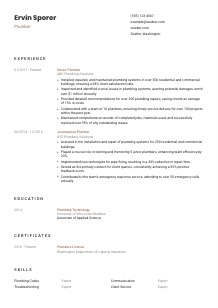
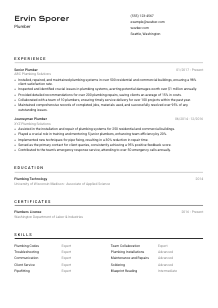
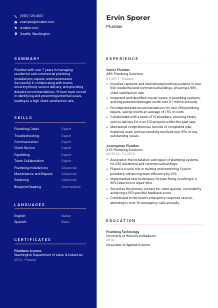
Fixing pipes, but your resume is leaky? Check out this Plumber resume example, created with Wozber free resume builder. It shows how to thread your pipe prowess into a strong job narrative, so your career doesn't go down the drain!
Plumbing resumes get taken seriously when they show dependable field work, not just a list of duties. Hiring teams want to see the kind of systems you handled, the settings you worked in, how you diagnosed faults, and whether clients could trust your recommendations. If your resume only says you repaired pipes and installed fixtures, it misses the real picture of your trade judgment.
A targeted resume changes how quickly that judgment comes through. When your experience uses the same language as the job posting, an employer can immediately connect your background to service calls, inspections, estimates, code compliance, and customer communication. Wozber's free resume builder helps shape that into an ATS-compliant resume, so the screening process surfaces your plumbing experience instead of burying it in generic wording.
For plumbers, the top of the resume should read like a service professional who is easy to contact, properly located, and ready to work. Keep it clean and practical.
Use your full name in a slightly larger font than the rest of the resume so it anchors the page immediately. In skilled trades hiring, this section does not need flair. It needs to be clear, readable, and professional, the same way a clean work order or invoice would be.
Place "Plumber" directly under your name unless you are targeting a more specific version of the trade, such as Journeyman Plumber or Senior Plumber, and your background supports it. This helps the employer and ATS connect your resume to the opening right away, especially when the posting is focused on installation, maintenance, and repair work.
List a phone number you answer and a professional email address that uses your real name. For field-service roles, speed matters. If a company is scheduling interviews around active job volume, they need to know they can reach you without friction.
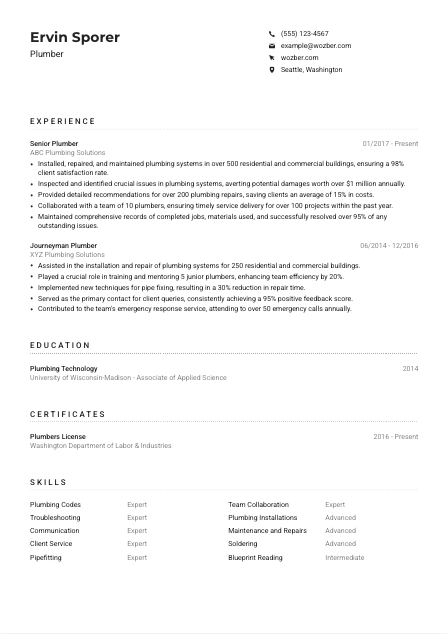
If the job requires local availability or relocation, add your city and state. Here, Seattle, Washington matters because the posting specifically asks for candidates based there or willing to move. If location is not a factor in another application, keep it simple and only include what helps the employer understand your availability.
A website or LinkedIn profile can help if it reinforces your licensing, work history, commercial or residential project scope, or recommendations from clients and supervisors. Skip it if it is sparse or outdated. Any link on a plumbing resume should strengthen credibility, not create loose ends.
Your header should make three things obvious within seconds: who you are, what trade role you perform, and how quickly an employer can contact you. If location matters for the posting, make that visible here and move on.




This is the section that carries the most weight for a plumber. Employers want to see the scale of your work, the types of systems you handled, how you solved problems, and whether you worked safely and efficiently across service calls or larger projects.
Start by identifying the actual plumbing work the employer needs done. In this posting, that includes installations, repairs, maintenance, inspections, recommendations, estimates, recordkeeping, and teamwork. Build your bullet points around those functions so your experience reads as directly relevant rather than broadly trades-related.
List jobs in reverse chronological order with title, company name, and dates. For trades hiring, this helps show progression from apprentice or journeyman work into more independent troubleshooting, client-facing service, or leadership responsibilities. A clear timeline also helps confirm you meet experience requirements such as the 5+ years requested here.
Your bullets should show what you handled and what happened because of it. Instead of writing only "repaired plumbing systems," specify the property type, volume, or outcome. The sample resume does this well by showing work across more than 500 residential and commercial buildings and pairing it with a 98% client satisfaction rate. That kind of detail tells the employer you can manage real workload and service quality.
Good plumbing metrics are practical. Include number of buildings serviced, emergency calls handled, cost savings from recommendations, reduction in repair time, client satisfaction, project turnaround, or damage prevented through inspection. The example's mention of averting over $1 million in potential damage works because it connects inspections to business impact, not because the number is dramatic on its own.
Keep the section focused on work that proves you can install, diagnose, estimate, document, and communicate in plumbing environments. If older jobs do not add to that story, compress them or remove them. A hiring manager for a plumbing role should be able to scan this section and quickly see technical range, field reliability, and customer-facing judgment.
After reading your experience section, the employer should understand what systems you worked on, how independently you solved problems, and what kind of service results followed. Show the trade, the scope, and the outcome in every role.
Education is rarely the first section a plumbing employer studies, but it still helps frame your technical foundation. Trade school, an associate degree, and relevant coursework can reinforce that you were trained in systems, safety, and code-aware work.
If you completed plumbing technology, construction, mechanical systems, or another related program, include it. Even when a posting focuses more on experience and licensing, formal training helps explain where your understanding of installation methods, system layouts, and codes was built.
List the degree or credential, field of study, school, and graduation year. Employers reviewing multiple field-service resumes do not need a complex academic layout. They need quick confirmation that your education is relevant and legitimate.
If your degree directly relates to plumbing, say so clearly. An Associate of Applied Science in Plumbing Technology, like the one in the sample resume, immediately supports hands-on experience because it signals structured training in the craft rather than unrelated education.
Early-career plumbers can strengthen this section with courses in plumbing codes, blueprint reading, pipefitting, safety procedures, or commercial system installation. If you already have years of field experience, keep coursework minimal unless it directly supports a specialized opening.
Graduating with honors, completing a standout apprenticeship program, or participating in a student trade association can be worth mentioning if it reinforces discipline and trade commitment. Leave out extras that do not add to your credibility as a working plumber.
This section should back up your field experience with technical training, not compete with it. Keep it short, relevant, and clearly tied to the plumbing work you do.
Licenses and certifications matter in plumbing because they confirm legal eligibility, code knowledge, and trade standing. When a posting asks for a state license, this section becomes essential, not optional.
Put the required plumbing license first. In this case, a valid state plumbing license or certification is named directly in the posting, so it should be the first item an employer sees in this section. If you hold the license for the state where the job is based, that is especially useful to surface early.
After the required license, include certifications that support the kind of work you actually do. That may include backflow prevention, gas piping, safety training, green plumbing systems, or specialized commercial equipment. Choose credentials that relate to the target role, not every card you have ever earned.
Include the issuing body and the date earned, and make renewal status clear when relevant. The sample resume handles this well with a Washington plumbing license listed as active from 2016 to present. For regulated trades, current status matters as much as the credential name.
Plumbing standards change, and employers notice candidates who stay current. If you have recent continuing education or code-related certifications, include them here. That supports one of the biggest hiring concerns in the trade: whether your work meets present-day regulations and inspection expectations.
Your certificates section should answer two practical questions quickly: are you qualified to do the work legally, and are your credentials current enough for the systems and codes you will be working under.
The best plumbing skills sections balance technical trade ability with the client-facing skills that come with service work. This is where you make your working style easy to scan.
Pull skills from the posting and match them to your real experience. For this role, that includes plumbing codes and regulations, troubleshooting, communication, interpersonal skills, and installation, maintenance, and repair work. When those exact capabilities appear naturally in your resume, ATS screening and human review both become easier.
Lead with the capabilities that matter most for the role you are targeting. If the opening emphasizes diagnostics and repair, place troubleshooting and system inspection near the top. If the role is more construction-focused, installation, pipefitting, blueprint reading, and code compliance may deserve more space.
Avoid vague filler like "hardworking" or "team player" in this section. Use real plumbing and service terms instead, such as pipefitting, soldering, fixture installation, leak detection, estimate preparation, blueprint reading, and client service. The sample resume works because it combines technical skills like Plumbing Codes and Pipefitting with service-oriented skills like Communication and Client Service.
A hiring manager should be able to scan your skills and picture the kind of plumbing work you can step into immediately, from code-aware repairs to customer communication on site.
Language skills are not central on every plumbing resume, but they can matter in service roles where clear communication affects estimates, troubleshooting explanations, and client trust.
If the posting asks for English proficiency, list English clearly with an honest level. This job does. Put it first so there is no doubt you can handle client conversations, work orders, team communication, and written records.
Additional languages can be useful in residential service, commercial site coordination, and diverse metro areas. If you can explain repair options or scheduling details in another language, that may help with client experience even when it is not listed as a requirement.
Choose straightforward terms such as Native, Fluent, Intermediate, or Basic. A language section should set accurate expectations, especially for jobs where communication affects safety, estimates, and documentation.
For plumbers who spend a lot of time in homes, businesses, or property management settings, language ability can support smoother service and fewer misunderstandings. It is not a substitute for technical skill, but it can strengthen a client-facing profile.
Keep the language section concise. Its job is to reinforce communication range, especially when the role includes explaining repairs, giving recommendations, or coordinating with crews and clients. The sample resume's English and basic Spanish listing is a good example of useful, restrained detail.
Language skills work best as a supporting asset. They add value when they help you communicate clearly with clients, crews, and supervisors in the environments where you actually work.
A plumber's summary should read like the top line of a service record: years in the trade, core systems work, and the kind of results you are trusted to deliver. Keep it focused on real scope and practical strengths.
Read the posting and pull out the main demands before writing anything. Here, that means plumbing installations, maintenance, repairs, inspections, troubleshooting, communication, and recordkeeping. Your summary should reflect the overlap between those priorities and your own background.
Start with your title and years of experience, such as "Plumber with 7+ years of experience in residential and commercial systems." That quickly tells the reader whether you are likely to meet the experience threshold and what kind of environment you know.
Choose strengths that show how you work, not just what tools you know. Strong examples include diagnosing system issues, recommending cost-effective repairs, maintaining code compliance, handling high service volume, or coordinating well with clients and team members. The sample summary points to installations, repairs, maintenance, and issue prevention, which aligns well with the posting's priorities.
Aim for 3 to 5 lines with no wasted language. Skip broad claims like "dedicated professional" unless you immediately back them up with trade-specific proof. A short summary that names your years, system scope, and service strengths will do more than a longer paragraph full of general confidence statements.
By the time someone finishes this section, they should already know your level of plumbing experience, the kind of work you handle, and why you belong in the interview pile. Keep it short, specific, and tied to the actual opening.
A plumber resume works when every section supports the same hiring decision: you have the field experience, license status, troubleshooting ability, and customer-facing judgment to handle the work. Keep the language grounded in actual service, repair, installation, inspection, and code-aware performance.
Wozber's AI resume builder can help you tailor that experience to the posting, strengthen ATS optimization, and present it in an ATS-friendly resume format that stays easy to scan. The final result should make one thing clear fast: you can step into the plumbing work and deliver dependable results.




