



Use Wozber and land your dream job
Create Resume
No registration required
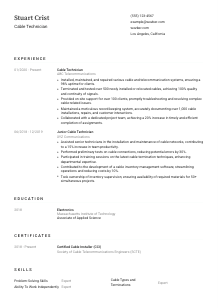
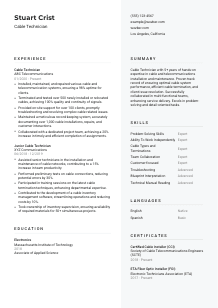
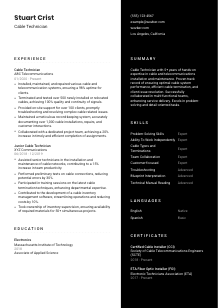
Untangling wiring webs, but your resume is in knots? Connect with this Cable Technician resume example, created with Wozber free resume builder. It shows how your technical prowess and signal strength can be wired into a format that meets job criteria, setting your career reception to full bars!
Cable technician hiring moves quickly when a resume makes the field work easy to picture. Managers want to see who has actually installed runs, handled terminations, tested signal continuity, read telecom drawings, and fixed problems on site without slowing down the crew or the customer. If those details stay vague, even solid hands-on experience can look thinner than it is.
A tailored resume changes that first read by putting the right technical language in front of both the hiring team and the ATS. Wozber's free resume builder helps you line up your wording with the posting, keep an ATS-friendly resume format, and surface the installation, testing, troubleshooting, and documentation work that matters most for cable technician roles. That makes it easier to recognize whether you can step into live jobs and keep systems performing reliably.
This section is straightforward, but it still does real work. For cable technician roles, your header should immediately confirm who you are, how to reach you, and whether a practical requirement like location is already covered.
Use your full name in the largest text on the page so it is easy to spot at a glance. Keep the styling clean and readable. In trades and field service hiring, clarity beats decorative formatting every time.
Place the role title directly below your name and match the posting where it makes sense. If the opening is for a "Cable Technician," use that phrasing instead of a broader label like "Technician" or "Installer." It helps the resume read cleanly in ATS filters and immediately frames your background around cable installation, maintenance, and repair work.
Include a reliable phone number and a professional email address. Check both carefully. Field roles often move from application to screening call fast, and one typo can cost you an interview window.
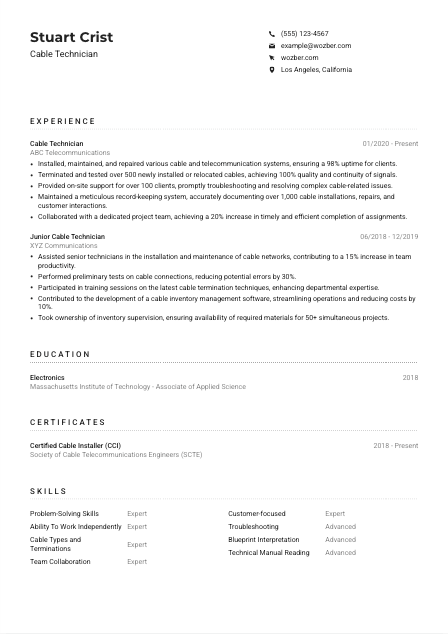
If the employer asks for a specific city or region, include it in your header. Here, Los Angeles, California is relevant because the posting asks candidates to be local or willing to relocate. If you are relocating, make that clear rather than leaving the employer to guess.
Include LinkedIn or a personal site only if it supports your application. For a cable technician, that could mean a profile with matching work history, certifications, project photos, or telecom-related training. Make sure the information matches your resume title, dates, and credentials.
Keep this section accurate, clean, and easy to scan. It should remove basic questions before the reader reaches your installation history, certifications, and technical skills.




This is where hiring teams decide whether you have done the job at the level they need. Cable technician experience should show the kind of systems you worked on, the technical tasks you handled, how you solved faults, and whether your work held up in the field.
Read the job description line by line and mark the core work: installation, maintenance, repair, cable termination, testing, blueprint reading, on-site troubleshooting, and recordkeeping. Then make sure those exact responsibilities appear in your experience if they reflect what you have actually done. In the example resume, the bullets clearly mirror the posting by covering installation, signal testing, client support, and documentation.
Start with your most recent position and work backward. For each role, include your job title, employer, and dates. This format helps hiring teams quickly understand your progression from junior support work into independent installation and maintenance responsibility.
Do not stop at generic duty statements. Show what your work produced. Good bullets for cable technicians mention outcomes such as stable network performance, completed installations, resolved service issues, fewer errors, or faster project completion. "Installed, maintained, and repaired cable systems" becomes stronger when tied to uptime, service quality, or job volume, like the sample bullet noting 98% uptime.
Use metrics that make sense for telecom and cable work. That can include number of cables terminated, clients supported, uptime maintained, service calls resolved, projects completed on schedule, or documentation volume. The sample resume uses figures like 500 tested cables and 1,000 recorded installations and repairs, which make the scope of the work much easier to judge.
Keep the focus on work that reinforces your value as a cable technician. Earlier jobs can stay if they show transferable technical habits such as equipment handling, testing, inventory control, or field support, but give most of the space to telecom installation and maintenance. Every bullet should help the reader picture you on a site, in a customer location, or working through a service issue.
Your experience should leave no doubt that you can install correctly, test thoroughly, troubleshoot under pressure, and keep accurate records. Those are the habits that make a cable technician useful from day one.
Cable technician hiring usually leans more heavily on hands-on experience and certifications, but education still helps when it reinforces your technical foundation. Relevant coursework and degrees can support your understanding of electronics, signal flow, and system components.
Some openings specify a degree, while others focus almost entirely on field experience and certification. If the posting is light on education requirements, keep this section concise and use it to support your technical background rather than trying to make it carry the application.
Include the school, degree, field of study, and graduation date or year. Put the highest or most relevant credential first. A clean format keeps the reader moving toward the sections that usually matter most in this trade, especially experience and certifications.
Degrees or programs in electronics, telecommunications, electrical systems, or related technical fields are worth calling out clearly. The sample resume's Associate of Applied Science in Electronics works well because it supports the kind of installation, testing, and troubleshooting expected in cable work.
If you are earlier in your career, a short note on coursework can help. Focus on classes that connect directly to the job, such as wiring systems, fiber optics, network fundamentals, electronics, or technical blueprint reading. Skip general classes that do not reinforce your field capability.
Honors, technical competitions, labs, or student projects can be useful if they show hands-on technical interest or disciplined training. If you have several years of direct cable experience, keep these details brief so they do not compete with stronger field credentials.
This section should quietly reinforce your technical grounding. If your degree or coursework connects to installation, testing, or telecom systems, make that connection obvious and move on.
For cable technician roles, certifications often matter because they show recognized training in installation standards, fiber work, or telecom practices. When a posting names a credential directly, make it easy to find.
Check the requirements for specific credentials and place matching certifications prominently. Here, Certified Cable Installer and ETA Fiber Optic Installer are called out, so candidates who hold them should list them exactly as issued. That direct match helps both ATS screening and the hiring manager's first scan.
Prioritize certifications connected to cable installation, termination, testing, fiber optics, low-voltage systems, or telecom maintenance. A shorter list of directly applicable credentials is more useful than a long list of unrelated training.
Show when the certification was earned and whether it is current when that information is available. That tells employers whether your training is recent and maintained. In the example resume, listing the credentials as active helps reinforce ongoing qualification.
Telecom equipment, testing procedures, and installation standards change over time. If you are pursuing another certification or recent training in fiber, testing equipment, or structured cabling, add it when completed. Current training tells employers you are keeping pace with the work rather than relying only on older experience.
A well-built certifications section gives the employer a quick read on your formal training. For cable technician jobs, that can be the difference between looking experienced and looking fully qualified.
This section should read like the toolkit behind your field performance. Focus on technical strengths and work habits that directly affect installation quality, signal integrity, troubleshooting speed, and coordination on active jobs.
Start with the language in the job ad. For cable technicians, that often includes cable types, terminations, testing procedures, blueprint interpretation, troubleshooting, independent work, teamwork, and customer support. Build your skills list from capabilities you can actually back up in your experience.
Lead with the skills that are central to day-to-day cable work. Technical items such as cable termination, continuity testing, telecom blueprint reading, and fault diagnosis should usually come before broader traits. The example resume does this well by highlighting cable types and terminations, troubleshooting, and blueprint interpretation alongside problem-solving and collaboration.
Avoid filling the section with vague terms that could apply to any job. A shorter list with field-specific language carries more weight. If a skill does not help the reader understand how you install, test, repair, document, or support telecom systems, it probably does not belong here.
The best skills section reinforces what your experience already demonstrates. For this role, that means technical knowledge, dependable troubleshooting, and the ability to work cleanly with both customers and project teams.
Cable technicians spend a lot of time translating technical issues into plain language for customers, coordinators, and other technicians. If a posting asks for communication ability in a specific language, treat that as a real requirement, not a minor extra.
If the job specifies language expectations, list that language clearly with an honest proficiency level. In this posting, strong English speaking and writing are required, so English should be easy to find in the section.
Extra languages can strengthen your profile, especially for service roles involving customer visits, multi-crew coordination, or diverse service areas. They are usually a plus, even when not required, as long as you list them accurately.
Choose plain labels such as Native, Fluent, Intermediate, or Basic. Hiring teams do not need guesswork here. Clear proficiency helps them understand whether you can handle customer explanations, written updates, and team communication.
Language matters in more places than interviews. Cable technicians may need to explain service issues on site, document repair notes, read work orders, and coordinate with supervisors or clients. If an additional language genuinely helps you do that work, include it.
Do not overstate proficiency. A basic level can still be worth listing if it helps with customer interaction in the field, but only if you can use it in real situations. Credibility matters as much here as it does in your technical claims.
For cable technician work, language skills support service quality, documentation, and teamwork. List them clearly so employers can quickly judge whether you can communicate well on the job site and with customers.
Your summary should give a fast, accurate read on your level of cable experience. In a few lines, it should cover your technical scope, the kind of systems or service work you handle, and the results you are known for delivering.
Before writing the summary, identify the two or three themes that define the job. For this opening, that includes installation and maintenance work, cable termination and testing, troubleshooting, and clear communication. Those themes should shape the summary instead of a generic career statement.
Begin with a direct professional label and your level of experience, such as "Cable Technician with 5+ years of experience in telecommunications installation and maintenance." That immediately tells the reader whether your background is at the right level for the opening.
Use the next sentence to mention the work you handle best, such as testing signal quality, reading telecom drawings, repairing faults, or supporting customer sites. Add one concrete result if possible, like system uptime, installation volume, or resolution speed. The example summary works because it ties hands-on cable work to system performance and client issue resolution.
Stay concise. Three to four lines are usually enough. Every phrase should support your case for this specific type of role, using terminology that matches the posting and the work you have actually done.
A solid summary tells the employer, within seconds, that you know the work, speak the language of the trade, and can contribute across installation, testing, troubleshooting, and service documentation.
A cable technician resume should make the practical parts of the job easy to confirm: installation experience, testing accuracy, troubleshooting ability, documentation habits, and the certifications that back up your training. When those details are clear, hiring teams can picture you handling real service calls and project work instead of guessing from generic claims.
Use Wozber's free resume builder to organize that experience in an ATS-friendly resume template, align your wording with the posting, and strengthen ATS optimization without losing the technical detail that matters in the field. The final resume should make one thing clear fast: you are ready to install, test, repair, and support telecom systems with confidence.




