



Use Wozber and land your dream job
Create Resume
No registration required
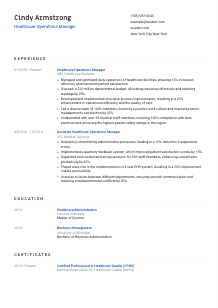
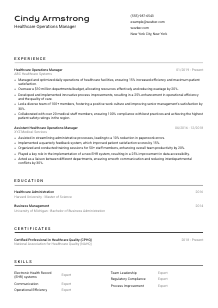
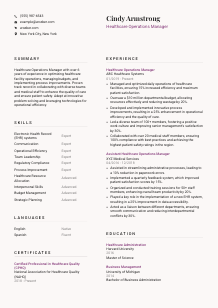
Juggling hospital duties, but your resume feels like a waiting room? Check out this Healthcare Operations Manager resume example, created with Wozber free resume builder. It shows how to align your healthcare leadership acumen with job specifics, so your career prognosis is always top-notch!
Healthcare operations management sits where patient flow, staffing, compliance, and service quality meet. A resume for this field needs to show that you can keep care delivery running smoothly while improving the systems behind it, whether that means tightening workflows, managing a department budget, or raising patient satisfaction without disrupting clinical teams.
Screening for this role often turns on whether your resume makes operational scope legible fast. Wozber's free resume builder helps you align your wording with the posting, keep an ATS-friendly resume format, and surface the right terms around EHR use, process improvement, and resource allocation so hiring teams can quickly see the scale and outcomes of your management work.
Healthcare employers move quickly past the header, but they still expect it to answer a few practical questions right away. For an operations leadership role, your personal details should confirm who you are, what position you target, and whether you meet basic location and contact requirements without creating friction.
Set your name at the top in a clean, readable style. Keep it slightly more prominent than the rest of the header so it anchors the page without looking decorative. In operations roles, clarity matters everywhere, including the first line of the resume.
Place "Healthcare Operations Manager" directly beneath your name when that is the role you are pursuing. Matching the posted title helps with ATS alignment and immediately positions your background around healthcare facility operations, process improvement, and team oversight rather than broader administrative work.
Include a reliable phone number and a professional email address, then verify both before sending your application. Small errors here can stall an interview request. If you add a website or LinkedIn profile, make sure the information supports your resume with consistent titles, dates, and achievements.
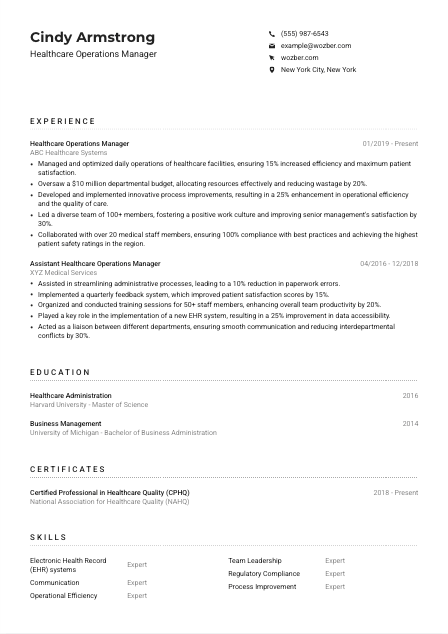
When a job specifies a city, include your city and state in the header. In the example, listing New York City, New York directly addresses the employer's stated location requirement and removes uncertainty about availability. Use this the same way whenever geography is part of the screening process.
Only link to professional pages that strengthen your candidacy. For a Healthcare Operations Manager, that usually means a LinkedIn profile with leadership history, healthcare systems exposure, quality initiatives, or cross-functional projects. Skip links that do not add useful context for hospital, clinic, or facility leadership work.
Your header should confirm the basics in seconds and support the rest of the resume, not distract from it. When the title, contact details, and location are clean and complete, hiring teams can move straight to your management scope, improvement work, and healthcare results.




This is the section where employers look for operational control, improvement work, and leadership range. They want to see what kind of facility or department you managed, how you handled resources, and what changed under your oversight in areas like efficiency, compliance, patient experience, or team performance.
Before rewriting bullets, mark the responsibilities and requirements that shape the role. For this position, the priority areas are daily operations, budget and resource allocation, process improvement, EHR proficiency, compliance, patient satisfaction, and staff leadership. Those themes should guide which accomplishments you move up, expand, or cut.
List jobs in reverse chronological order and make the progression clear. Healthcare employers want to see whether you moved from support or coordinator-level responsibility into full operational ownership. The example does this well by showing a step from Assistant Healthcare Operations Manager into Healthcare Operations Manager, which signals increased authority over budgets, staff, and facility performance.
Use accomplishment statements that connect your actions to operational results. Good bullets in this field often show reduced waste, improved patient satisfaction, stronger compliance, faster access to records, fewer process errors, or better staffing efficiency. The sample bullets work because they quantify changes such as a 15% efficiency gain, a 20% reduction in wastage, and a 25% improvement in operational efficiency.
If you have experience across healthcare, administration, and general management, lead with the work most relevant to care delivery. Hiring teams care more about facility operations, departmental coordination, quality initiatives, and collaboration with medical staff than about unrelated management duties. Keep older or less relevant roles brief unless they directly support your readiness for operational leadership.
Mirror the employer's wording where it matches your actual work. Terms such as "process improvement," "resource allocation," "performance metrics," "patient safety protocols," and "EHR systems" belong in the experience section when they reflect your responsibilities. Wozber's ATS resume scanner can help you catch missing terminology and tighten phrasing so your experience reads clearly both in ATS screening and in human review.
A Healthcare Operations Manager resume earns attention when it shows control over day-to-day execution and measurable improvement over time. If this section makes your operational scope, budget responsibility, staff leadership, and quality outcomes easy to track, it is doing its job.
For a role at this level, education establishes your formal grounding in healthcare administration or business management. It should confirm that you meet the degree requirement quickly, while leaving the heavier proof of your leadership and operational results to the experience section.
Start with your highest completed degree, especially if it is in Healthcare Administration, Business Management, or a related field. In the example, the Master of Science in Healthcare Administration should appear before the bachelor's degree because it directly strengthens alignment with a posting that prefers a master's.
List degree, field of study, school, and graduation year in a clean structure. Hiring teams reviewing operations candidates do not need a long academic narrative. They need to confirm that your education supports work in healthcare systems, administration, and organizational management.
When the posting names specific educational backgrounds, make that alignment easy to spot. A bachelor's in Business Management or a graduate degree in Healthcare Administration directly answers the requirement here. If your degree title is adjacent rather than exact, the field name and related coursework can help clarify relevance.
Honors, coursework, capstones, or student leadership can be useful if they connect to healthcare operations, quality improvement, finance, or organizational leadership. For experienced candidates, these details should stay brief. Your recent operational achievements will carry more weight than older classroom work.
With 5+ years in healthcare management, employers are looking first at what you have run, improved, and reported on. Keep education concise and credible. For most mid-career and senior operations resumes, degrees matter more than course lists, and graduation dates can remain simple unless recency is relevant.
Your education section should answer the degree requirement without slowing down the resume. Once that box is checked clearly, the hiring focus returns to operational leadership, healthcare process improvement, and results.
In healthcare operations, certifications can strengthen your standing in quality, practice management, and continuous improvement. They are especially useful when a posting names them as preferred, because they show formal commitment to the standards that shape patient safety, compliance, and operational discipline.
Lead with credentials that match the work. For this kind of role, certifications such as CPHQ or CMPE are highly relevant because they connect directly to quality of care, healthcare leadership, and operational oversight. If the job description names a credential as desirable, it deserves a visible place on the resume.
Choose certifications that support the responsibilities of the role rather than listing every course or short program you have completed. A focused certifications section tells employers more about your professional direction than a long mixed list. Prioritize credentials tied to healthcare operations, regulatory standards, quality management, or leadership.
Show when the certification was earned and whether it is current when that information is relevant. In regulated or quality-driven healthcare environments, recency matters because practices, standards, and reporting expectations change. Clear dates also help employers understand the depth of your ongoing professional development.
If you are still growing into larger operational scope, certifications can help round out your profile in areas like quality improvement, compliance, patient safety, or medical practice management. They will not replace hands-on leadership, but they do add useful weight when your experience and the posting point in the same direction.
Relevant credentials add another layer of credibility to your resume, especially when they support quality improvement and healthcare leadership. Present them clearly, and they will reinforce the case that you understand both the operational and regulatory side of care delivery.
A skills section for this role should read like the toolkit of someone who manages healthcare delivery, people, systems, and performance. Generic management terms are not enough on their own. Employers want to see the mix of technical, operational, and leadership strengths that support safe, efficient care.
Review the job description for both direct requirements and implied capabilities. Here, that includes EHR systems, process improvement, resource allocation, budget oversight, regulatory compliance, leadership, communication, and collaboration with medical staff. Those are the terms most worth reflecting when they match your background.
Choose skills that connect to the actual work of running healthcare operations. "Electronic Health Record systems," "Operational Efficiency," "Budget Management," and "Regulatory Compliance" say much more than broad labels like "hardworking" or "team player." The sample skills list is effective because it centers operational and healthcare-specific capabilities rather than filler.
This role sits between frontline service delivery and organizational management, so your skills should show both. Pair technical or operational strengths such as EHR proficiency, performance reporting, and process improvement with people-facing strengths such as team leadership, communication, and cross-functional coordination. That combination reflects how the work is actually done.
Every skill listed should help explain how you manage operations, support quality care, or lead teams in a healthcare setting. When the section reflects real workflows and responsibilities, it strengthens both ATS alignment and hiring confidence.
Language ability can matter more in healthcare than in many other fields because communication affects patient experience, coordination, and trust. Even when only one language is required, listing proficiency clearly helps employers understand how you will operate across staff, patients, and leadership teams.
If the posting states a language requirement, include it exactly and give it a clear proficiency level. Here, English proficiency is fundamental, so it should appear first. That simple choice removes doubt about a basic qualification for reporting, collaboration, and day-to-day operational communication.
Include additional languages when you can use them professionally. In many healthcare settings, another language can support patient communication, community access, and smoother coordination with diverse staff groups. The example's Spanish proficiency is a good illustration of an extra language that could be useful without being treated as universally required.
Use plain labels such as "Native," "Fluent," or "Conversational" so employers can judge practical communication ability. In healthcare, overstating language skill can create real operational problems, especially when communication touches patient instructions, scheduling, or service recovery.
If multilingual ability has supported patient satisfaction, team coordination, or service access in your work, that impact can also appear in your experience section. The languages section itself should stay concise, while the experience section can carry the fuller story of how communication improved outcomes.
List languages because they help you work more effectively in the environment, not because they look impressive. For healthcare operations, their value usually appears in clearer communication, stronger patient interactions, or smoother collaboration across departments and communities.
Clear language listing helps employers understand how you will operate in a healthcare setting with patients, clinicians, and administrative teams. Keep it accurate and practical, and it will add useful context to the rest of your leadership profile.
Your summary should quickly establish the level at which you operate and the kinds of healthcare outcomes you influence. In a few lines, it needs to connect leadership experience with operational improvement, quality of care, and the systems or teams you manage.
Begin with a direct statement of who you are professionally. A line such as "Healthcare Operations Manager with over 6 years of experience" works because it immediately sets role level and tenure, then gives you room to specify strengths like healthcare facility operations, budget management, or process improvement.
Choose two or three points that match the employer's priorities. For this job, that might be improving operational efficiency, managing budgets and resource allocation, leading departmental teams, or raising patient satisfaction. The example summary succeeds because it ties management experience to measurable improvement and quality of care rather than staying abstract.
Aim for three to five lines with clear, role-specific language. This is not the place for generic leadership claims. Mention the kinds of facilities, systems, or operational challenges you handle if that strengthens the fit, but keep every phrase working toward a clear picture of your management value.
Use relevant terms from the posting naturally, especially those that define the role's scope. Phrases like "process improvement," "resource allocation," "EHR systems," and "patient safety" can all belong here if they reflect your real experience. Wozber's AI resume builder can help refine the wording so the summary stays readable while improving ATS optimization.
A good summary gives hiring teams a quick read on your operational level, healthcare context, and results. When these first lines clearly link your leadership to efficiency, quality, and care delivery, the rest of the resume lands with more force.
A Healthcare Operations Manager resume should show that you can run complex daily operations, improve processes, manage resources responsibly, and support safe, high-quality care. When each section points back to those outcomes with clear metrics, relevant systems knowledge, and credible leadership scope, your application reads like someone ready to step into operational responsibility.
Use Wozber's free resume builder to sharpen that alignment, build an ATS-compliant resume, and check role-specific language with the ATS resume scanner. The final result should make it easy to see your command of healthcare operations, your impact on efficiency and patient experience, and your readiness to lead.




