




Use Wozber and land your dream job
Create Resume
No registration required
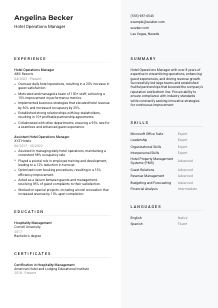
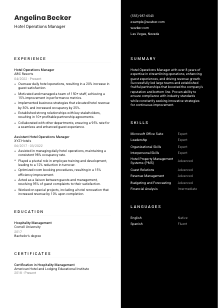
Mastering the art of hospitality, but your resume needs a check-in? Explore this Hotel Operations Manager resume example, created with Wozber free resume builder. Learn how to align your hotel expertise with job goals, and keep your career journey rated five stars!
Hotel operations managers are trusted with the parts of hospitality that guests notice immediately and ownership tracks closely behind the scenes. Service consistency, staff performance, occupancy, revenue, vendor coordination, and standards compliance all land on the same desk. Your resume needs to show that you can keep daily operations running smoothly while improving the business, not just supervise a shift or handle guest issues as they come up.
When the resume is tailored well, the hiring team can quickly separate hotel operations leadership from general hospitality experience. Wozber's free resume builder helps you shape that story in an ATS-friendly resume format, so terms like PMS, occupancy, guest satisfaction, and department leadership are easy to read by both people and applicant tracking systems. That makes it much easier to see whether you can lead the property, not simply support it.
Hotel leadership roles move quickly, and your contact section should answer practical questions right away. Can they reach you easily, do you present yourself professionally, and do you already meet any location requirement listed in the posting?
Place your full name at the top in a clean, readable format. For a Hotel Operations Manager resume, this should feel polished and businesslike, much like the front desk standard you would expect from your own team.
Put "Hotel Operations Manager" directly under your name when that is the role you are pursuing. Matching the target title helps frame your background around property leadership, daily operations, and revenue responsibility from the first line.
Use a reliable phone number and a professional email address, ideally in a simple format such as firstname.lastname@email.com. Hospitality hiring often moves around scheduling demands, so missed calls or an unprofessional email can create avoidable friction.
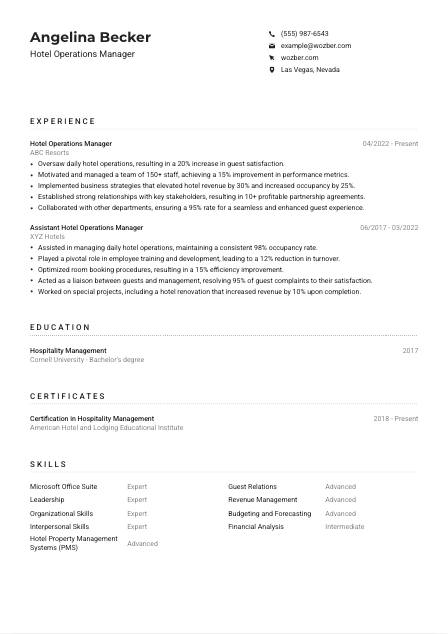
If a job requires a local candidate, show your city and state clearly. In the example, listing "Las Vegas, Nevada" directly addresses the employer's stated location requirement. For other applications, only include location details that help remove a practical hiring concern.
Include LinkedIn or a professional website if it strengthens your candidacy. For this field, that profile should reinforce hotel leadership experience, multi-department coordination, service results, and operational scope rather than read like a generic social page.
Your personal details should remove basic questions before the reader reaches your experience. Clear contact information and any required location detail keep the focus on your ability to run hotel operations.




For hotel operations roles, experience is where employers look for real operating range. They want to see whether you have managed staff at scale, improved guest outcomes, handled revenue and occupancy pressure, and kept standards consistent across departments.
Start by pulling the posting apart into its main responsibilities, then map your experience to those areas. Daily operations oversight, team management, revenue growth, cross-department coordination, and stakeholder relationships should all appear if they reflect your work. In the example, leading 150+ staff and improving performance metrics directly supports the leadership side of the role.
List your roles in reverse chronological order with job title, hotel or company name, and dates. A hiring manager scanning hotel resumes wants to see progression, such as moving from assistant operations leadership into full property operations responsibility.
Routine oversight is expected in hotel management, so your bullets need to show what changed under your watch. Strong examples include raising guest satisfaction, improving complaint resolution, reducing turnover, increasing occupancy, or strengthening vendor partnerships. The sample does this well with measurable improvements in guest satisfaction and performance metrics.
Numbers carry real weight here because hotel performance is measured constantly. Include results tied to occupancy, revenue, guest satisfaction, staff retention, booking efficiency, cost control, or partnership value. A bullet like "increased hotel revenue by 30% and occupancy by 25%" tells a far clearer story than saying you "supported business growth."
Prioritize experience that shows hotel management judgment, service delivery, team leadership, and commercial impact. If an older role does not connect to property operations, guest experience, budgeting, compliance, or department coordination, trim it back so the stronger operational evidence stands out.
Your experience section should make it easy to picture you running a hotel day to day. Staff scale, service outcomes, revenue movement, and operational improvements are the details that carry the most weight.
Education is usually straightforward for this role, but it still helps hiring teams confirm that your background aligns with hotel operations and business decision-making. Keep it clean, relevant, and easy to verify.
If the posting asks for a bachelor's degree in Hospitality Management, Business Administration, or a related field, list that clearly. In the example, a bachelor's degree in Hospitality Management directly matches the requirement and deserves a visible place in the section.
Include degree, field of study, school, and graduation year or date. Hotel hiring teams do not need long academic descriptions here. They need a quick confirmation that your educational base supports operational and managerial responsibility.
If your degree is closely tied to hospitality, make sure the field is written in full rather than abbreviated or buried. A degree in Hospitality Management immediately connects to service operations, property standards, and guest-focused business performance.
Most experienced hotel managers will not need course lists, but they can help if you are earlier in your career or have especially relevant work in revenue management, lodging operations, finance, or hospitality leadership. Use them only when they add something the experience section cannot.
Academic honors, leadership roles, or hospitality-focused projects can be worth listing if they reinforce management potential or industry commitment. Keep them brief and relevant so the section stays focused on qualifications that matter to hotel operations.
This section does not need to do heavy lifting if your experience is strong. It simply needs to confirm that your education supports the operational and business demands of hotel management.
Certifications are not always mandatory for Hotel Operations Manager roles, but they can reinforce your commitment to the field and show continued development beyond your degree and job history.
Read the job posting carefully and prioritize certificates that connect to hotel operations, service standards, lodging management, or hospitality leadership. In this case, a hospitality management certification supports the employer's preference without overstating its importance.
Choose certifications that add practical value to your profile rather than filling space. A hiring manager will respond more strongly to one respected hospitality credential than to a long list of unrelated short courses.
Show the issue date or active date range so the employer can see whether the credential is current. This is especially helpful when the certification reflects recent professional development or ongoing standing in the field.
Hotels evolve through changing guest expectations, technology, revenue strategy, and brand standards. If you are adding certifications, focus on areas that support operations leadership, such as hospitality management, revenue strategy, compliance, or service excellence.
A well-chosen certification adds weight when it supports the kind of hotel leadership the job requires. Keep the section focused on credentials that belong in hospitality operations, not general resume filler.
A Hotel Operations Manager skills section should read like the toolset behind a well-run property. That means combining systems knowledge with people leadership, guest service judgment, and commercial awareness.
Start with the skills the employer names, then add related capabilities you genuinely use. For this job, that includes hotel property management systems, Microsoft Office Suite, leadership, organization, and interpersonal skills. From there, you can add adjacent strengths such as guest relations, budgeting, forecasting, or revenue management if they are backed by your experience.
Hotel operations is not only a people role and not only a systems role. Show both. A balanced list might include PMS proficiency, reporting tools, budgeting, revenue management, staff coaching, vendor coordination, and guest issue resolution. The sample resume does this well by pairing PMS and Microsoft Office with leadership and financial skills.
Place the most job-relevant skills near the top, especially those named in the description. For an operations manager opening, hotel systems, leadership, organizational control, guest service management, and commercial skills should appear before broad traits that could apply to almost any role.
The best skills lists show how you manage a hotel in practice. Lead with the tools, leadership abilities, and business skills that support occupancy, service quality, and smooth daily operations.
Language skills matter in hospitality because communication affects guest satisfaction, complaint handling, staff coordination, and vendor relationships. For management roles, list languages in a way that reflects actual working ability.
If the posting specifies strong English literacy, make English prominent and state your proficiency clearly. For a management role, this supports expectations around reporting, policy communication, guest correspondence, and staff direction.
After the required language, include other languages that help in guest service or team communication. In markets with international tourism or multilingual staff, a second language such as Spanish can be a useful asset, as shown in the example.
Use clear levels such as Native, Fluent, Advanced, or Conversational. Hotel leaders often step into sensitive guest interactions, so overstating language ability can create the wrong expectation.
When a language is relevant, it can support smoother front-of-house interactions, clearer communication with staff, and better handling of service recovery situations. Mention languages that genuinely improve your effectiveness in a hotel environment.
Languages can strengthen your profile, but they should support the main story rather than distract from operational leadership. Unless multilingual communication is central to the target property, keep this section concise and accurate.
List the languages you can use confidently in a professional setting. For hotel operations, that means communication that helps guests, supports staff, and keeps service standards consistent.
Your summary should quickly establish your level, your operating strengths, and the kind of outcomes you deliver. For hotel leadership roles, that usually means combining service quality, team management, and revenue performance in a few focused lines.
Start with your title and years of relevant experience so the reader immediately understands your operating range. For example, "Hotel Operations Manager with 8+ years in full-service hospitality" tells the employer you are coming from management-level work, not a general hotel background.
Pull two or three strengths from the job description and your own record. Good choices here include daily operations oversight, team leadership, guest experience improvement, PMS proficiency, and revenue growth. The sample summary uses this approach by linking operational improvement with guest experience and business results.
Aim for 3 to 5 lines that show what you manage and what improves because of your work. Avoid vague claims about being passionate or dedicated when you could mention occupancy growth, stronger service scores, or better staff performance instead.
Close with one detail that reflects how you lead. That might be improving compliance with company standards, building productive vendor relationships, or creating strategies that raise revenue and occupancy. This gives the summary a point of view grounded in hotel operations, not generic management language.
A strong summary should leave no doubt that you can oversee hotel operations, lead teams, and improve both guest experience and business performance. That is the standard the rest of the resume should support.
A Hotel Operations Manager resume should make three things easy to see: the scale of the property work you have handled, the teams and departments you have led, and the operating results you improved. When those points are clear, hiring teams can quickly connect your background to their occupancy goals, service standards, and day-to-day management needs.
Use Wozber's free resume builder to shape that experience into an ATS-compliant resume that reflects the language of the job posting and keeps the structure clean for fast review. With the right tailoring, your resume will show that you are prepared to lead hotel operations from the first shift onward.




