




Use Wozber and land your dream job
Create Resume
No registration required
Inking brilliance, but your resume isn't making a mark? Check out this Tattoo Artist resume example, created with care using Wozber free resume builder. Learn how to blend your artistic flair and needlework expertise to match job requirements, so your career can head out on a beautifully illustrated journey!
Tattoo hiring turns on trust. A studio is weighing whether you can translate a client's idea into clean linework, solid saturation, safe procedure, and a session experience that keeps people calm and informed. Your resume needs to show more than artistic taste. It should make your consultation style, hygiene discipline, and professional track record easy to understand before anyone opens your portfolio.
Studios also sort candidates quickly by whether the resume reflects the actual work of tattooing, not just general art experience. Wozber's free resume builder helps you shape that experience into an ATS-compliant resume with wording that matches the posting, so client consultation, sterilization practice, licensure, and portfolio range are visible right away. That gives the hiring team a faster read on whether you can work safely, communicate clearly, and produce quality tattoos clients will come back for.
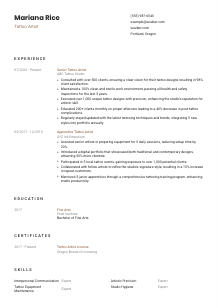
Studios expect the top of the resume to confirm practical basics fast. For a Tattoo Artist, that means clear contact information, an accurate professional title, and a portfolio link that lets the reviewer move straight from your resume to your work.
Use your full name as the most prominent text on the page. Keep it clean and readable rather than decorative. Tattoo studios review resumes alongside portfolios, social profiles, and booking histories, so your name should match the one attached to your professional work and public-facing presence.
Place "Tattoo Artist" directly under your name if that is the role you are applying for. This makes your specialization clear immediately and helps ATS filters connect your resume to the posting. If your current level is closer to Junior Tattoo Artist or Senior Tattoo Artist, you can still align with the target role while keeping the wording honest.
List a current phone number and a professional email address based on your name. Double-check both. In a studio setting, interviews and guest spot conversations often move quickly, and missed contact details can cost you the opportunity before your artwork is reviewed.
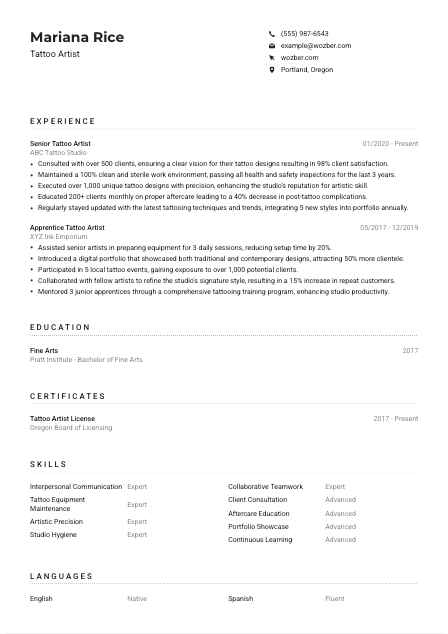
If a studio specifies a city or state, show that clearly in your personal details. In the example, "Portland, Oregon" directly answers the employer's location requirement and removes questions about relocation or licensing transfer. If you are nearby and willing to move, state that plainly only when it is true.
For tattoo work, a portfolio link is essential. Link to a site or profile that shows healed work when possible, multiple styles, clear line detail, and professional presentation. The sample resume includes a website, which is useful, but your portfolio should do the heavier lifting by showing the kind of custom work, consistency, and finish a studio would trust with clients.
This section should answer the first practical questions in seconds: who you are, what role you do, how to reach you, where you are based, and where to view your work. When those basics are clear, the studio can move on to your tattooing experience instead of chasing missing information.




Tattoo studios read experience with two things in mind: can you execute quality work, and can you handle the client side of the chair. Your bullets should cover consultation, design execution, hygiene standards, aftercare guidance, and results that show repeatable professional performance.
Before writing bullets, identify the operating requirements behind the ad. Here, the studio wants client consultation, sterile setup, precise execution, aftercare education, and current technique knowledge. The example resume mirrors that well with bullets about consulting 500+ clients, maintaining a fully sterile environment, and adding new styles to the portfolio each year.
Start with your most recent studio position so the reviewer sees your current level of responsibility first. This is especially important in tattooing, where recent client volume, current hygiene practice, and up-to-date style work matter more than older, less relevant experience. An apprenticeship can still add value, but it should support your current professional practice rather than lead it.
Under each role, show what you handled and what happened because of it. "Consulted with clients to refine concepts into final tattoo designs" is stronger when paired with a result such as satisfaction rate, repeat bookings, or portfolio growth. The sample bullet about executing over 1,000 unique tattoo designs works because it points to volume and artistic consistency, not just general responsibility.
Metrics make this section more credible when they match how studios actually track performance. Strong numbers include client count, satisfaction scores, repeat customer rate, inspection results, complication reduction through aftercare education, booking volume, or turnaround improvements in prep and cleanup. The sample's 98% client satisfaction and 40% drop in post-tattoo complications are good examples because they connect directly to service quality and safe practice.
Keep the section focused on work that supports studio performance. Prioritize tattooing, apprenticeship experience, custom design work, sanitation practice, events that built clientele, and collaboration inside a studio. Side experience only belongs if it strengthens your case through artistic development, client-facing service, or hands-on health and safety discipline.
A hiring manager should finish this section knowing how many clients you have worked with, how seriously you treat hygiene, what kind of tattoo volume or range you manage, and how you support the client before and after the session. That is the experience picture studios use to decide who gets called in.
Formal education is rarely the deciding factor in tattoo hiring, but it can still strengthen your resume when it supports drawing skill, design fundamentals, or visual training. Keep it concise and relevant so it adds context without crowding out your studio experience and portfolio.
If you have a degree or formal training in fine arts, illustration, design, or a related field, include it. The posting does not require a degree, but education like a Bachelor of Fine Arts can reinforce your grounding in composition, color, form, and visual storytelling, all of which carry into custom tattoo design.
List the field of study, degree, school, and graduation year. That is enough for most tattoo resumes. Clear structure matters because this section is supporting material, not the centerpiece. Keep the emphasis on training that helps explain your artistic base.
When your degree is relevant, present it in a way that ties naturally to tattoo work. In the example, a Fine Arts background fits because it supports design quality and stylistic range. You do not need to over-explain it, but the link between visual training and tattoo execution should be easy to infer.
Relevant coursework can help if it points to skills your portfolio or resume also reflects, such as figure drawing, color theory, illustration, typography, or printmaking. Skip generic classes. Include detail only when it sharpens the reader's understanding of your style, design process, or technical control.
Art shows, juried exhibitions, or academic honors can strengthen this section if they genuinely support your artistic credibility. Use them sparingly. A short mention works best when it shows disciplined craft or public presentation of your artwork, not when it distracts from your professional tattooing history.
Education can reinforce your artistic discipline, but studios will still weigh your portfolio, licensure, hygiene practice, and client experience first. Use this section to add context, then let your hands-on tattoo work carry the application.
In tattoo hiring, certifications are not a decorative extra. They show that you meet legal requirements, understand bloodborne pathogen safety, and can work within the studio's health standards. If a posting mentions licensure or certification, make those items impossible to miss.
Read the posting carefully and place any required tattoo license or certification near the top of this section. The example job asks for a valid state-specific tattoo artist license, so an Oregon license belongs here prominently. When you are licensed in the same state as the job, that removes a major barrier immediately.
After licensure, list certifications tied to safe studio practice. Bloodborne Pathogens certification is especially relevant because it speaks directly to sterilization, exposure prevention, and compliance with health regulations. Those are daily operating standards in tattooing, not background details.
Studios need to know that your credentials are current. Add issue dates, validity ranges, or "Present" where applicable. This is especially useful for licenses and safety training that require renewal, because it shows you maintain compliance rather than treating certification as a one-time checkbox.
If you complete updated safety courses, advanced technique workshops, or continuing education tied to professional tattooing, add the ones that are relevant to the role you want. Fresh training can support a resume when it aligns with the kind of work a studio offers, whether that is realism, color work, cover-ups, or stricter health compliance standards.
This section should reassure the studio that you are legally cleared to work and serious about safe tattoo practice. When licenses and health credentials are current and easy to find, the review moves forward with fewer questions.
A Tattoo Artist skills section works best when it reflects what happens in the station every day. That means pairing artistic ability with consultation, sanitation, equipment handling, and client care. Generic creative skills are less useful than skills tied to the actual workflow of tattooing.
Use the posting to identify the mix of artistic and operational skills the studio expects. In this case, that includes interpersonal communication, sterilization knowledge, client consultation, and high-quality design execution. The example resume does this well by combining artistic precision with studio hygiene, equipment maintenance, and aftercare education.
Every skill should connect to experience, certification, or portfolio proof. If you list "Client Consultation," your experience bullets should show concept development or satisfaction results. If you list "Studio Hygiene," your work history or certifications should support it. This keeps the section credible and useful rather than aspirational.
Put the most job-critical skills first. For many tattoo roles, that means consultation, tattoo design execution, sanitation and sterilization, aftercare education, equipment setup and maintenance, and communication. Grouping them clearly makes the section easier to scan, whether it is being read by a studio owner or filtered through ATS software.
By the end of this section, the reviewer should understand how you work, not just what broad traits you claim. The best skill lists point back to clean procedure, dependable execution, and a client experience that leads to strong reviews and repeat business.
Language matters in tattooing because every session starts with conversation. Clients need to explain ideas, ask questions about placement and pain tolerance, and understand aftercare clearly. If you speak more than one language, that can expand the range of clients you serve and improve the consultation experience.
If the posting specifies English, list it clearly with an honest proficiency level. For this role, English is essential because consultation, consent, aftercare instructions, and studio communication all depend on it. A simple "Native" or "Fluent" is usually enough.
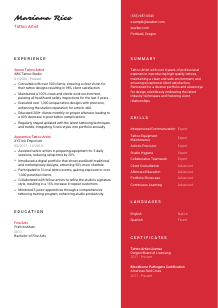
Include additional languages when you can genuinely use them in conversation with clients. In the example, Spanish adds real value because it can support consultations, comfort, and aftercare explanations for a broader client base. That kind of communication skill can matter in busy studios with diverse walk-in and booked clientele.
Use straightforward levels such as Native, Fluent, Conversational, or Basic. Avoid overstating your ability. In a tattoo setting, language skill is practical. If you cannot comfortably discuss design changes, placement, consent, and healing instructions, the label will not hold up in person.
List languages with the studio experience in mind, not as a general accomplishment. Multilingual ability is most persuasive when it supports consultation quality, clearer aftercare, and stronger rapport during long sessions. That is the context hiring teams care about.
If you regularly work with clients from different language backgrounds, improving your language skills can support your booking potential and your service quality. Even stronger conversational fluency can make custom design discussions smoother and reduce misunderstandings during the appointment process.
Studios value language skills when they improve consultations, comfort, and aftercare understanding. Present them in that practical light, and this section becomes part of your client-service profile rather than a side note.
Your summary should give the studio a fast, accurate read on your level, your working style, and the kind of value you bring to the chair. Keep it tight, but make sure it covers the parts of tattooing that matter most for hiring: experience, artistic quality, hygiene standards, and client interaction.
Start with your title and years of experience. "Tattoo Artist with over 4 years of professional experience" works because it immediately places you beyond the apprentice stage. If you have more than 2 years, say so clearly, since that meets a common threshold in studio postings like the one here.
Use the summary to highlight a few high-priority strengths, such as custom tattoo design, sterile work practices, client consultation, and aftercare education. The sample summary succeeds because it touches both artistic output and safe studio operation, which is exactly the balance employers look for.
Include a specific trait that helps define your professional identity. That might be a diverse style portfolio, a reputation for fine line precision, strong client retention, or a habit of integrating new techniques into your work. In the example, the mention of a diverse portfolio and ongoing technique development helps round out the profile.
Aim for 3 to 5 sentences with direct language. Avoid vague claims about passion or creativity unless you tie them to real work. A studio owner should be able to scan the summary and quickly understand your level of experience, your approach to safety, and the kind of client experience you deliver.
A good summary gives the studio a clear headline on your tattoo career before they read the details. If it captures your experience level, hygiene standards, artistic range, and client approach in a few lines, it is doing its job.
A Tattoo Artist resume works best when it reads like the reality of the job: client consultations, safe setup, clean execution, strong aftercare guidance, and artwork that holds up under scrutiny. When those points are clear across your experience, skills, certifications, and summary, the hiring team can picture you working in the studio, not just applying to it.
Use Wozber's free resume builder to shape that experience into an ATS-friendly resume format, refine your wording with targeted ATS optimization, and keep your portfolio, licensure, and studio-ready strengths easy to scan. The result should make one thing clear fast: you can tattoo well, work safely, and handle clients professionally from first consultation to healed result.




