



Use Wozber and land your dream job
Create Resume
No registration required
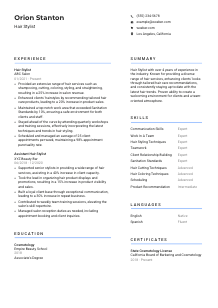
Snipping and styling, but your resume feels messy? Brush through this Hair Stylist resume example, created with Wozber free resume builder. Learn how to blend your artistic flair with job requirements, so your career can always be as polished as your clients' hairdos!
Salon hiring moves quickly when a resume makes the work easy to picture. For a Hair Stylist, that means more than saying you can cut and color. Employers want to see the range of services you perform, how you handle client relationships, how well you keep your station sanitized, and whether you can keep pace in a busy appointment-driven environment.
When those details are tailored to the posting, your resume is easier to sort in both human review and ATS screening. Wozber's free resume builder helps you line up your wording with the job description, keep an ATS-friendly resume format, and surface the experience that matters most first, so the salon can quickly see your service range, license status, and client-facing strengths.
This section needs to answer the practical questions a salon manager checks first: who you are, what role you do, how to reach you, and whether you meet any location requirement listed in the posting.
Use your full name in a clean, readable font slightly larger than the rest of the header. In salon hiring, speed matters, and your name should be easy to find whether the resume is viewed on screen, printed, or scanned alongside a portfolio.
Place "Hair Stylist" directly under your name if that is the role you are applying for. This keeps your positioning clear from the first line and helps align your resume with the title used in the posting and ATS filters.
Include a reliable phone number and a professional email address you check often. If a salon wants to fill shifts quickly or book a working interview, delayed replies can cost you the opportunity.
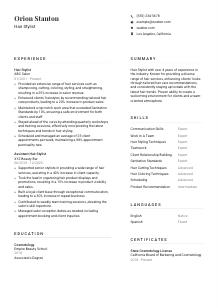
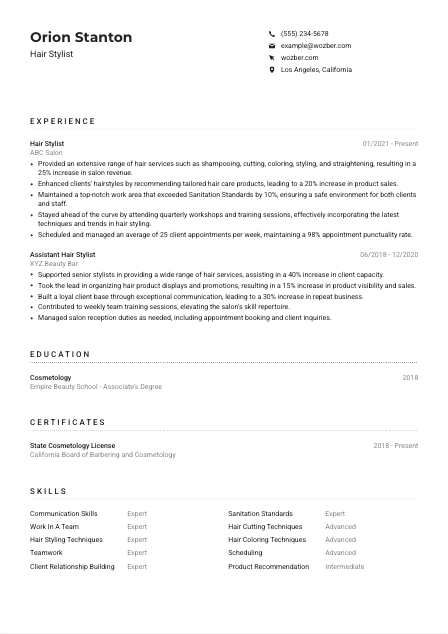
If the employer specifies a city or region, include it clearly. In the example, listing "Los Angeles, California" directly supports the stated location requirement and removes any doubt about local availability.
Hair styling is visual, so a portfolio link can strengthen your resume immediately. A website or professional social profile with cuts, color work, styling finishes, and before-and-after results gives the hiring team a better read on your aesthetic range and technical consistency.
Keep this section polished and easy to scan. A clear header tells the salon manager that you are reachable, locally relevant when needed, and already presenting yourself like a working professional.




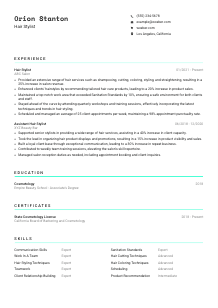
This is where salon employers look for proof that you can handle the chair, the client relationship, and the pace of the floor. Focus on services performed, customer outcomes, sanitation habits, product knowledge, and scheduling responsibility.
Before writing bullets, mark the services and responsibilities repeated in the job ad. For this role, that includes cutting, coloring, styling, straightening, product recommendations, sanitation, workshops, teamwork, and appointment management. Those themes should shape the language of your experience section.
Start with your most recent position and include salon name, job title, and dates. This makes it easy to follow your growth, whether you moved from assistant stylist work into a full stylist role or expanded from support duties into client ownership and retail contribution.
Numbers work well in salon resumes because they show pace, sales, retention, and reliability. The sample resume does this effectively with results such as a 25% increase in salon revenue, a 20% lift in product sales, and 25 appointments managed per week with 98% punctuality. Use metrics that reflect your own book of business, retail performance, rebooking rate, client volume, or sanitation audit results.
Do not stop at listing services. Show what your work changed. A bullet about recommending hair care products is stronger when tied to increased retail sales. Attending workshops becomes more valuable when you explain that you applied new coloring, cutting, or styling techniques on the floor.
Strong experience bullets often show dependability as much as technique. Mention things like maintaining a sanitized station, supporting team coverage, handling front-desk booking when needed, or building repeat business through consultations and client communication. Those details show how you contribute to salon operations, not just the finished hairstyle.
A hiring manager should come away knowing what services you perform well, how you work with clients, and what results followed. When your bullets connect technique to revenue, loyalty, cleanliness, and workflow, your experience reads like salon value, not a task list.
Formal training matters in hair styling because it underpins licensed practice, service quality, and safe technique. Keep this section concise, but make sure it clearly shows the education behind your work.
List the education most directly tied to your salon work first. A cosmetology program, barber training, or beauty school credential belongs front and center because it connects directly to licensing and service capability. The example's Associate's Degree in Cosmetology is a clear, role-relevant model.
Include school name, degree or program, field of study, and graduation year or date. Salon resumes do not need long academic descriptions unless a course or specialization is directly relevant to the work you want to do.
If your education included advanced color theory, textured hair, chemical treatments, extensions, bridal styling, or other services relevant to the jobs you target, mention them briefly. This helps employers see where your training supports the service mix they offer.
The job description specifically values staying current with new techniques and workshops, and that is common across many salons. If you have continued education in balayage, precision cuts, smoothing treatments, product systems, or trend-based styling, include it here or in certificates if that placement fits better.
Awards, student competitions, leadership roles, or standout beauty-school projects can help early-career candidates who are still building salon experience. Include them when they reinforce technical ability, professionalism, or initiative, not just to fill space.
Your education section should quickly confirm that you learned the craft through formal training and have continued developing it. For salon hiring, relevance matters more than detail overload.
For Hair Stylists, certification is not decorative. It can determine whether you are legally eligible to work, what services you can perform, and how quickly a salon can move forward with your application.
If the posting requires a state cosmetology or barber license, list it clearly and exactly. In this case, a valid state cosmetology or barber license is mandatory, so it should appear prominently and use the official credential name.
After required licensure, include certifications that strengthen your service profile, such as advanced color, smoothing systems, extension methods, or brand-specific product education. Choose credentials that reflect the kind of chair work you want to do.
Dates matter here. Employers need to know your credential is active, especially for regulated salon work. The sample handles this well by showing the California Board-issued cosmetology license with an active range.
Salons often value stylists who keep learning, especially in color trends, cutting methods, and product systems. Adding recent certificates or training signals that your technique is current and that you invest in professional growth beyond the minimum licensing requirement.
This section should answer two questions fast: are you licensed to do the work, and are you still developing your craft. When both are clear, employers can move on to evaluating your style, service range, and client impact.
A salon does not hire from a generic skills list. It hires for technical range, client communication, cleanliness, teamwork, and the ability to keep service moving on time. Your skills section should reflect that mix.
Start with the exact abilities named in the posting, then add closely related skills you genuinely use. Here, that includes cutting, styling, coloring, communication, teamwork, appointment management, and sanitation. Matching this language improves ATS optimization and keeps your resume aligned with what the salon actually needs.
Lead with the skills most central to salon performance. Technical abilities such as hair cutting, coloring, styling, and sanitation standards usually deserve priority, followed by client relationship building, retail recommendation, teamwork, and scheduling if they are part of your role. The example skills list does this well by pairing service technique with communication and cleanliness.
Avoid vague fillers like "hardworking" or "people person." Use concise, job-linked wording instead. You can group skills mentally into technical, client-facing, and operational categories, even if you present them in one list, so the section stays easy to scan and grounded in salon work.
The best skills section sounds like a real salon floor, not a template. If the list clearly covers service technique, client care, and operational reliability, it will support the rest of your resume well.
In a salon, language ability affects consultations, service accuracy, rebooking, retail recommendations, and the overall client experience. If a posting mentions language expectations, treat them as job requirements, not side details.
Check the posting for explicit language needs and list those first. This role requires high proficiency in English, so English should appear prominently with an accurate proficiency level.
Use straightforward labels such as "Native," "Fluent," "Advanced," or "Conversational." Clear labels help an employer judge whether you can manage consultations, explain aftercare, and communicate smoothly with both clients and coworkers.
Additional languages can be a real advantage in salons serving diverse neighborhoods or repeat clientele from different communities. The example includes Spanish, which could widen client communication and support stronger service relationships in many markets, even when it is not a formal requirement.
Do not overstate fluency. In salon work, language skill shows up quickly during consultations, product conversations, and service corrections. Honest proficiency descriptions set the right expectation and protect your credibility.
If you speak more than one language well, that can support smoother consultations, better trust, and stronger retention. In a large market with a varied client base, multilingual ability can make your service more accessible and help the salon serve a broader mix of guests.
Keep this section factual and useful. A salon should be able to tell, at a glance, whether you can communicate well enough to handle consultations, recommendations, and day-to-day client care.
Your summary needs to do in a few lines what a good consultation does in a few minutes. It should quickly communicate your experience level, technical range, client approach, and the kind of salon contribution you make.
Read the job description closely and identify the mix of technique and service it emphasizes. For this opening, the key themes are licensed salon experience, cutting and coloring range, client relationships, teamwork, sanitation, and appointment handling. Those should shape your summary.
Lead with your title and years of experience, then mention the services you perform confidently. A line like the example's "Hair Stylist with over 4 years of experience" works because it establishes level immediately before moving into cutting, styling, coloring, and client-facing strengths.
Use the summary to reinforce the qualifications that the employer is scanning for first. Mention licensed salon experience, service range, relationship building, and staying current with trends or training when those are central to the role. Keep the wording natural and tied to your real background.
Three to five lines is enough. Skip broad claims and use space for the details that matter in salon hiring, such as years in licensed salons, technical strengths, client retention focus, retail contribution, or team-based workflow. A concise summary should give the reader a clear snapshot of how you work behind the chair.
When this section is working, it tells the salon who you are, what you do well, and what kind of client and team experience you bring. Keep it brief, concrete, and closely matched to the services and standards in the role.
A Hair Stylist resume works best when it shows the full picture of how you contribute in a salon: licensed practice, service range, sanitation, client rapport, retail awareness, teamwork, and dependable scheduling. If those elements are easy to find, the hiring manager can picture you on the floor much faster.
Use Wozber to tighten that alignment with an ATS-compliant resume, stronger role-specific wording, and an ATS resume scanner that helps you match your background to the posting. The finished resume should make one thing clear right away: you can deliver great hair services and support the salon's day-to-day business.