



Use Wozber and land your dream job
Create Resume
No registration required
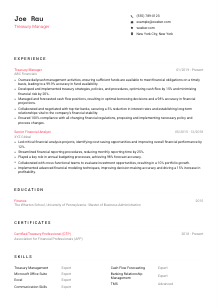
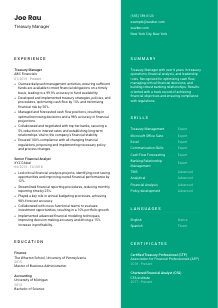
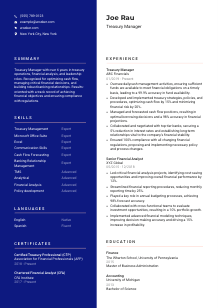
Into finances, but your resume feels like hidden treasure? Uncover this Treasury Manager resume example, created with Wozber free resume builder. Learn how to present your fiscal leadership to match job expectations, making your career prospects as rich and rewarding as your balance sheet!
Treasury work sits close to the company's pressure points. When cash positions are off, borrowing is mistimed, or banking terms are weak, the consequences show up fast in liquidity, cost of capital, and financial risk. A Treasury Manager resume needs to make that responsibility visible. Hiring teams want to see that you can manage day-to-day cash operations while making sound decisions on forecasting, funding, controls, and policy.
Resume tailoring matters here because treasury hiring often filters for very specific operating language before a human review ever reaches the finer details. Wozber's free resume builder helps you shape an ATS-compliant resume around the posting's actual treasury terms, so cash management, forecasting, bank relationship work, and compliance responsibilities surface clearly enough for a hiring team to judge whether you can run the function with confidence.
Treasury is a precision function, and the top of your resume should reflect that standard right away. Your personal details do not need flair. They need to be clean, accurate, and aligned with the job so the employer can move quickly to your treasury background without distractions.
Use your full name in a slightly larger font than the rest of the header so it is easy to find on first scan. Treasury roles are detail-sensitive, and a cluttered or inconsistent header creates the wrong first impression before the reader reaches your cash management or forecasting experience.
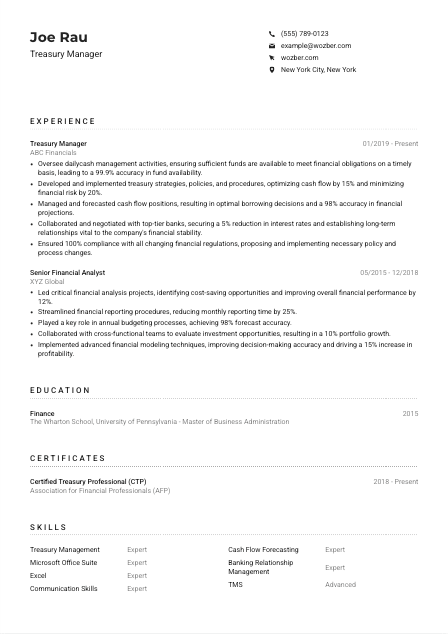
If the role is Treasury Manager, say "Treasury Manager" directly under your name. This helps align your resume with the posting and keeps your positioning clear in ATS searches and human review. If your current title is slightly different, you can still use the target title in the header as long as the experience section accurately reflects your real roles.
List a reliable phone number and a professional email address, ideally based on your name. Treasury managers are trusted with payments, liquidity decisions, and banking communication, so even small errors in contact details can undermine the image of control and accuracy your resume should project.
If the employer wants someone based in a specific market, show your city and state clearly. In this example, listing "New York City, New York" immediately addresses the stated location requirement and removes a common point of hesitation early in the review.
A LinkedIn profile or personal professional site can support your application when it matches the resume and adds useful context, such as treasury leadership, certifications, or broader finance progression. Only include it if it is updated and consistent with the experience and credentials you present here.
This section should confirm who you are, what role you are targeting, and whether any basic logistics are already covered. For Treasury Manager applications, clean details support the larger message that you are organized, accurate, and ready to step into a control-oriented finance role.




This is the section that carries the most weight for a Treasury Manager. Titles matter, but hiring teams look deeper into whether you have managed liquidity, improved forecasts, supported funding decisions, negotiated with banks, and maintained compliance under changing conditions. Your bullets should read like treasury outcomes, not general finance duties.
Read the posting closely and mark the treasury responsibilities that define the role. For this one, the core themes are daily cash management, cash flow forecasting, treasury strategy, banking relationships, funding decisions, and regulatory compliance. Those phrases should show up naturally in your experience if they reflect work you have actually done, because they map directly to how treasury teams are staffed.
List positions in reverse chronological order and make the move into treasury responsibility easy to follow. If you advanced from financial analysis into treasury leadership, show that progression clearly. In the example resume, the path from Senior Financial Analyst to Treasury Manager works well because it shows both analytical depth and eventual ownership of liquidity and banking decisions.
Each bullet should show what you managed, what changed, and how the business benefited. Treasury employers respond to metrics tied to liquidity, forecast accuracy, borrowing efficiency, interest costs, risk reduction, and compliance. A bullet like "optimized cash flow by 15%" or "secured a 5% reduction in interest rates" is strong because it shows direct financial impact rather than generic participation.
Use numbers that treasury leaders actually track. That can include cash availability accuracy, forecast accuracy, borrowing levels, days of liquidity coverage, rate improvements, reporting cycle time, policy adoption, or reduction in financial exposure. The sample's "99.9% accuracy in fund availability" and "98% accuracy in financial projections" are good examples because they sound native to treasury operations rather than forced metrics.
Prioritize experience that strengthens your case for managing cash, funding, controls, financial analysis, and stakeholder communication. Older or less relevant bullets can stay brief if they do not add much to the target role. The point is not to list everything you have done. It is to show a hiring manager that your background already covers the core operating demands of a Treasury Manager seat.
A Treasury Manager resume stands out when the experience section makes your operating judgment easy to trust. Focus on liquidity management, forecast quality, banking relationships, process improvement, and compliance outcomes, and your experience will read like someone who can run treasury rather than support it from the sidelines.
Education will not outweigh treasury experience at this level, but it still matters. It confirms your finance foundation and helps employers quickly see that you meet baseline requirements for analytical work, financial reporting, and decision support in a treasury environment.
If the posting asks for a bachelor's degree in Finance, Accounting, or a related field, make that easy to confirm. List your degree, field, school, and graduation year clearly. In the example, a Bachelor of Science in Accounting aligns directly, while the MBA in Finance adds senior-level depth without needing extra explanation.
Treasury hiring teams do not need a dense academic profile. They need a quick read on your qualifications. Use a simple format with degree, institution, field, and year so the section is easy to scan alongside your experience, certifications, and technical skills.
If you hold multiple degrees, present the ones that best support treasury responsibility. Finance, accounting, economics, and business degrees typically carry the most weight here. Advanced education, such as an MBA with a finance concentration, can strengthen your profile for roles involving policy, capital planning, and executive communication.
For experienced treasury professionals, coursework is usually optional. Include it only if it reinforces a gap or highlights a specialty such as corporate finance, risk management, capital markets, or financial modeling. If your work history already proves that depth, keep the section concise.
Honors, leadership roles, or notable finance-related activities can help early-career candidates, but they should not crowd the section for a managerial resume. Include them when they genuinely strengthen your financial profile or leadership track, and leave them out when your treasury record already does the heavier lifting.
This section should quickly reassure the reader that your academic background supports treasury work. Clear degree information, especially in finance or accounting, helps the employer move on to the stronger question your resume must answer: how you have applied that knowledge in live cash, banking, and risk decisions.
Professional certifications carry real weight in treasury because they point to specialized knowledge in cash management, liquidity planning, controls, and financial markets. They are especially useful when an employer mentions a preference such as CTP, or when you want to reinforce that your expertise goes beyond general finance management.
When a posting calls out a credential, move it to the front if you have it. Here, the Certified Treasury Professional designation is preferred, so it should appear prominently. That makes your treasury specialization easier to spot and immediately supports your fit for the role's operational and strategic scope.
List certifications that support treasury leadership, funding analysis, risk awareness, or broader financial judgment. In the example, CTP is the clearest match for the role, while CFA adds credibility in finance and analytical rigor. Order them by relevance to the target position, not by prestige alone.
Certification dates can show recency, active status, or continued professional engagement. That matters in treasury, where regulation, banking practices, and systems continue to evolve. A date range such as "2018 - Present" helps indicate that the credential remains current and maintained.
Treasury work changes with interest rate environments, financing conditions, regulatory updates, and system capabilities. Ongoing certifications or professional development can strengthen your resume, especially if you are targeting roles with larger cash structures, more complex debt activity, or broader policy responsibility.
Certifications should support the story your experience already tells. Used well, they show that your treasury knowledge is current, specialized, and serious enough for a role that touches liquidity, borrowing, controls, and financial risk.
A Treasury Manager skills section should read like the toolkit of someone who runs cash operations and supports financial decision-making, not a generic finance keyword list. Focus on tools, technical capabilities, and business-facing strengths that match the way treasury is actually measured and staffed.
Treasury hiring usually looks for a mix of systems knowledge, analytical ability, and stakeholder communication. In this description, that includes treasury management systems, Excel, analytical skills, and interpersonal communication. Start with those core requirements, then add related capabilities you genuinely use, such as cash flow forecasting, banking relationship management, or policy development.
Use the same or closely related terms the employer uses, provided they match your background. "TMS," "cash flow forecasting," and "banking relationship management" are better than vague labels because they map to actual treasury workflows. The example resume handles this well by pairing technical tools with core functional strengths instead of listing broad business buzzwords.
Keep the section focused on the abilities that support treasury execution and leadership. A compact list of high-value skills is more useful than a long inventory. If you use proficiency levels, make sure they are believable and consistent with your experience. Skills like Excel, treasury management, financial analysis, and policy development should line up with accomplishments elsewhere in the resume.
When this section is tailored well, it reinforces the operating language of the role and helps both ATS filters and hiring teams find the right capabilities fast. Every skill you include should connect back to cash visibility, funding judgment, systems fluency, or stakeholder management.
Language requirements can be simple or highly relevant, depending on the treasury structure. Some roles only need clear English communication for reporting, bank coordination, and policy work. Others support international cash operations or cross-border banking relationships, where additional languages can become a practical advantage.
If the posting states that English proficiency is vital, list English clearly with an honest proficiency level. Treasury managers spend plenty of time communicating with banks, internal finance leaders, auditors, and operating teams, so language clarity matters in both written reporting and verbal discussions.
Additional languages can be useful if your background includes multinational entities, regional banking contacts, or international cash operations. In the example, Spanish adds breadth, but it should be treated as a supporting asset unless the role specifically calls for multilingual communication.
Choose plain terms such as native, fluent, intermediate, or basic. That keeps expectations clear and helps the employer understand whether the language supports professional meetings, documentation, or only basic communication.
If the role involves global subsidiaries, foreign banking partners, or regional treasury coordination, language skills deserve more attention. If the position is domestically focused, keep the section concise and let your treasury experience stay in the foreground.
Only list languages you can use credibly. Treasury work depends on precision in reporting, negotiation, and compliance communication, so overstating proficiency creates risk. Honest language claims strengthen the professionalism of the whole resume.
For most Treasury Manager roles, language details play a supporting role. Include them clearly, be truthful about proficiency, and let them complement the larger picture of your cash management, forecasting, and stakeholder communication strengths.
Your summary should quickly place you in the treasury landscape. This is where you connect years of experience with the parts of the function that matter most for the target role, such as liquidity oversight, forecasting, bank relations, funding decisions, controls, and compliance. Keep it tight, specific, and grounded in results.
Start with the responsibilities that define the position rather than broad claims about being results-driven. For this role, that means treasury operations, cash management, cash flow forecasting, strategy, and regulatory compliance. Those themes should shape the summary so the employer immediately sees relevant depth.
Lead with your title or specialization and your years of relevant experience. A line such as "Treasury Manager with 6+ years in treasury operations and financial analysis" works because it establishes scope quickly and aligns with the experience threshold in the posting.
Choose the capabilities that matter most for the target job and support them with outcomes or focus areas. The example summary works because it points to cash flow optimization, critical financial decisions, banking relationships, and compliance, all of which connect directly to the stated responsibilities.
Aim for a short paragraph that a finance leader can read in seconds. Skip inflated descriptors and stay close to treasury substance. If every sentence points back to liquidity management, forecasting quality, financial control, or stakeholder trust, the summary will do its job well.
A strong summary gives the reader an immediate sense of your treasury scope and operating strengths before they reach the detailed bullets. When it is tailored well, it sets up the rest of the resume as the proof that you can manage cash, funding, and financial risk with control.
A Treasury Manager resume works when it makes your financial decision-making visible, not just your finance background. Show where you controlled cash positions, improved forecasts, influenced borrowing, strengthened banking relationships, and kept policies aligned with changing regulations.
Use Wozber's free resume builder to shape that experience into an ATS-friendly resume format, refine role-specific language with AI support, and check alignment with an ATS resume scanner. The finished resume should make one thing easy to judge: you can be trusted with the company's liquidity, risk discipline, and daily treasury execution.




