



Use Wozber and land your dream job
Create Resume
No registration required
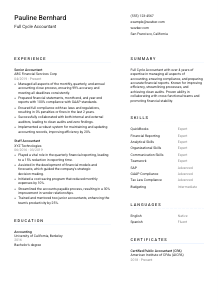
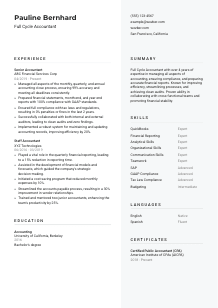
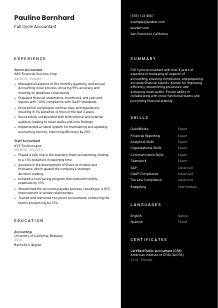
Number crunching, but your resume doesn't balance? Check out this Full Cycle Accountant resume example, built with Wozber free resume builder. It shows how to present your financial know-how and reporting expertise so they line up naturally with the job's fiscal criteria, paving the way for your career to be in the black, not in the red!
Full cycle accounting work leaves very little room for vague claims. Hiring teams want to see whether you can close the books on schedule, keep reporting accurate under deadline pressure, and maintain records that stand up during audit and tax review. Your resume should make that operating discipline visible from the first section.
When your resume mirrors the language of close management, financial statement prep, compliance, and accounting systems, it is easier for reviewers and an ATS to place you in the right lane quickly. Wozber's free resume builder helps you shape that alignment in an ATS-friendly resume format, so your background reads clearly as end-to-end accounting experience rather than a mix of disconnected finance tasks.
For accounting roles, the top of the resume should be clean, exact, and easy to verify. This section is simple, but it still does important work. It tells the employer who you are, what role you are targeting, and whether you meet any practical requirement such as location or professional presence.
Use your full name as the clearest line on the page, set a little larger than the rest of the text. In accounting hiring, presentation matters because it hints at how carefully you handle records, reconciliations, and financial documentation.
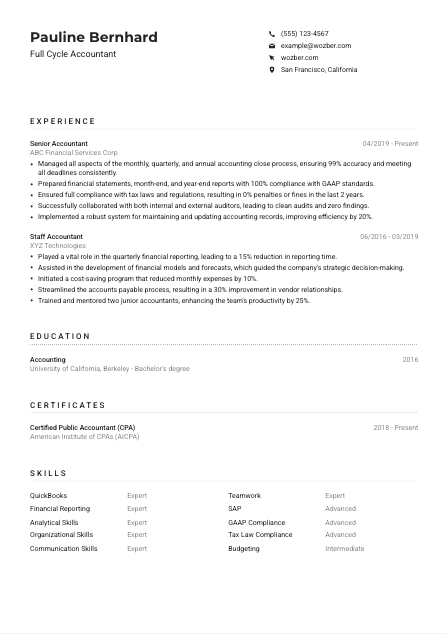
Place "Full Cycle Accountant" directly under your name when that is the role you are targeting. This immediately connects your resume to positions focused on close processes, reporting, reconciliations, and compliance. The sample resume does this well by matching the title without adding unnecessary wording.
Your contact information should be current and error-free so an employer can reach you without friction.
Some accounting openings are tied to office access, local compliance support, or audit coordination. If a posting specifies a city, reflect it clearly. In the example, listing San Francisco, California directly supports the employer's stated location requirement.
A LinkedIn profile or professional website can help if it reinforces your accounting background, systems knowledge, and career timeline. Make sure dates, titles, and credentials match your resume exactly. Any mismatch creates the kind of inconsistency finance employers notice quickly.
Treat this section like the header on a financial report. It should be clear, complete, and aligned with the role before the reader reaches your experience.




This is the section that carries the most weight for a Full Cycle Accountant. Employers are looking for more than accounting exposure. They want to know whether you have handled close activities, produced reliable reporting, managed compliance work, and supported audits without constant supervision.
Before writing bullets, isolate the accounting functions that define the role. For this kind of opening, that usually includes monthly close, quarterly and annual reporting, tax compliance, audit support, and record maintenance. Use those workstreams to decide which achievements stay and which get cut.
Lead with your most recent accounting work and make each entry easy to scan with title, company, and dates. Recent experience usually shows the systems, reporting cadence, and scope you can handle now. In the sample resume, the progression from Staff Accountant to Senior Accountant helps show increased ownership over close and reporting responsibilities.
General statements like "responsible for month-end close" do not say enough. Show what you handled and what happened because of it. A bullet such as "Managed the monthly, quarterly, and annual close process with 99% accuracy and on-time completion" tells the reader about scope, reliability, and execution under deadline.
Numbers make your impact easier to judge when they reflect real finance outcomes. Useful examples include reporting accuracy, close timeliness, audit results, compliance rates, efficiency gains, cost savings, and process cycle time. The sample bullets use metrics naturally, including zero penalties, clean audits, and a 20% efficiency improvement in records management.
Prioritize experience that supports full cycle accounting, even if your earlier titles were broader. If a bullet does not strengthen your case for close ownership, financial reporting, ERP or accounting software use, reconciliations, tax support, or audit coordination, it can usually be removed or rewritten. Relevance is especially important if you want your ATS optimization to surface the right accounting keywords instead of generic finance tasks.
Your experience section should leave little doubt about the level of accounting work you can carry. When the bullets show close discipline, reporting accuracy, and compliance follow-through, the role becomes much easier to picture you in.
Education is usually a checkpoint section for accounting roles, but it still matters. A degree in accounting, finance, or a related field tells the employer you have the formal grounding for financial reporting, controls, and compliance work, especially when paired with relevant experience.
If the opening asks for a Bachelor's degree in Accounting, Finance, or a related field, list your degree in clear terms. This helps both human reviewers and ATS systems identify the requirement quickly. The example does this directly with a Bachelor's degree in Accounting.
Include degree, field of study, school, and graduation year or date. For accounting positions, this section does not need decoration. Clear structure and accurate details are enough.
If your major is accounting, place that front and center. If your degree is in finance or another related discipline, make sure the field is still easy to spot. A relevant specialization, honors distinction, or accounting concentration can add useful context when it strengthens your alignment with reporting or compliance work.
Recent graduates can strengthen this section with courses such as financial accounting, auditing, taxation, cost accounting, or corporate finance. Once you have several years of close and reporting experience, coursework usually matters less than your work history.
Student accounting clubs, audit case competitions, or capstone projects tied to financial analysis can be worth listing if they show technical grounding or leadership. If they do not connect to the type of accounting work you are applying for, leave them out.
This section should confirm that you meet the educational baseline without slowing the reader down. Save most of the detail for the experience that proves how you apply that training in real close and reporting cycles.
Certifications matter in accounting because they signal technical depth, professional standards, and ongoing commitment to the field. For some openings, they are required. For others, like the example here, they are preferred but still influential.
If a posting says CPA preferred, make that credential easy to find. A CPA is especially relevant for roles involving financial statements, compliance, audit support, and GAAP-based reporting. In the sample resume, the CPA listing immediately strengthens the candidate's standing for a full cycle position.
Prioritize certifications tied to accounting, reporting, tax, audit, or ERP systems. A short, relevant list is more effective than a long catalog of unrelated training. This keeps the message centered on professional accounting capability.
Show the year earned or active date range when that helps confirm recency and status. For regulated professions like accounting, employers often want to know whether a credential is current and how long you have held it.
Continuing education in taxation updates, financial reporting changes, audit practices, or accounting systems can strengthen your profile, especially if the role touches those areas heavily. Use this space to show substance, not generic learning activity.
Well-chosen certifications tell the employer that your accounting knowledge is current and recognized beyond job titles alone. That can make a meaningful difference in roles tied to compliance, reporting accuracy, and audit interaction.
A Full Cycle Accountant skills section should read like a practical toolkit for running accounting operations well. Employers want to see the systems, technical knowledge, and working habits that support accurate close cycles, clean reporting, and dependable collaboration across finance teams.
Use the job description to identify the technical and functional skills that matter most. In this case, accounting software proficiency, financial reporting, compliance knowledge, analysis, organization, and communication all belong in the section. Specific platforms such as QuickBooks or SAP should appear when you genuinely use them.
Do not separate accounting software from the rest of the job. Full cycle work depends on both. A useful skills list might combine QuickBooks, SAP, account reconciliation, financial statement preparation, GAAP, month-end close, tax compliance, analytical skills, and cross-functional communication. The sample resume gets this balance right by pairing platform knowledge with reporting and compliance skills.
Keep the list focused enough that every item supports a likely hiring decision. If a skill does not relate to accounting operations, reporting, controls, systems, or collaboration needed for close and audit work, it probably does not belong. A shorter, better-matched list also performs better in ATS resume scanner reviews because the relevance is clearer.
By the time someone reaches this section, they should see the tools and strengths that back up your experience. The best list reads like support for the accounting work you already proved elsewhere on the page.
Language ability is usually a secondary section for accountants, but it still has a place when communication matters across teams, vendors, clients, or audit partners. Present it clearly, and keep the emphasis on language skills that actually support the work.
If the role requires strong English, list English at the top with an honest proficiency level. For accounting roles, this matters because close schedules, audit requests, financial narratives, and compliance communication all depend on precise written and verbal language.
Additional languages can help in organizations with multilingual teams, regional operations, or vendor relationships. They are usually a bonus rather than a core requirement, but they can still expand the kinds of stakeholders you can work with effectively.
Use realistic descriptions such as Native, Fluent, Advanced, or Intermediate. If you may need to explain financial variances, respond to audit questions, or coordinate with non-English-speaking partners, overstating your level will become obvious quickly.
Some full cycle accounting roles include international entities, foreign vendors, or parent-company reporting. In those cases, language ability can become much more relevant. If the role is purely domestic, keep this section brief.
The value here is practical. If you can explain account activity, billing issues, or reporting questions across language lines, that can support smoother operations and fewer misunderstandings.
List languages when they add real business value, and present them with the same accuracy you would bring to a financial statement. Clear, honest entries are enough.
Your summary should give a hiring manager a fast read on what kind of accountant you are. For a Full Cycle Accountant, that means showing your years of experience, the accounting cycle you handle, the systems or reporting strengths you bring, and one or two outcomes that set the tone for the rest of the resume.
Start with the functions that define your background, such as managing close processes, preparing financial statements, supporting audits, maintaining clean records, or handling compliance responsibilities. This keeps the section grounded in the role rather than generic accounting language.
Lead with your title, years of experience, and level of scope. A line like "Full Cycle Accountant with 4+ years of experience managing monthly close and financial reporting" tells the reader far more than a broad claim about being results-driven.
Choose achievements or strengths that map directly to the opening. Clean audits, accurate reporting, zero compliance penalties, process improvements, and expertise with systems like QuickBooks or SAP are all stronger than vague personality language. The sample summary works because it highlights efficiency gains, clean audits, and collaboration in a compact space.
Aim for three to five lines that can be scanned in seconds. Every phrase should either describe accounting scope, technical relevance, or a concrete result. If a sentence could apply equally well to almost any finance professional, tighten it until it reflects full cycle accounting work more clearly.
A focused summary helps the reader understand your accounting range before they reach the detail. When it clearly states your close experience, reporting strength, and compliance reliability, the rest of the resume lands faster.
A Full Cycle Accountant resume should make one thing easy to see: you can manage the accounting cycle accurately, keep reporting on schedule, and support compliance without loose ends. When each section reinforces that story with specific systems, outcomes, and responsibilities, your application reads with much more authority.
Use Wozber's free resume builder to shape that content into an ATS-compliant resume, refine the wording with its ATS resume scanner, and present it in a clean ATS-friendly resume template. The final result should give hiring teams a clear read on your readiness for close, reporting, and audit-facing accounting work.




