




Use Wozber and land your dream job
Create Resume
No registration required
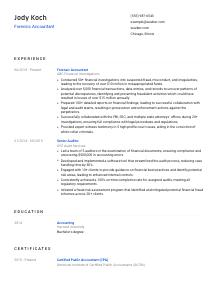
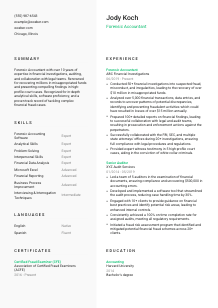
Digging into financial mysteries, but your resume doesn't add up? Investigate this Forensic Accountant resume example, created with Wozber free resume builder. Learn how to highlight your financial sleuthing skills to match the job's detective work, making your career narrative as clear and compelling as a perfectly balanced ledger!
Forensic accounting work gets scrutinized long before anyone reaches the courtroom. Hiring teams look for people who can trace irregular transactions, separate weak indicators from actionable findings, and document conclusions clearly enough for audit, legal, or compliance review. Your resume needs to show that kind of rigor on the page, especially in how you present investigations, financial analysis, and reporting outcomes.
A tailored resume also changes how quickly your background reads against case-driven requirements. When titles, certifications, investigation work, and tools are aligned with the posting, an ATS-compliant resume makes it easier to distinguish forensic accounting depth from general audit experience. Wozber's free resume builder helps you shape that alignment in an ATS-friendly resume format, so hiring teams can quickly see your fraud investigation scope, reporting strength, and legal collaboration.
Accuracy matters in forensic accounting, and that expectation starts with the header. Your personal details should be clean, current, and aligned with the posting, with no missing contact information or avoidable inconsistencies. Use this section to present yourself as a candidate who pays attention to detail from the first line.
Your name should be the most visible text in the header, set in a clear, professional font. In a field built on precision and credibility, a cluttered or understated header creates the wrong impression before your investigation work is even read.
Place "Forensic Accountant" directly beneath your name when that is the role you are targeting. Matching the posted title helps both recruiters and ATS systems categorize your background correctly, especially if your prior roles also include adjacent titles such as Senior Auditor or Financial Investigator.
Add a reliable phone number and a professional email address you check regularly. Small mistakes here can undercut the careful, detail-heavy profile you are trying to present, so review every character the same way you would review a transaction log or case report.
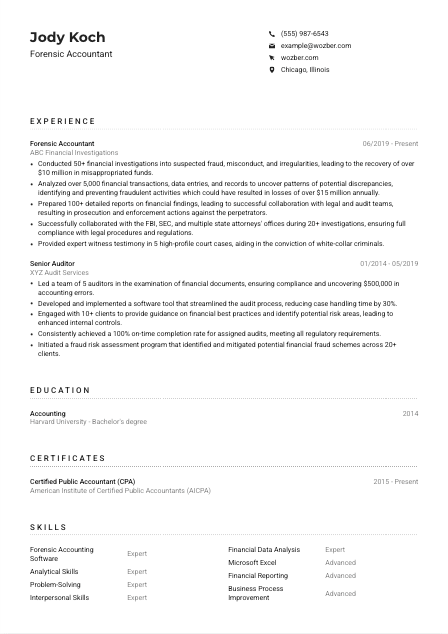
If the employer requests a specific location, reflect that clearly in your header. In the example, listing "Chicago, Illinois" directly answers the stated requirement and removes any doubt about local availability. Use this kind of detail when it is relevant to the job, not as filler.
If you include LinkedIn or a professional website, make sure it supports your resume with consistent titles, dates, certifications, and investigation-related experience. Forensic accounting employers may compare those details closely, especially when your work involves legal collaboration, expert testimony, or fraud examinations.
Your header should confirm that you are reachable, professionally presented, and aligned with any practical requirements in the posting. In a role where credibility and documentation matter, even the basics need to look exact.




This section carries the most weight for a forensic accountant. Hiring teams want to see what kinds of investigations you handled, how deep your financial analysis went, what business or legal outcomes followed, and whether your work held up under external scrutiny. Keep the focus on casework, findings, reporting, collaboration, and measurable results.
Start by isolating the work the employer actually needs done. For this role, that includes investigating suspected fraud, analyzing transactions and records, preparing detailed findings, working with legal stakeholders, and possibly giving testimony. Those are the responsibilities your bullets should reflect through real examples from your background.
List positions in reverse chronological order with job title, employer, and dates. That straightforward structure matters for ATS optimization and for human reviewers comparing your forensic accounting depth against related experience in audit, compliance, or investigations.
Each bullet should show the work performed and the result it produced. Instead of broad claims about analytical skill, describe the investigation volume, fraud patterns uncovered, control failures identified, or enforcement outcomes supported. The sample resume does this well with details like conducting 50+ investigations and preparing more than 100 reports for legal and audit teams.
Quantify impact with measures that matter in this field, such as funds recovered, transactions reviewed, cases completed, losses prevented, reporting volume, or time saved in investigative workflows. Figures like "$10 million recovered" or "5,000 transactions analyzed" tell a hiring manager far more than a generic statement about improving processes.
Forensic accounting resumes benefit from selectivity. Prioritize bullets tied to fraud detection, financial irregularities, audit rigor, report writing, regulatory coordination, software-driven analysis, and courtroom or legal support. If a past responsibility does not strengthen that picture, shorten it or leave it out.
By the end of this section, a reviewer should understand the scale of your investigations, the quality of your financial analysis, and the consequences of your findings. Make the progression from audit or investigation work into forensic accounting unmistakable.
Education matters here because it establishes your grounding in accounting and financial analysis. Forensic accounting hiring rarely stops at the degree alone, but the section should quickly confirm that you meet the baseline academic requirement and that your training supports the kind of investigative work described in the role.
If the posting asks for a bachelor's degree in Accounting, Finance, or a related field, list that clearly and exactly. A direct match such as "Bachelor's degree, Accounting" helps your resume pass an early qualification check without forcing the reviewer to interpret your academic background.
Include degree, field of study, school, and graduation year in a clean format. This is one of the easiest sections for ATS systems to parse, so avoid unnecessary wording that could hide a straightforward qualification.
When your degree lines up with the role, do not bury it. In the example, a bachelor's degree in Accounting makes the educational match obvious. That kind of direct relevance is worth keeping visually clear, especially when the employer is screening for accounting fundamentals before reviewing specialized experience.
If you are earlier in your career or your experience is less specialized, selected coursework in auditing, fraud examination, financial statement analysis, or investigative accounting can add useful context. Skip it if your work history already proves those capabilities more strongly.
Honors, research, or student activities can help when they connect to analytical discipline, ethics, or financial investigation. Keep them brief and relevant. For experienced forensic accountants, the emphasis should stay on professional casework and credentials.
This section should quickly confirm that you have the accounting or finance foundation the role requires. Once that baseline is clear, your experience and certifications can carry the more specialized part of the case.
Certifications carry real weight in forensic accounting because they show formal expertise beyond general accounting training. When a posting specifically asks for CPA or CFE credentials, this section should be impossible to miss and easy to verify at a glance.
If the employer asks for CPA or CFE, place those certifications prominently. They are not decorative extras in this field. They often signal credibility in fraud examination, financial review standards, and the kind of testimony or legal support the role may involve.
Focus on certifications that strengthen your forensic accounting profile. A short list led by CPA, CFE, or closely related fraud, audit, or compliance credentials will usually serve you better than a longer list of less relevant learning badges.
Include issue dates, renewal periods, or current status where appropriate. That makes it easier for employers to confirm that your credentials are active and current, especially in regulated or litigation-adjacent environments.
Forensic accounting sits at the intersection of accounting, investigation, and legal process. Current credentials help show that you stay connected to evolving fraud schemes, reporting standards, and examination practices. In the sample resume, listing both CPA and CFE immediately strengthens that specialized profile.
Relevant credentials tell employers that your expertise has been tested against professional standards, not just built through experience alone. For roles involving fraud, misconduct, and legal review, that distinction matters.
The skills section should read like the working toolkit behind your investigations. It needs to balance technical capability with the judgment and communication required to interpret financial records, build defensible findings, and work with attorneys, auditors, or enforcement teams.
Read the posting for both explicit requirements and implied working demands. Here that means forensic accounting software, advanced Excel, financial analysis, problem-solving, interpersonal ability, and reporting strength. Those skills map directly to how forensic accountants review records, test anomalies, and present conclusions.
Prioritize tools and capabilities that affect case quality and speed. Software proficiency, transaction analysis, fraud detection, report writing, interviewing, and spreadsheet modeling all matter more than broad business terms with no forensic context. The example skills list works well because it combines software, Excel, financial analysis, and investigation-adjacent communication skills.
Do not turn this section into a keyword dump. Group or order skills so the most job-relevant ones are easiest to scan, especially technical tools and investigative competencies. A shorter list with clear forensic relevance is more convincing than a long list of generic strengths.
Your skills section should reinforce what the experience section already proves. When the tools, analysis methods, and communication abilities line up, your forensic accounting profile reads as coherent and credible.
Language skills are usually secondary to investigative and accounting depth, but they can still add value in fraud work. Employers may need someone who can review records, communicate with witnesses or stakeholders, or support multi-jurisdiction matters. When English proficiency is named in the posting, make that qualification clear.
If English proficiency is listed as a requirement, place English at the top of this section and label your level plainly. That allows recruiters and ATS systems to confirm a stated requirement immediately, especially for roles involving written findings and verbal testimony.
Additional languages can be useful when investigations involve international transactions, multilingual records, or varied stakeholder groups. Treat them as relevant supporting information, not as a substitute for core accounting qualifications.
Use clear levels such as "Native," "Fluent," or "Intermediate." Forensic work depends on accuracy, so vague labels can create the wrong expectation about your ability to review documents or participate in sensitive conversations.
If your target roles involve cross-border fraud, multinational entities, or diverse witness and client communication, language ability can become more valuable. Include it when it supports the kind of investigative environment you want to work in.
Languages can strengthen your profile, especially when they help with document review or stakeholder communication, but they should not take up space better used for casework, certifications, or analytical tools. Keep the emphasis where forensic hiring usually places it.
Used well, this section shows communication range that complements investigative work. Just keep it anchored to the realities of fraud review, reporting, and stakeholder interaction.
Your summary should quickly place you in the right lane of the accounting market. For forensic accounting roles, that means stating your investigative background, your level of experience, the kind of financial issues you handle, and the outcomes your work supports. Keep it concise, specific, and grounded in real scope.
Before drafting, identify the themes that define the target position. In this case, that includes forensic accounting experience, financial investigations, fraud analysis, report preparation, legal collaboration, and recognized credentials. Your summary should touch the strongest of those points without becoming a checklist.
Lead with a direct description of who you are and how long you have worked in relevant areas such as forensic accounting, auditing, or financial investigations. That opening frames the rest of the resume and helps separate you from candidates whose background is purely general accounting.
Use the next lines to mention the kind of work you do best, along with one or two outcomes. The sample summary is effective because it combines years of experience with recovered funds, legal-team collaboration, and high-profile case support. Those specifics are more persuasive than adjectives alone.
Aim for 3 to 5 lines that can be read quickly at the top of the page. Focus on forensic accounting keywords and accomplishments you can support elsewhere in the resume. If a line does not strengthen your case investigations, reporting credibility, or fraud expertise, trim it.
A good summary tells the reader, within a few seconds, what kind of forensic accountant you are and where your value shows up. That gives the rest of the resume a clear frame and makes your most relevant experience easier to read in context.
You now have a clear framework for tailoring each section of your forensic accountant resume around investigation work, financial analysis, certifications, and legal-facing communication. Apply it carefully, and your resume will show more than accounting experience. It will show judgment, case discipline, and the ability to produce findings that matter.
Wozber's free resume builder can help you put that into a clean ATS-friendly resume template, while its ATS resume scanner and AI resume builder features help align your wording with the posting's real requirements. The final result should make one thing easy to judge: whether you can step into complex financial investigations and produce reliable, defensible work from day one.




