



Use Wozber and land your dream job
Create Resume
No registration required
Predicting market trends, but your resume seems traded on? Check out this Equity Research Analyst resume example, made with Wozber free resume builder. Learn how to match your financial insights to job requirements, building a career portfolio with growth potential as solid as blue-chip stocks!
Equity research hiring turns quickly on whether your resume shows real investing judgment. Firms want to see how you move from filings, channel checks, sector trends, and valuation work to a view they can actually use, whether that means a report, a recommendation, or a portfolio discussion. If your resume only lists research tasks without showing coverage, analysis depth, or investment impact, it will read like support work instead of analyst-level contribution.
A tailored resume also helps separate equity research from adjacent finance profiles such as FP&A, corporate finance, or general data analysis. When your language matches the role's emphasis on financial modeling, valuation, published research, and market reaction speed, Wozber's free resume builder helps you shape that experience into an ATS-compliant resume that makes your research process and investment relevance easier to recognize. That distinction matters when hiring teams need someone who can form a view and defend it.
This section is simple, but it still carries practical screening value. For equity research roles, employers need accurate contact details, a clear role label, and in some cases confirmation that location will not slow down interviews or onboarding. Keep it clean, direct, and aligned with the position you are targeting.
Use your full name as the visual anchor at the top of the page. Keep formatting professional and easy to scan in an ATS-friendly resume format. In a field built on concise research notes and clean models, cluttered styling creates the wrong first impression before anyone reaches your analysis experience.
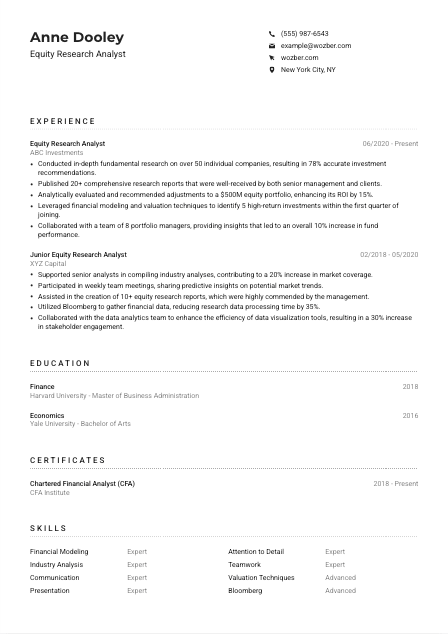
Place "Equity Research Analyst" directly under your name if that is the role you are pursuing. This immediately frames your background around company coverage, valuation work, and investment recommendations rather than broader finance duties. If your recent title was more junior, you can still target the role in your header while letting the experience section show your progression.
List a reliable phone number and a professional email address. Add a LinkedIn profile or relevant professional site only if it supports your candidacy with a consistent work history, sector focus, published commentary, or market-facing credibility. Every detail here should make it easier to reach you, not raise questions about polish or accuracy.
Some equity research roles have a firm location requirement because of office-based collaboration with portfolio managers, traders, or clients. In the example here, listing "New York City, NY" directly answers that filter. If you are relocating, say so plainly rather than leaving the employer to guess.
A website or profile can strengthen your resume when it includes market commentary, writing samples, speaking appearances, or a well-maintained professional background. Keep it tightly relevant to finance and research. A strong link acts like an appendix to your core resume, offering more depth without distracting from the main document.
Your personal details should confirm that you are reachable, professionally presented, and aligned with any stated logistics. That is all this section needs to do, and doing it cleanly keeps attention on your research work.




For an Equity Research Analyst, experience is where hiring teams decide whether you can turn information into an investable view. The strongest bullets show coverage scope, modeling depth, report output, collaboration with investment teams, and what changed because of your analysis. This section should read like analyst work in motion, not a generic finance job history.
Start by identifying the activities the employer cares about most. In this posting, that includes fundamental research, financial statement analysis, valuation, industry analysis, published reports, presentations, and collaboration with portfolio decision-makers. Use those priorities as the filter for what stays, what gets rewritten, and what deserves top placement.
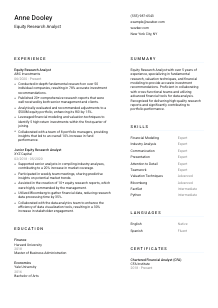
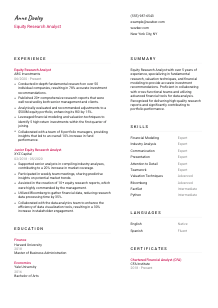
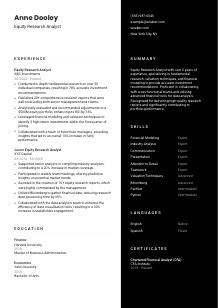
List roles in reverse chronological order and make sure the most recent position carries the most detail. For equity research, hiring managers usually want to see how your coverage and judgment developed over time, from supporting research production to owning recommendations or influencing portfolio actions. The sample resume does this well by moving from a junior analyst role into a full analyst position with direct investment impact.
Each bullet should show what you analyzed, what you produced, and what result followed. Useful patterns include company coverage, research reports issued, valuation models built, portfolio recommendations made, or insights presented to senior stakeholders. For example, "Conducted in-depth fundamental research on over 50 companies" and "Published 20+ comprehensive research reports" are effective because they show both scope and deliverable, not just effort.
Numbers matter here because research is evaluated by accuracy, coverage, portfolio impact, speed, and relevance. Metrics such as recommendation hit rate, assets influenced, return improvement, number of reports, or time saved through better data gathering all make your contribution easier to trust. In the example, references to a $500M portfolio, 78% recommendation accuracy, and a 35% reduction in research processing time give the experience commercial weight.
Keep the section centered on equity research, investment analysis, and adjacent work that supports those responsibilities. If you include broader finance or analytics work, connect it directly to market research, sector insights, data gathering, or decision support. Every line should help the reader picture you contributing to coverage, recommendations, or portfolio discussions from day one.
Your experience section should make it easy to picture the kind of analyst you are. Show the companies or sectors you studied, the reports and models you produced, the investment conversations you supported, and the measurable effect of your work.
Education matters in equity research because firms expect a solid grounding in accounting, economics, valuation, and markets. This section does not need to be long, but it should clearly support your ability to interpret financial statements, build models, and understand industry dynamics.
Use the job description as your guide for what to emphasize. Here, the employer asks for a bachelor's degree in Finance, Accounting, Economics, or a related field. If your background matches directly, make that easy to spot. If your degree is adjacent, use the field of study and any relevant graduate work to close the gap.
List degree, field of study, school, and graduation year in a clean format. Equity research hiring does not require decorative detail here. It requires clarity. A reader should be able to confirm your academic foundation in a few seconds, just as they would scan the assumptions page of a model before trusting the output.
If you hold multiple degrees, lead with the education that best supports the role. In the example, the MBA in Finance adds clear relevance, while the undergraduate Economics degree reinforces analytical training. That combination works well for research roles because it supports both market interpretation and technical valuation work.
Early-career candidates can use this section to show direct exposure to equity valuation, financial statement analysis, macroeconomics, investment management, or sector research projects. Include only coursework or projects that strengthen your case for handling company analysis and investment recommendations. Once you have several years of relevant experience, those details can usually be trimmed back.
Honors, scholarships, or leadership roles in finance and investment groups can add context when they reflect genuine analytical interest or strong academic performance. Keep them relevant. A student investment fund, equity research competition, or finance society role says more for this profession than a generic campus activity.
This section should confirm that you have the academic base for modeling, valuation, and industry analysis. Once that is clear, let your experience carry the heavier argument.
Certifications are not required in every equity research opening, but they can materially strengthen your profile when they deepen your finance knowledge or market credibility. In a field where judgment, ethics, and technical analysis all matter, the right credential adds useful context.
Start with the posting. This role does not require a certification, so do not treat one as mandatory. Still, widely recognized credentials such as the CFA can strengthen your case by reinforcing valuation discipline, accounting fluency, and long-term commitment to investment analysis.
List certifications that are clearly tied to equity research, financial modeling, securities analysis, or investment management. A relevant credential should help explain why you can build models, compare intrinsic value to market price, and communicate investment ideas with confidence. The sample resume uses the CFA effectively because it fits the role's technical and professional expectations.
Add the year earned or the active date range where relevant. For ongoing designations, use wording that shows current standing. This matters in finance because credentials often signal current commitment as much as past achievement, especially when employers are evaluating market-facing roles.
Equity research changes with accounting standards, sector developments, data sources, and market structure. Certifications and continued learning show that your toolkit is staying current. If you are between formal credentials, strong recent training in modeling or sector-specific analysis can still reinforce your profile.
A certification should strengthen your analyst profile in a specific way, whether that is valuation rigor, investment knowledge, or professional credibility. If it does not help explain your research capability, leave it out.
The skills section should read like the toolkit of someone who can analyze companies, build a view, and communicate it to decision-makers. Keep it focused on the methods, platforms, and communication strengths that equity research teams actually use.
Read the job description for explicit requirements and implied working demands. Here, that means financial modeling, valuation techniques, industry analysis, research tools such as Bloomberg or FactSet, plus presentation and English communication skills. Equity research is one of those fields where technical analysis and investment communication need to sit side by side.
Use the employer's terminology where it accurately reflects your background. If the posting says "financial modeling" and "industry analysis," use those phrases instead of vague substitutes. This improves ATS optimization and also makes your profile read as closer to day-to-day analyst work. The example resume does this well by naming Financial Modeling, Valuation Techniques, Bloomberg, and FactSet directly.
Group or order your skills so the most role-critical ones appear first. Core analytical capabilities, research platforms, and communication strengths should lead, while broader tools such as Python can follow if they genuinely support your workflow. The section should help a hiring manager scan your readiness for coverage work, research production, and cross-team discussion in seconds.
Your skills section should reinforce the picture already built by your experience. Prioritize the tools, methods, and communication strengths you use to turn company and sector data into investment insight.
Language ability matters in equity research when it affects report writing, internal presentations, client interaction, or coverage of international companies and markets. Present this section clearly and keep the emphasis on business-useful communication.
If the employer specifically asks for strong English communication, make your English proficiency easy to find. For equity research, this matters because the work often includes written reports, management meeting notes, earnings commentary, and presentations to internal teams or clients.
Use a plain descriptor such as Native, Fluent, or Professional. Pick the level that reflects how you actually write and speak in business settings. In this role, strong English is closely tied to whether your analysis can be understood, challenged, and acted on by stakeholders.
Additional languages can be helpful when they support coverage in specific regions, improve source gathering, or strengthen communication with international stakeholders. They are especially worth listing if you cover multinational companies or sectors with meaningful cross-border exposure.
Use one clear scale across all listed languages so readers can interpret your abilities quickly. Consistency matters more than the exact wording. Avoid inflated claims, especially in a profession where written precision and discussion under pressure are part of the job.
If a language has practical relevance to your coverage universe, that value becomes stronger. For example, a second language can support work on emerging markets, regional industry research, or management call follow-up. If it is not central to the role, it can still remain as a secondary differentiator rather than a headline qualification.
For this profession, language skills matter most when they improve the quality of your research communication or widen the markets you can cover. Make that connection clear without overstating it.
Your summary should quickly tell the reader what kind of equity research professional you are. Focus on experience level, analytical strengths, sector or research depth if relevant, and the kind of investment contribution you make. Skip generic traits and use this space to establish your angle.
Before writing, identify the two or three strengths that best describe your analyst profile. That might be fundamental company research, valuation and modeling, sector expertise, published report output, or collaboration with portfolio managers. This helps your summary sound specific instead of reading like a list of finance buzzwords.
Your first sentence should state your title or near-equivalent background, your years of experience, and your core research strengths. The example does this effectively by combining 5+ years of experience with fundamental research, valuation techniques, and financial modeling. That kind of opening gives immediate context for the rest of the resume.
Follow with a line that shows how your work affects investment decisions, portfolio performance, research quality, or stakeholder communication. Useful details include recommendation accuracy, report production, portfolio support, or collaboration with investment teams. Keep it selective so the summary remains sharp.
Aim for three to five sentences with no wasted space. A summary for equity research should read like the opening paragraph of a note to the investment committee: clear view, relevant facts, and no filler. Every sentence should strengthen the case that you can analyze businesses and communicate a market-informed recommendation.
When this section is written well, the rest of the resume reads in the right context. It should position you as someone who can research companies rigorously, form an investment view, and communicate it in a way a team can use.
An effective Equity Research Analyst resume shows more than finance knowledge. It shows company analysis, valuation discipline, report output, and investment relevance in language that hiring teams and ATS systems can read quickly.
Use Wozber's free resume builder to organize that experience into an ATS-friendly resume template, strengthen section-level tailoring, and align your wording with the role's research, modeling, and communication demands.
The final read should make one thing clear: you can produce research that stands up in portfolio conversations and client-facing settings.




