



Use Wozber and land your dream job
Create Resume
No registration required
Balancing books, but your resume isn't adding up? Check out this Chartered Accountant resume example, created with Wozber free resume builder. Learn how to match your financial expertise to job specifics, ensuring your career figures reflect success as accurately as your ledgers do!
Chartered Accountants are trusted with numbers that shape decisions, filings, audits, and client advice. That trust has to show up on the resume. Hiring teams want to see accurate reporting work, sound judgment around compliance, and a track record of improving financial processes, not a generic list of accounting duties.
A tailored resume changes how quickly your reporting scope and regulatory experience come through, especially when an ATS is screening for terms tied to audit, financial statements, filings, and accounting standards. Wozber's free resume builder helps you line up that language in an ATS-friendly resume format so a hiring team can quickly see whether you've handled the kind of financial control, analysis, and advisory work the role requires.
In accountancy, small errors raise large questions. Your contact section should reflect the same care you bring to reconciliations, filings, and audit support. Keep it exact, professional, and aligned with any practical requirement stated in the role.
Use your full name as the header and make it easy to spot. There is no need for decorative styling. A clean, prominent name line suits a profession built on accuracy, documentation, and client trust.
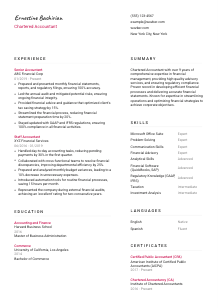
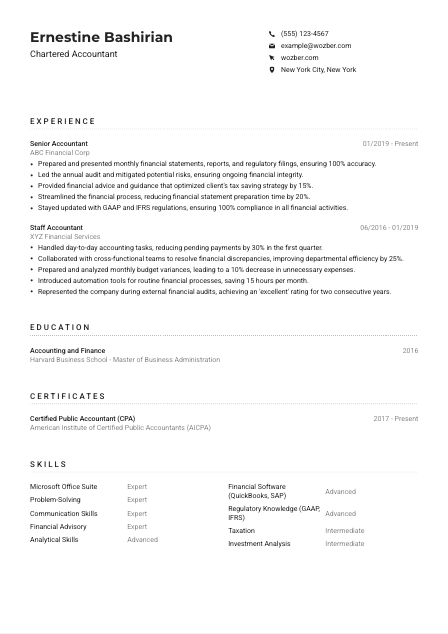
Place "Chartered Accountant" directly under your name when that is the role you are pursuing and you hold the relevant credential. This immediately frames your profile around statutory reporting, audit readiness, and financial advisory work rather than broader accounting support.
List a phone number you answer reliably and a professional email address based on your name. This section should look as orderly as the financial statements you prepare. If your contact details are inconsistent across your resume, LinkedIn, and application portal, it can create unnecessary friction.
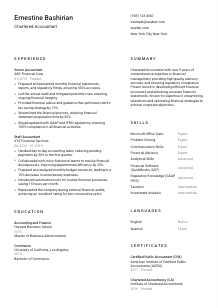
Some Chartered Accountant roles include a location condition because of office attendance, client work, or licensing practicality. If the employer requires New York City presence or relocation, state New York City, New York when accurate, as the example resume does. That removes a basic screening doubt early.
Include LinkedIn or a professional website only if it strengthens your application. For this profession, useful additions might include a complete employment history, finance credentials, publications on accounting topics, or industry affiliations. Keep the information aligned with your resume dates, titles, and certifications.
Do not include age, marital status, photo, or other nonessential identifiers unless a specific market requires them. For most accounting employers, the focus belongs on qualifications, credentials, reporting experience, systems knowledge, and communication ability.
This section should confirm that you are easy to contact, professionally presented, and practically available for the role. For a Chartered Accountant, even the basics should reflect reliability.




This is the section where finance employers look for substance. They want to know what you owned, how close you worked to the numbers, which standards or controls mattered, and whether your work improved reporting quality, compliance, efficiency, or decision-making.
Before writing bullets, identify the work that defines the role. For a Chartered Accountant, that often includes financial statement preparation, audit activity, regulatory filings, advisory support, and process improvement. Use those priorities to decide which achievements deserve space and which older duties can be cut.
List your positions in reverse chronological order with title, employer, and dates. That structure helps the reader follow your progression from transactional accounting into broader reporting, audit ownership, or advisory responsibility. If your title was general, your bullets should clarify the level of work you handled.
Your strongest bullets should show what changed because of your work. In accounting, that could mean cleaner reporting, faster close cycles, stronger audit results, tax savings, fewer discrepancies, or better compliance. The example resume does this well with bullets on monthly financial statements, annual audit leadership, and advisory work that improved tax outcomes by 15%.
Quantify improvements with measures that make sense in finance. Accuracy rates, reduction in preparation time, hours saved through automation, expense reduction, pending payment improvement, or audit outcomes are all stronger than vague claims about being results-driven. Numbers work well here because the profession itself is measured through control, timeliness, and financial impact.
Prioritize experience that reflects reporting, audit, compliance, standards knowledge, internal controls, variance analysis, process streamlining, or financial advice. For example, bullets about GAAP or IFRS compliance and cross-functional resolution of discrepancies are far more useful than generic statements about teamwork. Relevance matters more than volume.
A hiring manager should be able to scan this section and understand your reporting scope, your control over financial accuracy, and the business results tied to your work. That is what makes experience persuasive in chartered accountancy.
Education matters in accounting because it establishes your academic base in finance, reporting, and business principles. Once you have solid professional experience, this section becomes shorter, but it still needs to confirm that you meet the degree expectations tied to the role.
Check the posting for the academic baseline and make sure your education section clearly reflects it. For many Chartered Accountant openings, that means a bachelor's degree in Accounting, Finance, or a related field. If you hold a directly relevant degree, make it easy to find.
List each qualification with degree, field of study, institution, and graduation year if you choose to include dates. Accounting hiring usually values clarity over extra formatting. The reader should be able to confirm your educational background in seconds.
Order your education so the most job-relevant qualification is easiest to see. If you have both an undergraduate degree and a graduate business qualification, lead with whichever better supports the target role. In the example, the MBA adds seniority, while the commerce degree confirms core academic grounding.
If you are early in your career or moving into a more specialized accounting track, selected coursework can help. Focus on subjects like auditing, financial reporting, taxation, corporate finance, or management accounting. For experienced Chartered Accountants, this is usually unnecessary unless the role is highly specialized.
Honors, scholarships, or major academic projects can strengthen this section when they support your finance profile. Use them if they show analytical depth, discipline, or subject expertise. Once your resume is driven by several years of reporting and audit results, keep these details brief.
Your education section should quickly establish that you meet the formal entry requirements for the role. After that, your experience and credentials carry the heavier weight.
For Chartered Accountants, certifications are not an extra polish point. They often determine baseline eligibility. This section should make your standing with recognized bodies immediately clear and show that your professional knowledge is current.
If the role asks for ACCA, CA, CPA, or a similar chartered accountancy certification, those credentials should appear at the top of the section. They are often screened early and should never be buried below unrelated training.
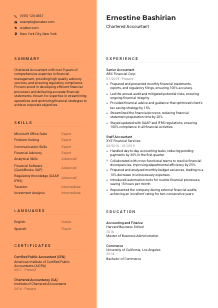
Choose credentials that support the work you want to be hired for, such as audit, financial reporting, taxation, compliance, or advisory services. In the example, CPA and CA both reinforce the candidate's suitability for regulated accounting work. Short courses are fine, but they should not crowd out core professional qualifications.
Show certification dates or active status when relevant. In regulated professions, dates can help the employer understand recency, continuity, and whether your credential is current. This is especially useful when licenses require ongoing standing or continuing professional development.
Accounting standards, filing rules, and audit expectations change. If you have relevant recent certification or continuing education in areas such as IFRS, GAAP updates, tax regulation, or financial systems, include it when it supports the target role. It signals that your technical knowledge is not static.
A well-ordered certificates section tells the reader that you meet the profession's formal standards and stay current with technical requirements. For many Chartered Accountant roles, that clarity is essential.
A Chartered Accountant's skills section should read like a summary of real operating capability. It should cover the tools, technical knowledge, and judgment areas that support reporting accuracy, compliance, analysis, and communication with clients or stakeholders.
Start with the job description and note the systems, knowledge areas, and interpersonal strengths it emphasizes. In this case, accounting software, Microsoft Office, analytical ability, problem-solving, and communication are all explicit. Matching your wording to the role also improves ATS optimization when those skills reflect your actual experience.
List practical tools and technical competencies alongside the judgment skills the role depends on. That may include Excel, ERP or accounting platforms, GAAP or IFRS knowledge, financial analysis, audit support, variance analysis, internal controls, and advisory capability. The example resume uses this balance well by pairing software skills with regulatory knowledge and financial advisory experience.
Do not overload this section with every skill you have used. Put the capabilities most relevant to the position near the top, especially those tied to reporting, compliance, audits, and process improvement. A shorter, sharper list is more useful than a long inventory with little connection to the role.
When this section is tailored well, the employer can quickly see the systems you can work in, the standards you understand, and the analytical and communication strengths you bring to financial reporting and audit environments.
Language ability matters in accountancy when the role involves client contact, written reporting, audit discussion, or coordination across teams. Even when only one language is required, clear communication is part of the job, especially when explaining financial findings or compliance issues.
Some accounting roles explicitly require clear written and spoken English because the work involves reports, meetings, regulatory communication, or client-facing advisory tasks. If that requirement appears in the job description, make sure English is listed with an honest proficiency level.
Start with the language most relevant to the position, then add others that could support client service or cross-border work. For the example role, English belongs first because it is a stated requirement and central to reporting and professional communication.
Extra languages can be useful in firms serving international clients, multilingual teams, or global reporting environments. They are not mandatory for every Chartered Accountant role, but they can add value when they support client relationships or regional business activity.
Keep proficiency descriptions standardized so the reader can interpret them quickly.
If the employer serves multinational clients or operates across jurisdictions, language skills can strengthen your profile. If the role is primarily domestic and English-led, keep this section concise and let your accounting credentials and experience do most of the work.
This section should confirm that you can communicate clearly in the settings the role demands, whether that means financial reporting in English or relationship management across a broader client base.
Your summary should tell the reader, in a few lines, what level of Chartered Accountant you are and where your value sits. Focus on reporting scope, audit or compliance exposure, advisory strength, and the kind of operational improvements or financial outcomes you have delivered.
Before writing, look for repeated themes in the job description. For Chartered Accountant roles, that often means financial statements, audits, regulatory compliance, software proficiency, and communication. Build your summary around the two or three areas where your background is strongest.
Start with a direct line that establishes your credential and depth of experience, such as "Chartered Accountant with 9 years of experience in financial reporting, audit support, and advisory services." This gives the employer immediate context and helps separate you from more junior accounting candidates.
After the opening line, include a small number of high-value strengths backed by outcomes. The example summary points to regulatory compliance, process improvement, and accurate financial statements, which align well with the job's core responsibilities. Keep the focus on areas that matter in finance operations, not broad personality traits.
Aim for a concise paragraph of two to four sentences. Every phrase should earn its place by clarifying your accounting scope, standards knowledge, systems fluency, or business impact. Avoid generic claims about being hardworking or passionate when you could mention audit success, reporting accuracy, or efficiency gains instead.
When written well, your summary tells the reader almost immediately whether you belong in a Chartered Accountant shortlist. It should position your experience with enough precision that the rest of the resume feels consistent and credible.
You now have a clear framework for presenting yourself as a Chartered Accountant with the right mix of reporting experience, certification, systems knowledge, and measurable results. Wozber's free resume builder helps turn that information into a structured, ATS-compliant resume that reflects the language employers use in accounting and audit hiring.
As you finalize your application, check that each section supports the same professional story, from credentials and financial reporting scope to audit work, compliance knowledge, and communication strength. An ATS-friendly resume template paired with Wozber's ATS resume scanner can help you tighten alignment before you apply, so hiring teams can quickly judge your readiness for the role.