



Use Wozber and land your dream job
Create Resume
No registration required
Crafting portfolios, but your resume doesn't show the dividends? Check out this Certified Financial Planner resume example, created with Wozber free resume builder. Learn how to present your financial wisdom and planning prowess to match job needs, making your career path as rewarding as those investment returns!
Financial planning work gets judged in the real world by how well you turn complex numbers, risk tradeoffs, and life goals into advice a client can trust and act on. Your resume needs to show that same standard. Hiring teams want to see more than general finance experience. They look for proof that you can build tailored plans, review portfolios over time, explain tax and investment choices clearly, and manage relationships with the judgment expected of a Certified Financial Planner.
A tailored resume changes how quickly your client advisory background comes into focus, especially when employers are sorting candidates with an ATS before a human review. Using Wozber's free resume builder makes it easier to align your wording with the posting, keep an ATS-friendly resume format, and surface the planning, portfolio, and client communication work that matters first.
For a Certified Financial Planner, the header should read like a clean client-facing profile. Keep it simple, accurate, and aligned with practical hiring requirements so the employer can confirm who you are, how to reach you, and whether you meet any location expectations right away.
Use your full name in the most prominent text on the page so it is easy to identify in both ATS records and recruiter review. In a profession built on trust and long-term client relationships, a clean presentation matters. Skip nicknames or decorative formatting and keep it consistent with your LinkedIn profile and licensing records.
Place "Certified Financial Planner" under your name when that is the role you are targeting and the credential you hold. This creates an immediate connection between your profile and the opening. If your recent title was "Lead Financial Planner" or "Financial Advisor," you can still use the target title here when it accurately reflects your qualifications and CFP status.
List a current phone number and a professional email address, ideally in a simple format such as firstname.lastname@email.com. Accuracy is especially important in advisory hiring, where attention to detail is part of the job. A broken number or casual email undercuts the polished, dependable impression expected in wealth management and financial planning.
If the employer asks for a specific location, show that requirement is covered in your header. For this opening, listing New York City, New York makes the match easy to spot. If you are relocating, state that clearly elsewhere in your application materials so there is no doubt about your availability.
Include LinkedIn or another professional profile if it reinforces your advisory background, certifications, network, or thought leadership. For planners, this can be useful when it reflects client service experience, industry affiliations, or consistent career progression. Just make sure the information matches your resume, including titles, dates, and credentials.
Your header should remove friction, not add it. When the personal details are clean and role-aligned, the hiring team can move straight to your planning experience, credentials, and client advisory results.




This is the section where planning work becomes concrete. Employers hiring Certified Financial Planners look for a record of client advice, portfolio oversight, risk analysis, and measurable business results, not broad statements about being passionate about finance.
Break the description into the actual work the employer needs covered. For this role, that includes building personalized financial plans, reviewing portfolios, recommending investment and risk strategies, educating clients, and coordinating with lawyers or accountants. Those priorities should shape which accomplishments you choose and the language you use to describe them.
List your most recent role first, then work backward with job title, firm name, and dates. That structure helps employers track your progression from advisory or analyst-level work into fuller client planning responsibility. In this field, growth in client complexity, assets advised on, or leadership scope is often as important as years of experience alone.
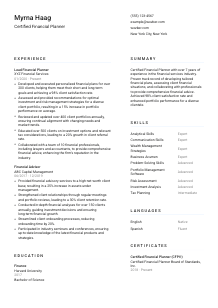
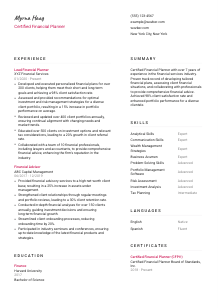
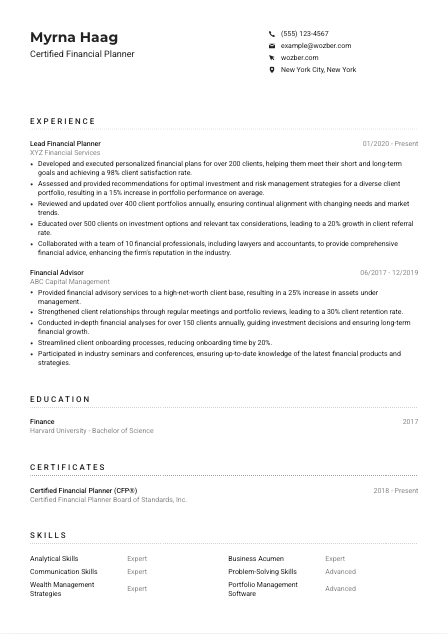
Each bullet should show what you handled and what changed because of your work. Strong examples in this profession mention client volume, portfolio performance, retention, referrals, assets under management, or review cadence. The sample resume does this well with points like developing financial plans for more than 200 clients and reviewing over 400 portfolios annually, which gives real scale to the work.
Not every finance accomplishment belongs here. Emphasize work tied to financial planning, wealth management, risk assessment, tax-aware guidance, portfolio reviews, and client education. If you have broader finance experience, frame only the parts that support a planner's responsibilities, such as translating analysis into recommendations clients could act on.
Metrics make your experience more credible when they fit the profession. Useful examples include client satisfaction, portfolio growth, assets under management, referral rates, retention, review volume, and onboarding efficiency. A line such as "increased portfolio performance by 15% on average" or "raised referral rate by 20%" works because it ties your advice to client and business outcomes the firm actually cares about.
By the end of your experience section, an employer should understand the kind of clients you advised, the financial decisions you influenced, and the results your planning work produced. That is the core of your value as a Certified Financial Planner.
Education matters here because it confirms the technical base behind your advice. For financial planning roles, employers usually want to see a finance, business, or closely related degree presented clearly and without extra clutter.
When a posting asks for a bachelor's degree in Finance, Business, or a related field, list that information clearly and exactly. If your degree is a direct match, such as a Bachelor of Science in Finance, that alignment should be visible at a glance rather than buried in extra detail.
Use school name, degree, field of study, and graduation year or date. That is usually enough for an experienced planner. Simple formatting helps both ATS parsing and recruiter review, especially when the employer is checking whether you meet minimum education requirements before moving on to experience and credentials.
Generic labels such as "Bachelor's degree" leave out useful information. Naming the exact degree shows direct preparation for work involving portfolio strategy, tax considerations, risk assessment, and client recommendations. In the sample resume, "Bachelor of Science" and "Finance" make the academic match explicit.
Most experienced CFP candidates do not need a course list. Recent graduates or career changers may benefit from including subjects such as investments, retirement planning, taxation, estate planning, or financial analysis if that helps connect their education to advisory work. Use this selectively and only when it adds real relevance.
Academic honors, research, or finance-related projects can help if they reinforce analytical ability or commitment to the field. This is most useful early in your career. Once you have several years of planning or wealth management experience, those details should stay secondary to client results and professional credentials.
Your education section should quickly confirm that you have the academic foundation expected for client planning work. Clear degree information keeps the focus where it belongs, on your CFP credential and advisory experience.
For a Certified Financial Planner, certifications are not a side note. They are a central part of professional credibility, especially when the role directly requires CFP status and the work involves client trust, fiduciary standards, and regulated financial advice.
If the job calls for the Certified Financial Planner designation, place it prominently and list the full certification name. This is one of the first things a hiring manager will look for because it separates licensed, qualified planning candidates from broader finance applicants. In this case, the CFP designation is essential, not optional.
If you hold multiple credentials, prioritize the ones that strengthen your position for financial planning and wealth management work. Certifications tied to investments, retirement planning, tax strategy, or fiduciary advice are usually more useful here than unrelated finance credentials. A shorter, relevant list is easier to scan and more persuasive.
Include the issuing body and the date earned, renewal period, or active range where appropriate. For CFP holders, current standing matters because it reflects ongoing professional requirements and continuing education. The sample format of "2018 - Present" works well when it accurately reflects an active credential.
Financial planning changes with tax law, market conditions, retirement rules, and product design. If you are pursuing continuing education or maintaining additional planning-related credentials, that can reinforce your commitment to current, compliant advice. Keep the wording factual and tied to the advisory value it adds.
Your certifications section should make your professional standing unmistakable. For CFP roles, that means the employer can immediately confirm you hold the credential, keep it current, and bring up-to-date planning knowledge to client conversations.
A Certified Financial Planner needs a skill section that mirrors how the job is actually done. Focus on abilities that support client planning, portfolio decisions, risk conversations, and coordination with other professionals rather than filling the page with broad business buzzwords.
Start with the capabilities the employer names or clearly implies. For this opening, that includes analytical thinking, problem-solving, interpersonal communication, financial planning, investment recommendations, and risk management. Matching your skills to that language helps both ATS alignment and human review while keeping the list grounded in real work.
Lead with the planning and advisory abilities most tied to day-to-day performance. Skills such as wealth management strategies, risk assessment, investment analysis, tax planning awareness, and client communication belong near the top because they reflect the actual services a CFP delivers. The sample resume's mix of analytical skills, wealth management strategies, and risk assessment is a good model for prioritization.
Group skills in a way that is easy to scan, and avoid padding the section with every finance term you know. A tighter list reads better and carries more weight. If you use proficiency labels, make sure they are believable and consistent with your experience. Employers will compare this section against your portfolio reviews, client planning work, and accomplishments elsewhere in the resume.
This section should reinforce the practical toolkit behind your client work. When the skills are relevant and well ordered, they support the picture already built by your experience and credentials.
Language ability matters in financial planning because much of the work depends on clear explanations, careful listening, and client confidence. Present languages in a way that supports the communication demands of the role without overstating their importance when they are not central to the opening.
If the posting requires strong English fluency, place English first and state your level clearly. That is especially important for a role involving client meetings, financial education, and coordination with attorneys and accountants. Hiring teams need to know you can explain investment options, risks, and tax considerations precisely.
Additional languages can be a real advantage in wealth management, especially in diverse markets or family-office settings where trust and nuance matter. If you speak another language fluently, include it. In the sample resume, Spanish adds credible value because it suggests the ability to serve a wider client base.
Use clear labels such as "Native," "Fluent," or "Professional Working Proficiency" rather than vague claims. Financial conversations involve technical terms, suitability discussions, and sensitive personal details, so precision matters. Employers should be able to understand your likely communication range from this section alone.
If multilingual communication has supported onboarding, relationship management, or client education in past roles, that context can strengthen the value of this section. Do not overstate it if the role is primarily English-speaking, but do show where language skills improve service for households with varied backgrounds or cross-border needs.
For planners, language skills matter most when they help clients understand recommendations and stay engaged with the plan. Present them as part of your client-facing capability. That framing is stronger than listing languages simply as personal attributes.
Your language section should confirm that you can communicate clearly in the required language and, where relevant, serve a broader client base with the same clarity and professionalism.
The summary sits at the top of the resume, so it needs to establish your planning background in a few lines with enough detail to be credible. For a Certified Financial Planner, that usually means years in advisory work, the kind of planning you handle, and one or two results that show client and portfolio impact.
Start by identifying the planning responsibilities that define the opening, then reflect those in your first few lines. Here, that means personalized financial plans, portfolio reviews, investment and risk guidance, client education, and cross-functional collaboration. Your summary should sound like an active planner who has done this work, not a finance professional speaking in broad terms.
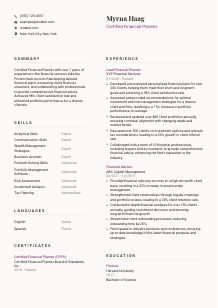
Lead with your professional identity and years of experience. A line like "Certified Financial Planner with 7+ years of experience in financial planning and wealth management" immediately gives the reader scope, credential, and career level. It is efficient and fits how this profession is screened.
Follow with capabilities that connect directly to business and client results. You might mention tailored financial plans, portfolio alignment, tax-aware recommendations, or collaboration with lawyers and accountants. The sample summary works because it pairs core planning work with measurable credibility, including a 98% client satisfaction rate and stronger portfolio performance.
Aim for a short paragraph that can be read in seconds. Three to five lines is usually enough. Every phrase should earn its place by clarifying your advisory scope, client impact, or specialization. Save extra detail for the experience section, where you can back it up with numbers and context.
After reading your summary, an employer should already understand that you are a qualified CFP with relevant client planning experience and a record of delivering results. That gives the rest of the resume a clear frame.
A well-tailored Certified Financial Planner resume should now show three things clearly: you hold the right credential, you can manage real client planning work, and your advice produces measurable outcomes across portfolios, relationships, and long-term goals.
Use Wozber's free resume builder, ATS-friendly resume template, and ATS resume scanner to align your content with the posting, strengthen ATS optimization, and present your experience in a format hiring teams can review quickly. The final resume should make your readiness for client-facing financial planning easy to judge.