



Use Wozber and land your dream job
Create Resume
No registration required
Uncovering financial mysteries, but your resume feels classified? Audit this Internal Auditor resume example, created with Wozber free resume builder. Learn how to align your analytic acumen and risk assessment expertise with job specifications, positioning your career for more transparent growth!
Internal audit work sits at the intersection of risk, controls, compliance, and business operations. Hiring teams want to see whether you can move beyond checking boxes to planning audits, testing controls, spotting process gaps, and turning findings into practical recommendations that departments will actually act on.
When that experience is tailored well, the resume quickly separates pure accounting backgrounds from candidates who can run audit engagements and communicate across finance, operations, and IT. Wozber's free resume builder helps organize that story in an ATS-friendly resume format, so terms like internal controls, compliance, audit programs, and external audit coordination are easy to read and easy to match to the role.
For Internal Auditor roles, the header needs to confirm the basics fast: who you are, what role you are targeting, and whether any logistical requirement is already covered. Keep it clean and factual so the reader can move straight to your audit background.
Place your full name at the top in a clear, readable format. This is simple, but it matters. Audit hiring often involves several reviewers across finance or compliance, and a cluttered heading creates friction before they reach your experience.
Put "Internal Auditor" directly under your name when that is the role you are pursuing. Matching the target title helps frame the rest of the resume correctly, especially if your previous titles include variations such as Internal Audit Associate or Senior Internal Auditor.
List a reliable phone number and a professional email address. Small errors here can stall an interview request, and in a profession built on accuracy and attention to detail, even your contact section should feel precise.
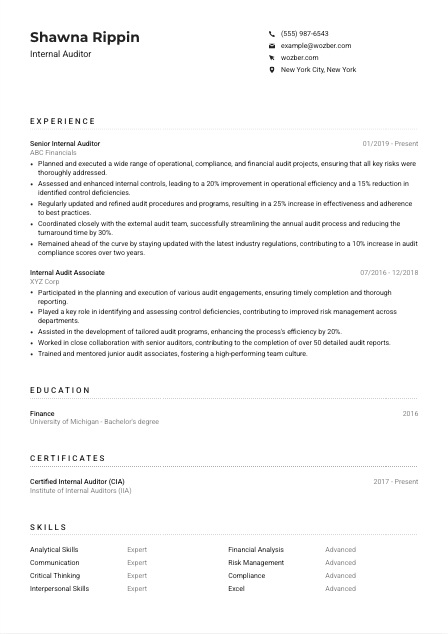
If the job posting includes a location requirement, show it clearly in your header. In this example, New York City, New York belongs in the personal details because it removes an immediate screening question without taking space away from your audit work.
Add LinkedIn or another professional profile only if it supports your candidacy. Make sure the titles, dates, certifications, and audit scope match your resume. For Internal Auditors, inconsistency between platforms can raise avoidable questions about reporting lines, credentials, or engagement history.
Your personal details should confirm role focus and logistical fit in seconds. Once that is clear, the hiring team can spend their attention where it matters most: your audit scope, control work, and business impact.




This section carries most of the decision weight for Internal Auditor hiring. Reviewers look for the kinds of audits you handled, the controls you assessed, the functions you worked with, and the business improvements that came from your findings.
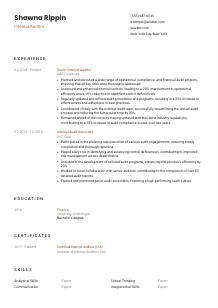
Read the posting line by line and extract the work themes that should appear in your bullets. Here, that includes planning and executing operational, financial, compliance, and IT-related audits, assessing internal controls, updating audit programs, coordinating with external auditors, and keeping current with regulatory change. Those priorities should shape how you describe past roles.
List your most recent audit role first, then work backward. Internal audit hiring usually places more weight on current scope than older accounting tasks, so lead with the position that best reflects your present level of ownership, whether that means leading engagements, reporting findings, or supporting annual audit activity.
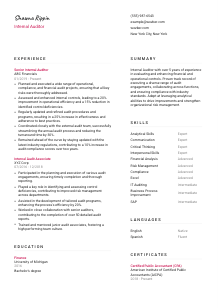
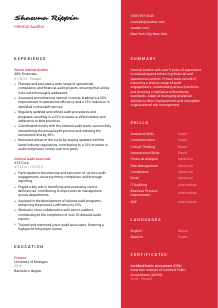
Each bullet should show what you audited, what you evaluated, and what improved. The example resume does this well by tying internal control work to a 20% improvement in operational efficiency and a 15% reduction in control deficiencies. That kind of phrasing tells the reader you did more than complete testing. You influenced process quality.
Quantify outcomes with measures that make sense in audit and controls work: reduction in deficiencies, faster audit cycle time, improved compliance scores, stronger adherence to procedures, or the number of audit reports completed. The sample's 30% faster annual audit turnaround and 25% increase in audit-program effectiveness are good models because they connect directly to audit execution.
Keep bullets focused on risk assessment, control evaluation, audit planning, reporting, remediation support, cross-functional coordination, and similar work. If an accomplishment does not help show your value in internal audit, shorten it or remove it. Space is better used on evidence that you can handle the engagement types and control environment the employer cares about.
A hiring manager should be able to scan your experience and picture you planning an audit, testing controls, reporting findings, and working with stakeholders on follow-up actions. That is the level of clarity this section needs to deliver.
Education is usually a checkpoint section for Internal Auditor roles, but it still matters. The degree should confirm that you have the accounting, finance, or related foundation needed to understand controls, reporting, and risk frameworks.
If the job asks for a bachelor's degree in Accounting, Finance, or a related field, make that easy to verify. A Finance degree, like the one in the example, directly supports the requirement and should be listed without extra wording or buried details.
Present school, degree, field of study, and graduation year in a clean order. This keeps the section easy to review for recruiters, audit leaders, and ATS systems scanning for education requirements.
Lead with the degree and field when they align closely with the role. For Internal Auditor positions, accounting, finance, business, and related disciplines carry the most weight because they support work involving internal controls, financial processes, and compliance review.
If you are early in your career, relevant coursework in auditing, financial reporting, information systems, or risk management can help fill out the profile. Once you have several years of audit experience, that space is usually better spent elsewhere.
Honors, leadership roles, or academic projects are worth mentioning only when they add something relevant, such as analytical rigor, process review, or finance-related work. Keep the section lean if your professional audit record already carries the application.
Your education section does not need to do heavy lifting, but it should remove doubt. Once the degree requirement is covered, the rest of the resume can focus on audit execution and control insight.
Professional certifications carry real weight in internal audit because they signal technical grounding and commitment to standards. When a posting mentions CIA or CPA, that is a direct invitation to feature those credentials prominently.
If you hold the CIA or CPA, list it clearly and make sure it is easy to find. In the example, both certifications are included, which immediately reinforces professional standing for a role that values internal audit and accounting credibility.
Focus on certifications that support internal audit, controls, compliance, accounting, risk, or related governance work. A shorter, more targeted list is stronger than a broad collection that does not sharpen your fit for audit engagements.
Include the year earned or active date range when useful. That helps confirm the credential is current and gives context for your professional development, especially for certifications that require maintenance or continuing education.
Internal audit changes with regulation, technology, and business processes. Additional training in IT audit, fraud, SOX, data analysis, or risk management can strengthen your resume when those areas match the target role, especially if the audit function spans financial and operational reviews.
Relevant credentials tell the reader that you understand the discipline behind the work. For Internal Auditor roles, they can quickly reinforce trust in your judgment, standards awareness, and technical foundation.
The skills section should reflect how Internal Auditors actually operate. That means balancing analytical ability with control knowledge, reporting judgment, and the communication needed to work across departments when findings affect processes, policies, or systems.
Pull the explicit skills from the job description first. In this case, analytical ability, problem-solving, critical thinking, communication, and interpersonal skills all belong on the shortlist because they directly reflect how the employer describes the work.
Use wording that matches the posting when it reflects your real strengths, then support it in your experience section. If you claim compliance, risk management, or IT auditing, your bullets should show the audits, control reviews, or process improvements that make those skills credible.
Choose a concise set of skills that covers both technical and interpersonal demands. For Internal Auditor roles, that often includes internal controls, audit planning, compliance, financial analysis, risk assessment, report writing, stakeholder communication, Excel, and sometimes ERP or audit-related systems such as SAP. The sample handles this well by combining core audit judgment with business process improvement and IT audit exposure.
A well-built skills section should confirm the kind of audit work you can step into immediately. Keep it aligned with your actual experience, and let the rest of the resume prove the depth behind each item.
Internal Auditors spend a large part of the job interviewing stakeholders, documenting findings, and writing reports that need to hold up under scrutiny. Language proficiency matters most when it affects clarity in meetings, documentation, and cross-functional communication.
If the role requires fluency in English, state your level plainly. For audit work, this is about more than conversation. It supports walkthroughs, report writing, exception documentation, and discussions with management or external auditors.
Additional languages can help if the company operates across regions or if audit work involves multinational teams, shared service functions, or cross-border process reviews. They are a useful secondary strength, not a substitute for core audit capability.
Choose straightforward labels such as Native, Fluent, Professional, or Basic. Clear language ratings are especially important in roles where precision matters, because overstatement can quickly become visible during interviews or written assessments.
If you have worked with global teams, mention languages that supported that work. In some audit functions, multilingual ability helps when reviewing regional documentation, interviewing local process owners, or supporting audits across business units.
Language skills can add range to your profile, but they should stay secondary to audit experience, certifications, and control work. Include them as an extra layer of capability, not as the center of the resume.
For Internal Auditor roles, languages matter when they improve communication, reporting, and collaboration. Present them clearly, then keep the main focus on your audit judgment and execution.
The summary should give a quick, credible read on your audit background before the reviewer reaches the detailed sections. It works best when it identifies your level, your audit scope, and the kinds of improvements or risk outcomes you are known for.
Start with a direct line that states your role and experience, such as Internal Auditor with 5+ years of experience in operational, financial, and compliance audits. This tells the reader immediately whether your background matches the opening.
Use a few job-aligned terms naturally, especially if the role emphasizes internal controls, audit engagement execution, regulatory awareness, or cross-department collaboration. This improves both ATS alignment and the human reader's understanding of your fit.
Summaries become more persuasive when they include a result tied to audit work. The example summary points to evaluating and enhancing financial and operational controls, and that could be sharpened further with outcomes such as reduced deficiencies, stronger compliance, or improved audit efficiency.
Aim for three to four lines, not a paragraph of broad claims. Internal audit summaries work best when they sound measured and informed, with enough detail to establish scope without repeating every skill or certification listed below.
Your summary should frame the rest of the resume in a few disciplined lines. When it is done well, the hiring team already knows what kind of audits you handle and what sort of control impact to expect from your experience.
A solid Internal Auditor resume makes it easy to see your audit coverage, control expertise, reporting strength, and ability to work across departments on remediation and risk issues.
Use Wozber's AI resume builder to refine wording, strengthen ATS optimization, and present your experience in an ATS-compliant resume that matches the role's language without forcing keywords.
Before you apply, scan for one final question: does this resume clearly show that you can plan audits, evaluate controls, report findings, and help the business improve? That is the hiring decision your resume should support.




