




Use Wozber and land your dream job
Create Resume
No registration required
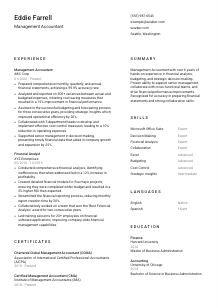
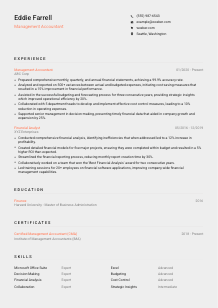
Balancing spreadsheets, but your resume doesn't add up? Check out this Management Accountant resume example, built with Wozber free resume builder. Learn how to clearly communicate your financial acumen to match job goals, keeping your career ledger consistently in the black!
Management accounting sits close to business decisions, not just month-end reporting. Hiring teams want to see whether you can turn financial statements, variance analysis, and budget data into clear recommendations that department leaders can actually use. Your resume should make that commercial judgment visible, not bury it under generic accounting duties.
When the wording mirrors the target role, it becomes much easier to surface the right mix of reporting accuracy, forecasting support, cost control work, and cross-functional communication in an ATS-compliant resume. Wozber's free resume builder helps you align that language cleanly while keeping the structure ATS-friendly, so the reader can quickly see whether your background fits the level and scope of management accounting work they need.
Management Accountant hiring starts with practical checks. Before anyone reads your forecasting wins or reporting accuracy, they need to confirm that your identity, title, contact details, and any location requirement are easy to find and professionally presented.
Use your full name in a larger, clean font so it stands apart from the rest of the document. For accounting roles, a straightforward presentation works best. It reflects the same clarity expected in financial reports, board packs, and monthly management accounts.
Place "Management Accountant" directly under your name when that is the role you are pursuing. This immediately positions your background in the right lane, especially when your earlier titles include adjacent roles such as Financial Analyst, Cost Accountant, or Finance Business Partner.
Add one reliable phone number and a professional email address, ideally based on your name. If you include a website or LinkedIn profile, make sure the content supports your resume with matching dates, titles, and achievements such as budgeting, reporting, or cost analysis work.
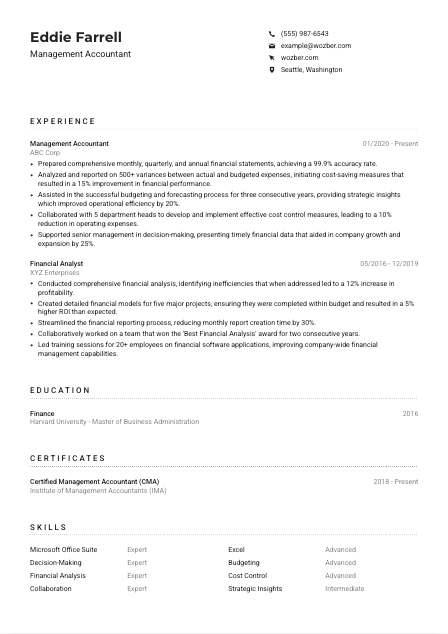
If a job requires you to be in a certain city or open to relocation, state that in your contact section. In the example, listing Seattle, Washington answers the employer's location requirement immediately and removes a basic point of doubt before the resume moves into technical qualifications.
A polished LinkedIn profile can strengthen your application when it expands on your finance background, systems exposure, or certification history. Keep it consistent with the resume. If your profile says you lead budgeting cycles, variance reviews, or Excel-based reporting, those themes should also appear in your core resume content.
This section should confirm that you are reachable, professionally presented, and logistically viable for the role. For a Management Accountant, that kind of precision is a useful first signal in itself.




Experience carries the most weight on a Management Accountant resume because it shows how you handle reporting cycles, budget discipline, and commercial support in real operating environments. Hiring managers are looking for proof that you can produce accurate numbers, explain them, and help leaders act on them.
Start by identifying the recurring work named in the posting. For this role, that includes preparing monthly, quarterly, and annual financial statements, analyzing budget variances, supporting forecasting, working with department heads on cost control, and supplying management with timely financial insight. Those themes should be visible across your recent positions, especially in your bullet points.
List jobs in reverse chronological order with title, company, and dates. Lead with the positions closest to management accounting work. A hiring manager should be able to trace your progression from general financial analysis into ownership of reporting, budgeting, and business support without hunting through dense paragraphs.
Each bullet should show what you produced, what you analyzed, or what changed because of your work. The example does this well with lines such as preparing financial statements at 99.9% accuracy and analyzing 500+ variances that led to a 15% improvement in financial performance. That kind of phrasing shows both technical execution and business effect.
Numbers matter here because management accounting is measured through accuracy, timeliness, savings, efficiency, and decision support. Useful metrics include reporting cycle time, forecast accuracy, budget size, variance volume, operating expense reduction, profitability improvement, or the number of departments supported. Choose figures that reflect how finance performance is actually tracked in your environment.
If you have broader finance experience, lead with bullets tied to management reporting, planning, variance analysis, and cost control before more general duties. The sample resume includes earlier Financial Analyst work, but the stronger bullets are the ones connected to financial models, process improvements, and profitability outcomes because they support the move into a Management Accountant role.
Your experience should show that you do more than close books or compile reports. It should show that you can interpret financial performance, work with operational stakeholders, and help management make better decisions.
For Management Accountant positions, education usually establishes that you have the accounting or finance foundation to handle reporting standards, budgeting logic, and analytical work. Keep this section straightforward, but make sure it reflects the level and field the employer asked for.
If the posting asks for a bachelor's or master's degree in Finance, Accounting, or a related field, make that connection obvious. Degrees in accounting, finance, business administration with a finance concentration, or similar disciplines should be listed clearly so the requirement is easy to confirm.
Present each entry with degree, field of study, school, and graduation year. Reverse chronological order is usually best. In the example, an MBA in Finance followed by a bachelor's in Accounting gives the employer a quick read on both advanced study and core accounting training.
Do not hide Accounting or Finance inside a long degree title. These fields are directly relevant to management accounting work, so they should stand out on the page. That is especially useful when ATS parsing or a quick human scan is looking for education that supports financial analysis and reporting responsibilities.
If you are earlier in your career, relevant coursework, honors, or academic projects in cost accounting, managerial finance, budgeting, forecasting, or financial modeling can add useful depth. If you already have several years of management accounting experience, keep this section lean and let your professional results carry more of the weight.
Short courses, executive education, or technical training in topics such as Excel modeling, ERP reporting, data analysis, or management accounting methods can be worth including when they sharpen your relevance. This is most useful when the role places noticeable emphasis on financial systems or advanced reporting support.
Your education section should confirm that your financial training matches the role's baseline requirements. Once that is clear, the rest of the resume can focus on how you have applied that knowledge in reporting, forecasting, and cost management.
Professional certifications carry real weight in management accounting because they signal deeper training in analysis, performance management, and decision support. When a posting names CMA or CGMA as preferred, that is worth addressing directly and prominently.
If the employer mentions CMA or CGMA, place those credentials in your certifications section exactly as recognized by the issuing body. This helps both ATS matching and human review. In this job description, either designation supports the employer's preference for formal management accounting credentials.
List certifications that strengthen your position for budgeting, reporting, cost analysis, and strategic finance support. A shorter list of directly relevant credentials is stronger than a long list of unrelated courses. In the example, CMA and CGMA both reinforce the candidate's positioning for a management accounting role.
Include the issuer and the active date or validity period where appropriate. This matters in fields where employers want to know whether a credential is current and maintained. Clear dates also help avoid confusion when certifications require continuing professional education.
If you are actively pursuing a respected accounting or finance credential, you can include it when the progress is real and recent. Keep the wording accurate, such as expected completion or current candidate status. This can help when a role prefers certification but does not strictly require it.
Relevant certifications back up your technical credibility and show long-term commitment to the discipline. For Management Accountant roles, they can meaningfully strengthen your profile when your experience already supports the core work.
A Management Accountant's skills section should read like a working toolkit, not a personality list. Employers want to see the systems, analysis capabilities, and business-facing strengths that support accurate reporting and better financial decisions.
Start with the explicit requirements. Here, that includes accounting software, Microsoft Office Suite, especially Excel, effective communication with cross-functional teams, and the ability to present financial information to non-financial audiences. Those are concrete prompts for what belongs in your skills section.
Include hard skills such as Excel, budgeting, forecasting, variance analysis, financial statement preparation, cost control, ERP or accounting systems, and financial modeling when they reflect your background. Then pair them with soft skills that matter in this profession, such as collaboration, stakeholder communication, and decision support. The sample's mix of Excel, financial analysis, cost control, collaboration, and decision-making is directionally strong because it reflects both the analytical and partnering sides of the job.
Use a clean format and avoid overloading the section with every finance term you know. Prioritize skills you can support elsewhere in the resume with actual examples. If you claim advanced Excel, your experience section should show reporting automation, model building, reconciliations, or variance work that makes that rating believable.
The skills section should quickly confirm that you can handle the tools, analysis, and communication expected in management accounting. Relevance matters more than quantity.
Language skills matter in accounting when the role involves reporting, presentations, or collaboration across teams and regions. Even when English is the only required language, listing language proficiency can still help clarify your communication range.
If the posting requires clear written and spoken English, include English with an accurate proficiency level. This role asks candidates to express ideas clearly in English, which matters because management accountants often explain variances, budgets, and performance results to non-finance stakeholders.
After English, add any other languages you can use professionally. Extra languages are especially helpful in multinational companies, regional finance teams, or environments where management reports and stakeholder communication cross borders. In the example, Spanish adds breadth, though it is a bonus rather than a core requirement.
Choose clear levels such as Native, Fluent, Advanced, Intermediate, or Basic. Accurate labels matter because language skill in finance is often practical. Can you explain a budget variance in a meeting, review documents, or support cross-border reporting without confusion?
Do not overstate the importance of languages if the job is primarily domestic and English-based. Include them, but keep the emphasis aligned with the actual work. For most Management Accountant applications, this section supports the resume rather than drives it.
If you have worked with international entities, shared service centers, global reporting cycles, or overseas stakeholders, language skills become more relevant. In those cases, they help explain how you manage communication around financial results across different business contexts.
Languages can strengthen your profile when they support reporting, stakeholder communication, or multinational finance work. Keep the claims accurate and tied to how you actually operate in a professional setting.
The summary is where you establish your level, specialty, and business value in a few lines. For a Management Accountant, that usually means combining years of experience with core strengths in reporting, budgeting, variance analysis, cost control, and management support.
Before writing, identify the themes that consistently show up in your experience. That might be management reporting, forecasting, variance analysis, process improvement, or helping operational leaders understand financial performance. Use those strengths to shape the direction of the summary instead of writing a generic introduction.
Your first line should quickly establish who you are professionally. A formula such as "Management Accountant with 6+ years of experience in financial reporting, budgeting, and variance analysis" works because it gives the reader level and focus immediately. The example summary does this well by leading with experience and hands-on finance scope.
Bring in the themes the employer cares about most, such as financial statement preparation, budget-to-actual analysis, cost control, forecasting support, and presenting financial insights to leadership. Keep the wording natural. You are aiming for alignment, not a pasted keyword block.
Three to five lines is usually enough. Use the space to connect your accounting work to business outcomes such as stronger financial performance, improved efficiency, faster reporting, or better management decisions. A brief summary that mentions accuracy, collaboration with department heads, and support for senior leadership will usually land better than a long paragraph full of broad claims.
Your summary should give the reader a fast, credible picture of your management accounting scope and the kind of decisions your work supports. If it is tailored well, the rest of the resume reads with the right context from the start.
A Management Accountant resume should make three things easy to see: the quality of your financial reporting, the depth of your budgeting and variance analysis work, and your ability to turn numbers into useful guidance for non-financial leaders.
Use Wozber to build an ATS-friendly resume format, align your wording with the job description, and strengthen section-by-section ATS optimization without losing the professional tone finance hiring expects.
Once the resume clearly shows your reporting accuracy, cost control impact, forecasting support, and communication range, you are presenting the kind of profile employers can evaluate with confidence.




