




Use Wozber and land your dream job
Create Resume
No registration required
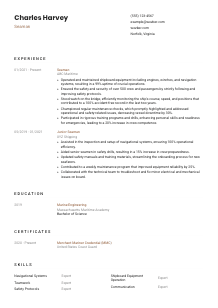
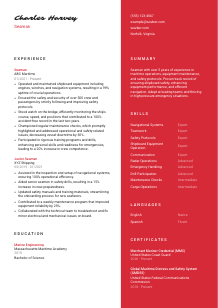
Sailing the high seas, but your resume feels adrift? Navigate this Seaman resume example, created with Wozber free resume builder. Learn how to anchor your maritime experience to match the job's port of call, keeping your career as steady as the North Star!
Life aboard a vessel runs on discipline, situational awareness, and equipment reliability. A seaman resume needs to show that you can keep operations steady, follow safety procedures under pressure, and handle bridge watch or deck duties without creating risk for the crew, passengers, or cargo.
On maritime resumes, tailoring quickly clarifies whether your sea time, credentials, and onboard work match the vessel's operating needs. Wozber's free resume builder helps you align your wording with the posting, keep the document in an ATS-friendly resume format, and surface the experience that matters first, such as watchstanding, maintenance checks, radar use, and emergency readiness.
For seafaring roles, the contact section does more than identify you. It confirms practical details that can affect deployment, credential review, and whether a hiring team can move you forward without extra back-and-forth.
Use your full name in a clean, readable style at the top of the page. Maritime employers often review many resumes for licensed and unlicensed crew positions, so your header should be quick to scan and look professional from the first line.
Place "Seaman" directly under your name if that is the position you are pursuing. This immediately connects your resume to the opening and helps distinguish you from adjacent profiles such as deckhand, ordinary seaman, or junior engineer.
List a reliable phone number and a professional email address you check regularly. If you include a website or profile, make sure it supports your maritime background with relevant sea service, licenses, or vessel experience rather than unrelated material.
Some employers need candidates who can report from a specific port or region. Here, being based in Norfolk, Virginia is a stated requirement, so listing Norfolk, Virginia in your personal details removes an immediate screening obstacle.
A profile link can strengthen your application if it includes useful maritime information, such as certifications, vessel assignments, or technical training. Skip it if it is incomplete or does not add anything beyond what your resume already shows.
This section should answer the first operational questions fast: who you are, what role you are targeting, how to reach you, and whether you meet any location requirement. Keep it clean and accurate so the review can move quickly to your sea time and onboard responsibilities.




Maritime hiring teams look closely at what you actually handled onboard. Your experience section should show vessel operations, maintenance discipline, watchstanding, emergency participation, and the kind of reliability that keeps a ship running safely.
Start by marking the duties the employer repeats or makes specific. For this opening, those include operating shipboard equipment, standing watch on the bridge, following safety protocols, reporting issues, and joining drills. Use those priorities to shape which accomplishments you lead with and how you phrase them.
List your jobs in reverse chronological order. For each one, include your title, employer, and dates. If helpful, your bullets can also indicate the scope of work, such as equipment maintained, type of watchstanding performed, or the scale of crew or passenger operations you supported.
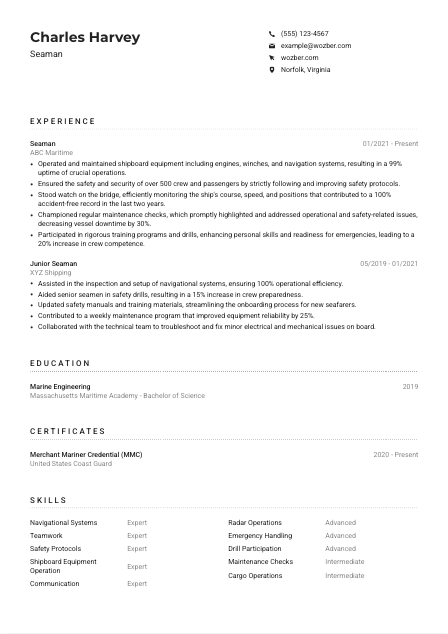
A seaman resume reads best when each bullet connects a shipboard responsibility to a concrete outcome. The sample does this well with lines about maintaining engines, winches, and navigation systems while supporting 99% uptime, or monitoring course and speed during bridge watch while contributing to an accident-free record.
Numbers help hiring teams gauge reliability and scope. Good examples include uptime, downtime reduction, accident-free periods, crew or passenger counts, drill participation, inspection frequency, and maintenance improvements. These measures feel native to vessel operations and carry more weight than vague claims about hard work.
Prioritize experience that shows navigational awareness, equipment handling, maintenance checks, safety compliance, teamwork onboard, and emergency response. If you have unrelated work history, trim it back unless it adds something useful such as mechanical troubleshooting, physical endurance, or regulated-environment experience.
Your experience section should read like a concise record of shipboard contribution. When hiring teams can see the equipment you handled, the watch duties you covered, the safety standards you followed, and the operational results you supported, your background becomes much easier to trust.
Education rarely carries a seaman resume on its own, but it can strengthen your case when it connects clearly to vessel operations, marine systems, or regulated maritime work. Keep this section straightforward and relevant to the level of the job.
Some seaman openings focus almost entirely on sea time and credentials, while others value formal maritime education. This posting emphasizes experience, credentials, radar proficiency, and safety knowledge, so education should support those points rather than overshadow them.
Include your degree, school, and graduation year. If your training is maritime-specific, such as marine engineering, nautical science, or marine transportation, make that field easy to spot because it reinforces your familiarity with shipboard systems and operations.
If your degree or diploma connects closely to the job, give that connection a little more visibility. In the example, a Bachelor of Science in Marine Engineering adds useful context because the role involves maintaining equipment and working around vessel machinery.
Early-career candidates can include selected courses in navigation, marine safety, diesel systems, electrical maintenance, or emergency procedures if those topics strengthen an otherwise light experience section. Once you have solid sea service, coursework usually becomes secondary.
Awards, projects, and maritime academy activities can help if they relate to vessel operations, leadership, technical training, or safety. Leave them out if they distract from stronger proof such as sea time, certifications, or onboard accomplishments.
Education supports your resume best when it reinforces practical maritime capability. Present it cleanly, and let it back up your experience with vessel systems, safety procedures, and life at sea.
In maritime hiring, certifications are often the first hard requirement checked after basic eligibility. They show whether you can legally serve onboard, meet safety standards, and operate within the vessel environment the employer manages.
Review the job description for mandatory certificates before you decide the order of this section. Here, a valid Merchant Mariner Credential with appropriate endorsements is essential, so it should appear prominently and exactly as the employer would expect to see it.
After the required credential, list certificates that support navigation, communications, safety, or emergency response. In the sample, the GMDSS certification adds useful weight because the role involves navigational systems, communication, and readiness in critical situations.
Maritime credentials often need renewal, so include dates or active status where relevant. This helps the employer quickly understand whether your documents are current and whether your qualifications align with the vessel type or tonnage they operate.
The most competitive seamen keep their credentials current and add training that matches the work they want to do. Depending on your path, that could include safety, radio, cargo, firefighting, survival, or vessel-specific endorsements that make you more deployable.
This section should make compliance easy to confirm. When your MMC, endorsements, and related maritime certificates are current and clearly listed, employers can move from eligibility questions to your operational value onboard.
A seaman skills section works best when it reflects the actual demands of shipboard life. Focus on the abilities you use during operations, maintenance, bridge watch, emergency drills, and crew coordination rather than broad workplace traits alone.
Pull skills from the posting and from your own documented experience. For this role, that includes navigational systems, radar operations, safety protocols, emergency handling, communication, teamwork, and shipboard equipment operation. These are the terms a hiring team expects to see because they map directly to daily duty.
Seaman work is hands-on and collaborative, so your list should reflect both sides of the job. Pair technical skills like maintenance checks, navigation systems, and cargo or equipment handling with crew-facing strengths like communication, watch discipline, and teamwork during drills or high-pressure situations.
Choose skills you can support through experience, training, or certification. A shorter list of accurate maritime skills is stronger than a long list of vague abilities. The sample gets this balance right by combining operational skills such as radar operations and shipboard equipment operation with safety and emergency readiness.
Your skills section should read like the operating toolkit you bring to a vessel. When the list matches the job description and is backed by your work history, it strengthens both ATS alignment and hiring confidence.
Onboard communication affects safety, watch handovers, emergency response, and coordination across departments. For seaman positions, language ability matters most when it supports clear instructions, accurate reporting, and effective teamwork in a regulated environment.
If the posting names a language requirement, list it clearly and near the top. Here, the ability to speak and write in English is essential, so English should be shown with an honest proficiency level that reflects your ability to follow procedures, log issues, and communicate during drills or incidents.
Use straightforward labels such as Native, Fluent, Intermediate, or Basic. Maritime employers need a realistic picture of how well you can communicate onboard, especially when instructions, safety briefings, or bridge communications leave little room for misunderstanding.
Extra languages can help on international routes, mixed-nationality crews, or passenger vessels. Spanish, for example, may support smoother coordination in certain ports or crew environments, but it should remain secondary to the required English proficiency.
Do not overstate language ability. If you can handle routine conversation but not technical communication, label it accordingly. Maritime work depends on precise language during maintenance reporting, emergency procedures, and team coordination.
If you are applying to roles involving international crews, frequent port calls, or passenger service, extra languages may deserve more visibility. For other roles, a clean language section led by strong English proficiency is often enough.
Your language section should reassure the employer that you can follow instructions, document issues clearly, and work effectively with the crew. For seaman roles, that clarity supports both safety and daily operations.
The summary sits at the top of the resume, so it should quickly establish the kind of mariner you are. For a seaman, that usually means years of experience, core onboard strengths, and the areas where you have delivered reliable results.
Before writing the summary, note the two or three qualifications the employer cares about most. In this case, that includes maritime experience, navigational and radar proficiency, safety awareness, emergency handling, and teamwork. Those themes should shape the opening lines.
Begin with a direct statement such as "Seaman with 5+ years of experience" or the equivalent that matches your background. This immediately frames your level and helps the reader place the rest of your resume in the right context.
After your opening, name the capabilities most relevant to the target job. Good examples include shipboard equipment maintenance, bridge watchstanding, safety protocol compliance, emergency drill participation, and reliable coordination with crew. The sample summary works because it ties experience to concrete maritime work rather than generic ambition.
Aim for a compact paragraph that can be scanned in seconds. Two to four sentences are usually enough to cover your experience level, core technical strengths, and one or two results-oriented themes such as vessel safety, equipment performance, or calm execution under pressure.
Your summary should tell the hiring team what kind of seaman you are before they reach your work history. Keep it grounded in sea time, safety, operational discipline, and the shipboard contributions you are ready to make.
A seaman resume works best when it reads like a reliable record of shipboard performance. Clear contact details, current maritime credentials, relevant sea service, and practical skills in navigation, maintenance, safety, and emergency response should all be easy to find.
Use Wozber's free resume builder to tighten your wording, align your experience with the job description, and present everything in an ATS-compliant resume with an ATS-friendly resume template. The final result should make one thing clear fast: you are ready to contribute safely and effectively onboard.




