



Use Wozber and land your dream job
Create Resume
No registration required
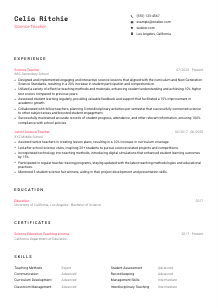
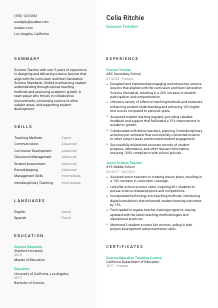
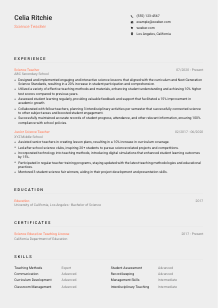
Unveiling molecular wonders, but your resume feels formulaic? Try this Science Teacher resume example, created with Wozber free resume builder. Learn how to pair your scientific insights with job requirements, making your career trajectory as insightful as a well-placed hypothesis!
Science teaching is practical work. Schools want to see how you turn standards into lessons, labs, discussions, and assessments that actually move student understanding forward. A resume for this field should show more than subject knowledge. It should make your classroom execution visible, from lesson design and NGSS alignment to student growth, collaboration, and the daily discipline of managing records and routines.
When that experience is tailored to the posting, hiring teams can quickly separate a general teaching background from a science-focused one. Wozber's free resume builder helps you build an ATS-compliant resume that mirrors the language of the role, so terms like NGSS, classroom management, assessment, and interdisciplinary planning are easy to find and easy to connect to real results. That makes it much easier to judge whether you can step into a science classroom and deliver.
School administrators move fast through applications, and the top of the resume should answer the obvious questions immediately. In teaching, that means clear identity, reachable contact information, and any location detail the posting specifically asks for.
Put your name at the top in a clean, readable format. Keep it larger than the rest of the text so it stands out on first scan, whether a principal is reviewing the document on screen or a district recruiter is sorting through several applicants for the same science opening.
Place your professional title directly under your name and match it to the role when appropriate. If the posting is for a Science Teacher, use "Science Teacher." That gives immediate context and keeps your resume aligned with both ATS searches and human review.
List a phone number you answer and a professional email address, ideally based on your name. Teaching roles often move from application to interview scheduling quickly, so one typo in your contact information can interrupt the process for no good reason.
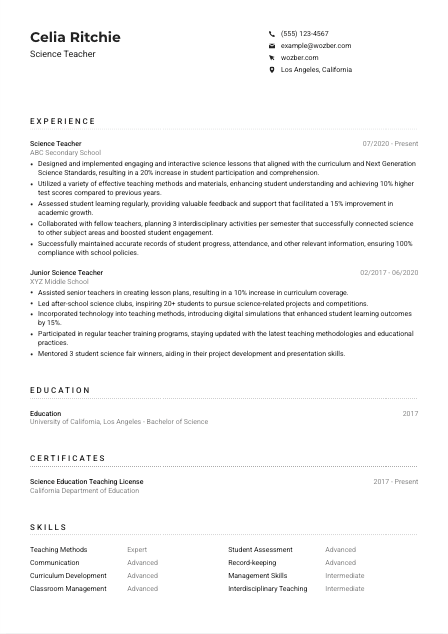
If a school or district asks for a local candidate, show your city and state clearly. In the example, listing "Los Angeles, California" directly supports the employer's stated requirement and removes uncertainty about relocation or local availability.
A LinkedIn profile or professional teaching portfolio can support your application if it reflects the same experience shown on your resume. Include it only if it adds useful context, such as curriculum projects, science fair involvement, professional development, or recommendations from school leaders.
This section should read like a well-run front office. Clear details, the right title, and the right location information let the school focus on your teaching background instead of chasing basic facts.




For science teachers, experience is where hiring teams look for proof that you can run instruction, not just support it. They want to see how you plan lessons, use different teaching methods, track learning, and contribute to the wider school program.
Before rewriting your bullets, identify the work the school cares about most. Here, that includes NGSS-aligned lesson design, interactive instruction, regular assessment, interdisciplinary collaboration, and accurate record-keeping. Use those priorities to decide which classroom examples deserve space on the page. The example resume does this well by centering lesson delivery, assessment, collaboration, and student progress rather than listing general teaching duties.
List your most recent school first, then work backward. For each role, include your title, school name, and dates. That structure helps reviewers quickly understand your teaching progression, such as moving from a junior science teaching role into a full classroom science teacher position with broader planning and accountability.
Bullet points should show what you taught, how you taught it, and what changed because of your work. Strong science teacher bullets often mention lab-based learning, differentiated instruction, digital simulations, formative assessment, or curriculum alignment, followed by a student outcome. In the example, "designed and implemented engaging and interactive science lessons" becomes stronger because it is tied to higher participation and comprehension.
Quantify impact with measures schools recognize. That can include test score gains, participation rates, academic growth, attendance improvements, science club participation, project completion, competition outcomes, or compliance with reporting standards. The sample's 20% increase in participation, 10% higher test scores, and 100% record-keeping compliance give concrete shape to the teacher's impact.
Choose experience that supports the classroom you want next. A hiring team for a science position is looking for evidence of science instruction, standards-based planning, student assessment, and cross-curricular work. If you have broader education experience, keep the bullets that show transfer well, such as using instructional technology, mentoring science fair students, or collaborating on interdisciplinary units.
Your experience section should show a teacher who can plan instruction, manage a classroom, measure learning, and improve student outcomes in science. If those points are visible at a glance, the section is doing its job.
Education matters in teaching because it establishes both eligibility and subject grounding. Schools usually scan this section quickly, so the key is to make your degree level, field, and teacher preparation easy to read.
Start with the degree that directly matches the posting. For many science teaching roles, that means a bachelor's degree in education, science, or a related field. In the example, the Bachelor of Science in Education clearly addresses that baseline requirement, while the master's in Science Education adds subject-specific depth.
Use a consistent format that includes degree, field of study, school, and graduation year. School administrators and HR staff often scan dozens of applications, so simple structure helps them confirm your academic qualifications without slowing down.
If your degree title alone does not fully explain your preparation, include the field clearly. This matters in education hiring because "Bachelor of Science" could mean many things, while "Bachelor of Science in Education" or "Master of Education in Science Education" immediately clarifies your training.
Early-career teachers can benefit from listing relevant coursework, student teaching, research projects, or subject-specific academic work, especially if it connects to lesson planning, adolescent learning, lab instruction, or standards-based teaching. If you already have several years of classroom experience, keep this section lean unless the added detail is unusually relevant.
Honors, thesis work, leadership in education programs, or science-related extracurriculars can help when they reinforce your teaching profile. Choose details that support classroom credibility, such as curriculum research, STEM outreach, or instructional leadership, rather than general campus involvement.
A school should be able to confirm your academic background in seconds. Clear degree information, relevant fields, and selective supporting detail are enough to establish a solid foundation for the rest of the resume.
In K-12 hiring, certification is often a gating requirement. If the role asks for a state-issued science teaching license, that credential needs to be visible and current before anything else on the resume gets much attention.
Read the posting carefully and list the credential that directly matches it. Here, the essential item is a state-issued teaching license or certification in Science Education. Put that certification first so there is no doubt that you meet the minimum requirement.
Lead with licenses and certificates tied to instruction, subject authorization, or grade-level eligibility. A California science teaching credential, for example, carries more weight for a science classroom than unrelated professional development certificates listed above it.
Licenses often need renewal, so dates help schools understand whether your credential is active. The example's "2017 - Present" format works because it quickly shows that the teaching license is current and ongoing.
If you have relevant training beyond the required license, include it when it supports your classroom practice. Useful additions might include STEM instruction, lab safety, differentiated learning, educational technology, or NGSS-focused professional development. These are strongest when they reinforce the teaching work described in your experience section.
For teaching roles, certification is not a minor detail. Make your science credential easy to find, easy to read, and clearly current so the school can move on to the quality of your instruction.
A science teacher's skills section should reflect how teaching actually happens. Schools are looking for a mix of instructional practice, subject-specific planning, classroom control, and assessment habits that support student progress.
Use the job description to identify the exact abilities the school is emphasizing. In this case, communication, organization, classroom management, NGSS knowledge, lesson design, and student assessment all belong in the resume if they reflect your real work.
Include skills that show both general teaching competence and science classroom relevance. Useful examples include curriculum development, differentiated instruction, formative assessment, lab-based teaching, interdisciplinary planning, and standards alignment. The sample skill list covers core teaching areas well, and could be even stronger with a direct reference to NGSS if that is a major requirement in your target posting.
Do not overload this section with every capability you have developed across your career. Put the most relevant skills first, especially those tied to instruction, classroom culture, assessment, and science curriculum delivery. A shorter list with clear relevance is more effective than a long inventory of broad strengths.
If this section is tailored well, a school should immediately recognize the kind of science teacher you are: organized, standards-aware, effective with students, and able to deliver instruction that produces measurable learning.
Language proficiency can matter more in schools than candidates sometimes expect. At minimum, you need to meet the communication requirement in the posting. In some communities, additional language ability can also support student and family engagement.
If the role requires fluent English, list English prominently and mark your level accurately as "Native" or "Fluent." That directly addresses a stated hiring requirement and avoids any ambiguity about classroom communication, parent contact, or written reporting.
Additional languages are worth listing when they are genuinely useful in the school community. In the example, fluent Spanish is a meaningful addition, especially in a diverse district where communication with students and families may benefit from bilingual ability.
Stick to familiar terms such as "Native," "Fluent," "Intermediate," or "Basic." Schools need a practical sense of how well you can teach, explain, write, or communicate in each language, so avoid vague labels that overstate your ability.
If another language has helped you support multilingual learners, communicate with families, or build stronger classroom relationships, it can strengthen your application. Keep the claim grounded in real use rather than treating multilingual ability as a general bonus.
Teaching depends on clear communication in lessons, feedback, and student support. Only list languages you can use reliably in professional settings. Accurate language ratings build trust and help schools place value on abilities they may genuinely need.
Handled well, the language section confirms that you meet the posting's communication requirement and may bring added value in a multilingual school community.
Your summary sits near the top of the resume, so it should quickly establish your teaching level, science focus, and strongest classroom strengths. For this profession, a useful summary usually combines years of experience, standards-based instruction, and a clear link to student learning.
Start by pulling out the two or three priorities that define the job. For this posting, those are science teaching experience, NGSS alignment, and the ability to improve student learning through engaging instruction and assessment. Those points should shape the summary instead of a generic statement about loving education.
Lead with a direct description of who you are as an educator. A line such as "Science Teacher with 5+ years of experience" gives immediate context and helps a reviewer quickly place your level of classroom responsibility.
Use the next sentence or two to highlight your most relevant teaching strengths. Strong choices here include designing interactive lessons, aligning curriculum to NGSS, assessing student growth, and collaborating across subjects. The sample summary does this effectively by connecting science instruction, standards alignment, and collaborative teaching in a compact format.
Aim for a short paragraph that can be read in seconds. Three to five sentences are enough. If you mention outcomes, use believable education measures such as student growth, engagement, or achievement gains rather than broad claims about excellence.
A well-written summary should make a school expect to see thoughtful lesson planning, solid classroom practice, and measurable student progress in the sections that follow. That is the right first impression for a science teacher.
You now have a framework for building an ATS-compliant resume that reflects how science teachers are actually hired: through clear proof of standards-based instruction, classroom results, certification, and subject-specific teaching strength. Wozber's free resume builder and ATS resume scanner can help you tailor each section to the posting, surface missing requirements, and present your experience in an ATS-friendly resume format that schools can read quickly.
When the resume is tailored well, a hiring team should be able to see your classroom practice, your science background, and your readiness to teach from the first page.




