



Use Wozber and land your dream job
Create Resume
No registration required
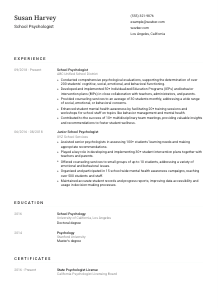
Decoding student minds, but your resume feels misunderstood? Check out this School Psychologist resume example, created with Wozber free resume builder. It shows how to blend your psychological prowess with job criteria, ensuring your career prospects are as hopeful as the future scholars you support!
School psychologists are trusted with decisions that shape student services, classroom supports, and family conversations. A resume for this field needs to show more than compassion. It should make your assessment work, intervention planning, counseling scope, and collaboration with educators visible enough for a district or school team to picture you in case conferences, IEP meetings, and student support planning.
When that experience is tailored closely to the opening, the first read changes quickly. School-based hiring teams can see whether your background lines up with psycho-educational evaluations, evidence-based interventions, and multidisciplinary work rather than general counseling alone. Wozber's free resume builder helps you organize that information in an ATS-friendly resume format, so the screening process surfaces your school psychology experience early and clearly.
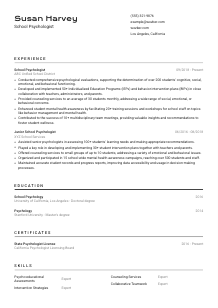
This section should confirm the basics without wasting space. For a School Psychologist, that means clear contact information, the exact professional title, and any location detail that matters for the role or district.
Use your full name as the header's focal point so administrators and HR teams can identify you quickly when reviewing a large batch of applications. Keep the formatting clean and professional. You work in a field built on trust, documentation, and precision, so even small presentation choices should feel orderly.
Place "School Psychologist" directly beneath your name if that is the role you are pursuing. It immediately frames your background around school-based assessment, intervention, counseling, and IEP support instead of leaving room for confusion with adjacent roles such as clinical psychologist, counselor, or behavior specialist.
List a reliable phone number and a professional email address, then check them carefully. In school settings, hiring often moves through direct outreach from district staff, principals, or special education coordinators, so missed calls or a typo in your email can cost you an interview.
If the employer specifies a local requirement, include your city and state. In the example opening, Los Angeles, California is named directly, so showing "Los Angeles, California" in the header answers that point without taking up extra space elsewhere on the resume.
If you include LinkedIn or a professional website, make sure it supports your resume with matching roles, dates, licensure, and school-based experience. For School Psychologists, that profile may also reinforce workshop facilitation, assessment expertise, publications, or presentations, but only if the information is current and consistent.
This section should remove basic questions immediately. A hiring team should be able to confirm your role focus, contact details, and any location match before they move into your assessments, interventions, and student support work.




Experience carries the most weight in a School Psychologist resume because it shows how you work inside real educational systems. Hiring teams want to see the kind of caseloads you handled, the services you delivered, and how you contributed to IEP decisions, behavior plans, counseling, and staff support.
Start by pulling the main needs from the posting and mapping them to your own background. Here, the priorities include 2+ years in educational settings, psycho-educational assessments, evidence-based interventions, collaboration with families and educators, and strong written and verbal communication. Make sure those themes appear in your bullets in the language you actually use on the job.
For every position, include employer name, job title, and dates, then let the bullets explain your school-based responsibilities. In this profession, context matters. A district role, contracted school services position, or junior role under supervision can each be relevant when the scope of assessment, counseling, and consultation is clearly described.
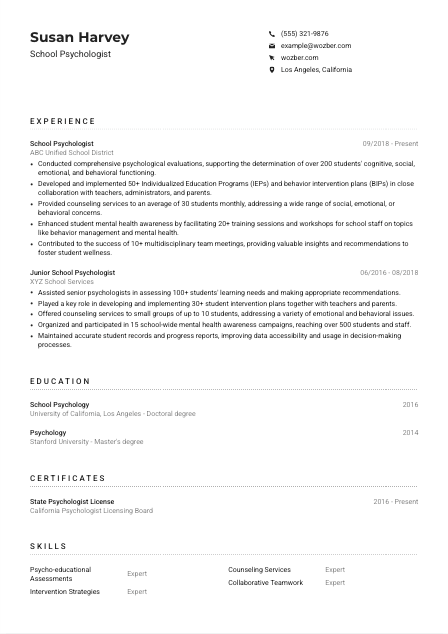
Prioritize bullets that show evaluations, IEP participation, BIP development, counseling delivery, consultation with teachers, and multidisciplinary collaboration. The example resume does this well by leading with comprehensive psychological evaluations, IEP and BIP development, counseling volume, staff workshops, and team meeting contributions. That sequence mirrors how many school employers think about the role.
Quantify work in ways that make sense for school psychology. Strong metrics include number of students assessed, IEPs or BIPs developed, counseling caseload, workshops delivered, schools supported, or cases managed over a semester or year. "Conducted evaluations for over 200 students" and "provided counseling to an average of 30 students monthly" are useful because they show both volume and relevance.
If a past duty does not support your candidacy for school-based psychological services, trim it or reframe it. Keep the emphasis on assessment, intervention planning, consultation, counseling, documentation, and student wellness outcomes. The section should read like a record of educational impact, not a general helping-professions timeline.
Your experience section should show how you function in the rhythm of a school environment. By the end of it, a hiring team should be able to picture you evaluating students, collaborating on IEPs, supporting behavior plans, and communicating clearly with staff and families.
Education matters heavily in School Psychology because the degree itself is part of the qualification threshold. This section should make your academic preparation easy to confirm, especially when the posting asks for a master's or doctoral degree from an accredited institution.
List the degree that directly supports your eligibility first, especially if you hold a specialized graduate credential in School Psychology. The opening here asks for a master's or doctoral degree in School Psychology, so that qualification should be impossible to miss.
Present each entry with school name, degree, field of study, and graduation year. School districts and educational employers often review many applications quickly, and a straightforward format helps them confirm licensure eligibility and subject-matter alignment without hunting for details.
Do not assume the degree title alone tells the full story. If your degree is in School Psychology, say so directly. The example resume handles this well with "Doctoral degree, School Psychology," which closely matches the requirement language and strengthens ATS alignment naturally.
If you are earlier in your career, a brief mention of advanced practica, thesis focus, or school-based assessment training can strengthen this section. For more experienced candidates, those details are usually less important than your evaluation and intervention record, so keep the emphasis proportional.
If your academic training clearly supports a credential such as NCSP or state licensure, that connection can reinforce your preparation. This is especially useful if your program included supervised practice, assessment training, or other components directly tied to how school psychologists are credentialed.
This section should confirm that you meet the educational bar without delay. When your graduate training is presented clearly, the reader can move on to the evidence of how you apply that training with students, families, and school teams.
For School Psychologists, credentials are a core hiring checkpoint rather than a nice extra. State licensure, certification, and recognized professional credentials help schools confirm that you are qualified to assess students, participate in special education processes, and provide services within the role's legal and professional scope.
Read the listing carefully and place required credentials first. In this case, valid state licensure or certification is a stated requirement, so that entry should appear before optional or supplementary certifications.
Choose certificates and licenses that matter in school settings, such as state school psychologist credentials, psychologist licensure where applicable, or the National Certification in School Psychology. The example resume's California license and NCSP are strong illustrations because both speak directly to professional qualification.
Show when the credential was issued and whether it is current. For regulated roles in education, active status matters. A date range such as "2016 - Present" quickly tells the employer the credential is maintained and current.
Credential expectations vary by state, district, and service model, so revisit this section for each application. If you earn additional training in threat assessment, behavior analysis, crisis response, or trauma-informed practice, include it when it supports the role you are targeting.
Your credentials section should answer a practical question right away: are you currently qualified to practice in the setting named in the posting? When the answer is clear, the rest of your resume can focus on the quality and scope of your work.
A School Psychologist skills section should feel grounded in actual practice. That means combining technical competencies such as assessment and IEP work with interpersonal capabilities that affect consultations, family communication, counseling, and staff training.
Look for both explicit requirements and implied expectations. Here, the posting points to psycho-educational assessments, evidence-based interventions, communication, and collaboration with parents, teachers, and other educational professionals. Those belong in your skills list if they are genuinely part of your work.
Focus on skills that support the core responsibilities of school psychology, such as cognitive and behavioral assessment, counseling services, intervention planning, IEP development, behavior intervention plans, consultation, workshop facilitation, and data interpretation. The example list is useful because it balances technical service areas with collaboration and communication.
Lead with the most role-critical skills rather than building a long generic inventory. Put assessment, interventions, counseling, IEP or BIP work, and collaboration near the top. That ordering helps both ATS systems and human reviewers see your strongest alignment with school-based practice first.
A well-built skills section should reinforce the work described in your experience, not compete with it. When the right capabilities appear here in plain language, your resume reads as a close match for school-based psychological services.
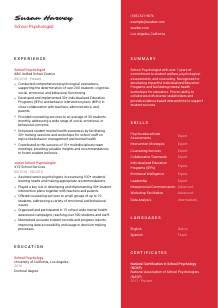
Language ability matters in school settings because communication sits at the center of assessment feedback, counseling, consultation, and parent collaboration. This section should show the languages you can use professionally, especially when the posting names a language requirement.
If the posting specifies English proficiency, list English clearly and assign an accurate level. In this opening, effective English language skills are required, so that should be visible without the reader searching for it.
Additional languages can add real value when they help with parent communication, student rapport, or collaboration in multilingual districts. For example, Spanish can be highly relevant in many California school communities, though it is an advantage only when you can use it confidently in professional interactions.
Only include languages that you could realistically use in meetings, counseling, interviews, or written communication when appropriate. If a second language helps you explain supports to families or build trust with students, that is worth showing.
Use direct labels such as "Native," "Fluent," "Advanced," or "Intermediate." This makes expectations realistic and helps schools understand whether you can use the language casually, professionally, or in high-stakes conversations such as parent conferences and assessment discussions.
Language skills matter most when they support better service delivery. Frame them as part of your effectiveness with students, caregivers, and staff rather than as a general personal attribute.
This section works best when it reflects real professional communication capacity. The right language details can strengthen your case for roles that involve family partnership, multilingual communities, and school-wide collaboration.
The summary sets the tone for the resume and should read like a focused professional snapshot, not a generic mission statement. For School Psychologists, it needs to establish your years of experience, service areas, and the kind of school-based outcomes you support.
Start with your title, years of experience, and the setting you know best. A line such as "School Psychologist with 7+ years in K-12 settings" gives immediate context and tells the reader that your background comes from educational practice rather than a different behavioral health environment.
Include the work that matters most for the target opening, such as psycho-educational evaluations, evidence-based interventions, counseling, IEP development, behavior support planning, and consultation with school teams. The example summary does this effectively by combining assessments, counseling, IEP work, and collaboration in a compact paragraph.
Aim for 3 to 5 lines with concrete language. Skip broad statements about passion or making a difference unless they are backed by actual practice areas. The summary should quickly establish what populations you support, what services you provide, and how you contribute to student success.
Rework your summary for each application so the opening mirrors the employer's priorities. If a district emphasizes comprehensive evaluations, behavior plans, and multidisciplinary meetings, those should appear early. If the role leans more heavily on counseling or MTSS support, shift the emphasis accordingly.
A sharp summary helps the reader interpret everything that follows through the right professional lens. By the end of those first lines, your background should already read as school-based, qualified, and relevant to the students and teams you will serve.
A School Psychologist resume works best when it shows the real substance of your practice: evaluations completed, interventions delivered, IEP and BIP collaboration, counseling support, staff consultation, and current credentials. Keep each section tied to how schools actually use your expertise.
Before submitting, review the posting one more time and tune your wording to match the employer's language where it reflects your experience. Wozber can help you do that with ATS-friendly resume templates, an ATS resume scanner, and practical ATS optimization tools that keep your resume aligned, readable, and ready for school-based hiring.