



Use Wozber and land your dream job
Create Resume
No registration required
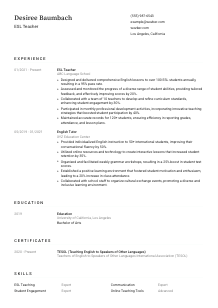
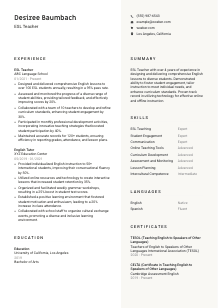
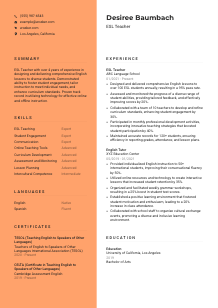
Building bridges between languages, but your resume feels lost in translation? Check out this ESL Teacher resume example, created with Wozber free resume builder. It shows how to align your bilingual brilliance with job requirements, paving a clear pathway to your teaching triumphs!
ESL teaching is practical work. Schools want to see how you plan lessons for different proficiency levels, keep students engaged in class or online, track language growth, and adjust instruction when learners struggle. A resume for this field should quickly show that you can manage those day-to-day teaching demands, not just that you care about education.
When your resume mirrors the language of the posting, it becomes easier for a school to connect your classroom results to its needs, especially when an ATS is filtering for terms like lesson planning, student assessment, curriculum collaboration, and ESL certification. Wozber's free resume builder helps you shape that language into an ATS-compliant resume that reads cleanly to both hiring teams and software, so your teaching range and student outcomes are easier to recognize.
School administrators do not need a creative introduction here. They need clear contact details, the exact role you are targeting, and any location detail that affects eligibility or interview timing.
Use your full name as the main header in a clear, professional font. Keep it larger than the rest of the text so the document feels easy to scan, whether a principal is reviewing it on screen or an HR coordinator is sorting through applications.
Place "ESL Teacher" under your name if that is the role you are applying for. This keeps your resume aligned with the posting and immediately frames your background around English language instruction rather than general teaching or tutoring.
Include a phone number you answer, a professional email address, and only links that support your teaching candidacy. If you add LinkedIn or a teaching portfolio, make sure it reflects the same experience, certifications, lesson focus, and classroom technology mentioned on the resume.
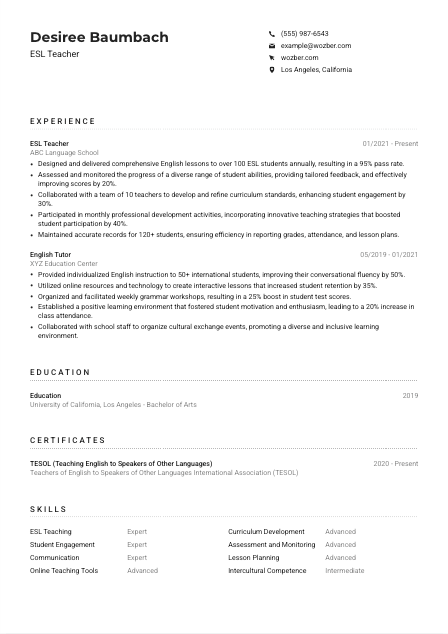
Some schools filter early for local candidates, especially when they need in-person teaching availability. In the example, listing Los Angeles, California directly supports the stated location requirement. If a posting asks for local presence, make that easy to confirm in this section.
A portfolio can help if it includes relevant material such as lesson samples, student-facing resources, classroom technology use, or professional development work. Skip any link that is sparse, outdated, or unrelated to ESL instruction.
This section should remove basic questions before the school reaches your experience. Clear contact details, a matching title, and any required location information help the reader move straight to your teaching results.




For ESL roles, experience is not a list of classrooms you have worked in. It is where you show student progress, lesson delivery, assessment practice, collaboration with other teachers, and the teaching tools you can use across different learning settings.
Before writing bullets, mark the recurring needs in the job description. For ESL teaching, that often means lesson planning, differentiated instruction, progress monitoring, curriculum coordination, record keeping, and classroom technology. Then shape your experience so those areas appear clearly in your own wording.
List your positions in reverse chronological order with title, school or organization, and dates. Under each role, focus on the scope that matters in ESL settings: age group or learner profile, class size, individual versus group teaching, online or in-person delivery, and the kind of English instruction you handled.
Strong bullets show what you taught, how you taught it, and what changed because of your instruction. The example does this well by pairing actions such as designing lessons, assessing progress, and refining curriculum with outcomes like higher pass rates, stronger engagement, and improved scores.
Metrics are especially persuasive when they reflect real teaching outcomes. Student pass rates, score improvement, attendance gains, number of learners taught, workshop frequency, or record volume all help define your impact. Figures like "95% pass rate," "20% score improvement," or "120+ student records maintained" give a hiring team a more concrete view of your classroom performance.
Keep the emphasis on experience that strengthens your case for teaching English learners. Tutoring, language instruction, curriculum support, assessment work, and student engagement initiatives belong here. Less relevant work can stay brief unless it adds something useful, such as cross-cultural communication, mentoring, or instructional technology experience.
Your experience section should make it easy to picture you running lessons, measuring progress, collaborating with colleagues, and keeping instruction organized. If each bullet points to better learning outcomes or smoother classroom delivery, this section is doing its job.
Education matters in ESL hiring because it helps schools confirm subject grounding and teaching preparation quickly. This section should make your degree easy to find and clearly connected to the role.
If the posting asks for a bachelor's degree in Education, English, Linguistics, or a related field, list that degree clearly. In the example, a Bachelor of Arts in Education directly supports the requirement and should be easy to spot without extra explanation.
Include your degree, field of study, school name, and graduation year. That is enough for most experienced ESL teachers. Schools reviewing many resumes want to confirm qualifications quickly, not search through dense academic detail.
If your coursework or specialization supports language teaching, literacy, linguistics, second-language acquisition, or curriculum design, include that only when it adds value. This is especially useful if your degree title is broad and you want to show a stronger link to ESL instruction.
Recent graduates can include honors, relevant projects, practica, or teaching placements if professional experience is still limited. If you already have several years of classroom work, keep the focus on the credential itself and let the experience section carry the heavier proof.
Additional study in assessment, educational technology, multilingual education, or child and adult learning can help, especially if the role includes online teaching or mixed-format delivery. Mention these details selectively so the section stays clean.
This section does not need flourish. It needs to confirm that your academic preparation supports the kind of language teaching, planning, and student support the role calls for.
Certifications carry real weight in ESL hiring because they show formal preparation in language instruction methodology. If the posting names specific credentials, make them prominent and easy to verify.
When a school asks for CELTA, TESOL, or a comparable credential, list it clearly with the issuing body. That tells the reader you meet a major screening requirement before they even reach your teaching bullets.
Focus on credentials tied to ESL methodology, lesson planning, language assessment, online teaching, or learner support. A short, relevant list is more convincing than a long collection of unrelated certificates.
Certification details matter in education. Naming the issuer and date helps schools confirm that the credential is recognized and current. In the example, both TESOL and CELTA are presented in a way that reinforces professional credibility right away.
Professional development is often part of the job itself, so this section can also reflect your commitment to updating teaching practice. If you have newer training in digital instruction, assessment methods, or inclusive classroom strategies, add it when it supports the target role.
For an ESL teacher, certifications are more than add-ons. They show training in how to teach language, structure lessons, and support learners effectively. Keep this section focused on credentials that matter in the classroom.
A hiring team should be able to glance at your skills and see how you teach, manage learning, and support student progress. That means combining instructional skills, classroom tools, and people-facing strengths in a way that reflects real ESL work.
Pull out the abilities that appear directly in the job description, then match them to your own background using the same language where it is accurate. For this kind of role, that may include ESL teaching, lesson planning, assessment and monitoring, curriculum development, online teaching tools, and strong communication.
Do not treat the skills section as a wish list. If you claim student engagement, assessment, or curriculum collaboration, those same abilities should appear in your experience bullets through concrete teaching examples. The sample resume handles this well by pairing skills like curriculum development and online teaching tools with measurable classroom outcomes.
Prioritize skills you will actually use in the role. A balanced ESL skills section often includes instructional design, classroom management, intercultural competence, student feedback, digital learning platforms, and communication. Put the most role-specific and job-matched items first so both ATS systems and human readers catch them quickly.
Every skill listed should connect to how you plan lessons, teach English, monitor progress, or support learners from different backgrounds. If the section reads like a realistic ESL teaching toolkit, it will hold up well in review.
Language ability matters here for obvious reasons, but the way you list it still needs discipline. Schools want to know whether you can communicate clearly in English and whether any additional languages may help you work with learners and families.
If the role requires effective communication in English, list English clearly and use an honest proficiency level such as "Native" or "Fluent." For ESL teaching, this is a core requirement, not a minor detail.
Additional languages can strengthen your profile when they help with rapport, classroom support, or cross-cultural communication. In the example, Spanish adds practical value, especially in communities where students or families may be Spanish-speaking.
Choose straightforward levels such as Native, Fluent, Intermediate, or Basic. Avoid vague descriptions. Schools may use this section to gauge classroom communication range, so clarity matters.
Do not overstate what you can do. If you can hold conversations but not explain grammar or school procedures confidently, rate yourself accordingly. Honest language levels prevent mismatched expectations once teaching begins.
For ESL teachers, another language is useful when it helps build trust, clarify cultural context, or support learners during difficult transitions. It is a valuable asset, but English teaching ability and instructional skill should remain the center of the section.
This section works best when it confirms strong English communication and adds any other languages that genuinely strengthen your classroom presence. Keep it accurate, clear, and relevant to the learners you may serve.
Your summary should read like the opening case for your candidacy. In a few lines, show your experience level, the kind of learners or teaching environments you handle well, and the outcomes you consistently drive through instruction.
Start with the parts of your background that match the posting most closely. For an ESL teacher, that usually means years of teaching experience, lesson design, student progress monitoring, differentiated instruction, and comfort with both in-person and online teaching tools.
Lead with a direct first sentence such as "ESL Teacher with 4+ years of experience" if that reflects your background. This immediately places you in the right lane and helps the reader understand your level before they move into the rest of the resume.
Choose strengths that reflect the work, not generic praise. Student engagement, curriculum support, assessment practice, multilingual learner instruction, and measurable score or participation gains all belong here. The example summary works because it ties lesson delivery, tailored instruction, and technology use to actual teaching impact.
Aim for three to five lines. Skip broad statements about passion or dedication unless they are supported by something concrete. A concise summary with role-specific language will do more for you in ATS review and human screening than a long paragraph full of general teaching adjectives.
A solid summary tells the school, within seconds, what kind of ESL teacher you are and where your strengths show up in practice. Once that opening is clear, the experience and skills sections can do the detailed proof.
You now have the structure to build an ATS-compliant resume that reflects how ESL teaching is actually evaluated: lesson delivery, student progress, instructional flexibility, collaboration, and organized classroom records.
Use Wozber's free resume builder to tailor your content with stronger role language, cleaner structure, and ATS optimization that supports real teaching experience. The final resume should make it easy to see that you can step into the classroom, support diverse English learners, and deliver measurable progress.