




Use Wozber and land your dream job
Create Resume
No registration required
Embracing the lotus pose, but your resume feels tangled? Stretch your career aspirations with this Yoga Instructor resume example, created with Wozber free resume builder. Learn how to blend your breathwork expertise with job requirements, making your career journey as balanced and centered as a perfect tree pose!
Yoga instruction is practical, people-facing work. Studios look for teachers who can lead a room with calm authority, cue clearly across mixed ability levels, make safe alignment decisions in real time, and create a class atmosphere students want to return to. Your resume should make those teaching habits visible, not just list styles you've studied.
A tailored resume changes how quickly a studio can place you in the right teaching lane, whether that is foundational Hatha, a stronger Vinyasa flow, or a technique-focused class where anatomy knowledge matters. Using Wozber's free resume builder helps you shape that experience into an ATS-compliant resume with the right class-language, certifications, and teaching outcomes so hiring teams can quickly see how you handle students, sequencing, and studio standards.
Studios usually scan this section fast. They want to confirm who you are, how to reach you, and whether you meet practical requirements before they spend time on your teaching history.
Use your full name in a clear, readable format. Keep it more prominent than the rest of the contact details so the resume feels professional and easy to reference after a class audition or interview.
Use the title "Yoga Instructor" if that is the role you are applying for. This keeps your positioning direct and helps both ATS systems and studio managers immediately connect your resume to the opening.
Include a reliable phone number and a professional email address. If a hiring manager wants to invite you to teach a sample class, your contact information should be easy to spot and ready to use.
If the role has a location requirement, state your city and state clearly. In the example posting, being based in San Francisco, CA is a stated condition, so listing that upfront removes an avoidable question early in the review.
A website, LinkedIn profile, or teaching page can support your application if it shows class philosophy, workshop experience, schedule history, or student-facing professionalism. Only include it if the content is current and consistent with your resume.
Personal details do not need personality flourishes. They should confirm that you are reachable, professionally presented, and, when relevant, already in the right market for the role.




For yoga instructors, experience is less about listing every studio and more about showing how you lead classes, support different bodies, and contribute to retention, safety, and student satisfaction. This is where hiring teams look for proof that your teaching works in a live room.
Read the job description closely and underline the work the studio cares about most. Here, that includes tailoring classes to student ability, guiding safe asanas, providing adjustments and modifications, demonstrating poses, and maintaining an organized studio. Those priorities should shape which bullets you lead with in each role.
Start with your most recent teaching position and work backward. That structure helps studios quickly see your current class load, recent responsibilities, and whether you have the group teaching background they requested, such as the 2+ years of group instruction mentioned here.
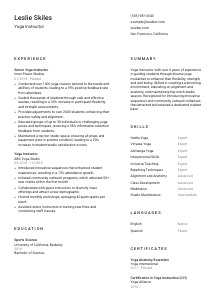
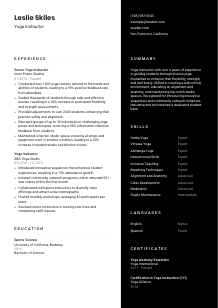
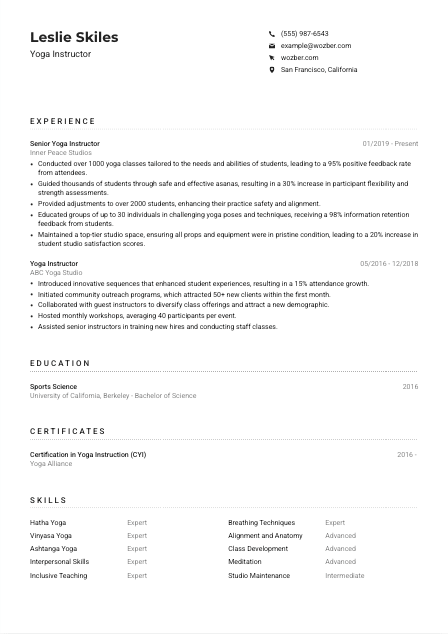
Focus each bullet on what you taught, how you taught it, and what changed for students or the studio. Good yoga-instructor bullets often mention class formats, student levels, alignment support, workshops, retention, attendance, or satisfaction. The sample resume does this well with specifics such as conducting more than 1000 classes, teaching groups of up to 30, and improving flexibility and strength assessments.
Numbers make your teaching scope easier to picture. Useful metrics include class volume, class size, attendance growth, student feedback, workshop turnout, client retention, or satisfaction scores. If you introduced new sequences that increased attendance by 15 percent or helped raise student satisfaction through better prop setup and studio upkeep, say so plainly.
Prioritize roles that strengthen your case as a yoga instructor. Studio teaching, workshops, community outreach, teacher support, and wellness instruction all help. Jobs with no connection to instruction, movement, client care, or studio operations can stay off the page unless they fill a major gap.
By the end of this section, a studio should be able to picture you teaching. Clear bullets about class leadership, alignment, modifications, and student response do more than a generic list of duties ever will.
Formal education is not always the deciding factor for yoga roles, but it can strengthen your profile when it supports anatomy knowledge, movement science, wellness, or teaching practice. Present it in a way that adds context to your instruction, not just another line item.
List degrees, diplomas, or formal study that reinforce your work with movement, anatomy, health, or coaching. Even when a posting focuses more on certification than academic background, education can still show depth behind your cueing and class design.
Keep each entry easy to scan by including school, degree, field of study, and graduation year or date. Hiring teams should be able to absorb it in seconds without searching through extra wording.
If your education relates directly to yoga teaching, make that connection clear. In the example resume, a Sports Science degree supports the kind of alignment and anatomy knowledge this employer specifically asks for.
Additional coursework in areas such as yoga anatomy, functional movement, trauma-informed teaching, breathwork, or mobility can strengthen your resume, especially if those topics influence how you modify poses or cue safely in mixed-level classes.
Include honors, research, clubs, or projects only when they reinforce your direction as an instructor. A wellness leadership role, movement-focused research project, or campus yoga teaching experience can add substance. If it does not relate to teaching, health, or community work, leave it out.
Your education section should support the way you teach, especially if it strengthens your knowledge of movement mechanics, anatomy, or student well-being. Keep it concise and relevant.
For yoga instructors, certifications are central. Studios often look here early to confirm formal training, current standing, and whether your background matches the class styles and teaching standards they need.
If the job posting asks for certification from a recognized yoga school or organization, place that credential first. This employer states that requirement directly, so your primary yoga teaching certification should never be buried below less relevant courses.
Prioritize credentials tied to actual studio needs, such as yoga instruction, anatomy, sequencing, restorative practice, prenatal work, or specialty formats you are qualified to lead. Relevance matters more than listing every short course you have completed.
Dates show when you qualified and whether you have maintained your professional development over time. That matters in yoga, where continued education often shapes how you cue, adjust, and adapt classes for different student populations.
Recent or active study in anatomy, biomechanics, breathwork, meditation, or inclusive teaching can strengthen your application. In the example, a Yoga Anatomy credential usefully supports the posting's emphasis on alignment and anatomical knowledge.
A studio should be able to glance at this section and confirm that you are qualified to teach, current in your training, and serious about developing your practice as an instructor.
The skills section should reflect how you actually teach. For yoga roles, that means a mix of modality knowledge, class leadership, student support, and practical studio awareness rather than a generic list of soft skills.
Start with the language in the job ad. Here, the explicit needs include Hatha, Vinyasa, Ashtanga, alignment, anatomy, and group teaching. The implied skills include inclusive instruction, interpersonal ease, safe modifications, clear demonstrations, and maintaining an orderly studio environment.
Select skills you can back up in your experience section or certifications. For this kind of role, that usually means yoga styles taught, breathwork, meditation, anatomy knowledge, sequencing, class development, hands-on or verbal adjustments, and student-centered instruction. The example resume handles this well by pairing style expertise with inclusive teaching and studio maintenance.
Arrange skills in a way that makes sense to a studio reviewer. You might cluster by teaching styles, instructional strengths, and operational skills. A tidy structure helps the most relevant terms stand out for both ATS matching and human review.
Every skill listed here should connect to something concrete, whether that is a class style you regularly teach, a safety principle you apply, or a studio responsibility you handle well.
Language matters in yoga instruction because cueing, corrections, and atmosphere all depend on how clearly you communicate. If a posting names a required language, make that qualification visible right away.
If fluent English is required, list English clearly with an accurate proficiency level. For this role, that is a baseline qualification because class demonstrations, safety cues, and student interaction all depend on precise communication.
Additional languages can be valuable in studios serving diverse communities, private clients, or multilingual wellness programs. They are especially useful when they help you welcome students, explain modifications, or build trust more easily.
Choose simple terms such as Native, Fluent, Advanced, Intermediate, or Conversational. Clear labels are easier for studios to interpret than creative wording.
If you have taught bilingual classes, supported international clients, or worked in community wellness settings, language ability can reinforce your interpersonal range. It is not essential for every role, but it can strengthen your profile when the student population is broad.
Only list languages you can genuinely use in teaching or student communication. If you mention a language, be prepared to cue, explain, or interact at the level you claim.
For yoga instruction, strong communication in the required language matters first. Additional languages are a bonus when they help you teach more clearly and serve a wider student base.
The summary should give a studio a fast, credible picture of your teaching background. In a few lines, show your experience level, class strengths, and the kind of student experience you are equipped to lead.
Before writing the summary, identify the needs the studio repeats or emphasizes. In this posting, those include recognized certification, group teaching experience, multiple yoga styles, inclusive instruction, and alignment knowledge. Your summary should reflect that mix rather than sounding broad or spiritualized.
Begin with a direct line that names you as a Yoga Instructor and states your years of teaching experience. If you have taught in group settings for 6+ years, say that clearly. It gives immediate context for the rest of the summary.
Use the next sentence or two to mention your relevant styles, approach to student safety, and any standout strengths such as inclusive cueing, anatomy-based instruction, workshop leadership, or strong student retention. The sample summary works because it combines teaching breadth with student well-being and studio contribution.
Aim for a short paragraph, usually three to four lines. Every phrase should earn its place by telling the studio something concrete about your classes, your teaching background, or the value you bring to the floor.
Your summary should read like someone a studio can picture introducing to students. Short, specific statements about class experience, styles taught, and safety-minded instruction create that impression quickly.
A yoga instructor resume works when it makes your class leadership easy to understand. That means recognized certification, clear group teaching experience, the yoga styles you can confidently lead, and proof that you create safe, inclusive instruction with solid alignment cues.
Wozber's free resume builder helps you organize that content into an ATS-friendly resume format, and its ATS resume scanner can help you match studio language around styles, anatomy, modifications, and student experience. The finished resume should make one thing obvious: you can step into a class and teach it well.