



Use Wozber and land your dream job
Create Resume
No registration required
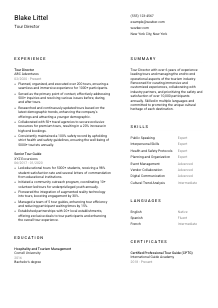
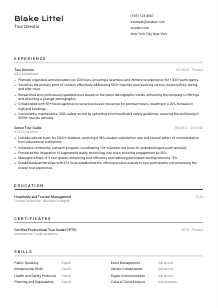
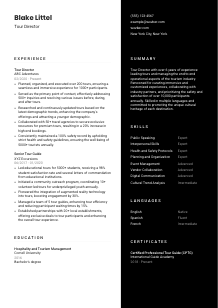
Leading explorations, but your resume is off the beaten path? Navigate this Tour Director resume example, created with Wozber free resume builder. Learn how to align your adventure expertise with job expectations, guiding your career journey just as masterfully as a scenic route!
Tour Directors work at the intersection of guest experience and live operations. Hiring teams look for people who can keep a group engaged, coordinate vendors, handle last-minute issues calmly, and maintain safety standards without interrupting the flow of the tour. Your resume needs to show that you can manage the logistics behind the scenes while still delivering an experience participants remember for the right reasons.
Screeners often need to quickly distinguish between someone who has simply led tours and someone who has owned the full tour experience, from planning and participant communication to partner coordination and issue resolution. A tailored resume, built in Wozber's free resume builder with ATS optimization in mind, helps surface that broader operating scope clearly so your application reads like a match for Tour Director work, not just general tourism experience.
For a Tour Director, the top of the resume should immediately confirm who you are, what role you do, and whether you meet practical requirements that affect hiring speed. Keep this section clean, accurate, and aligned with the posting.
Your name should be the most visible text on the page. Use a clear font size and straightforward formatting so hiring teams can identify you quickly, especially when reviewing multiple resumes for customer-facing tourism roles.
Place "Tour Director" directly under your name when that is the role you are pursuing. This instantly aligns your application with the opening and helps ATS filters and human readers place your background in the right category.
List a phone number you answer reliably and a professional email address. Tour Director hiring often moves quickly, especially when schedules, seasonal demand, or interview availability are tight, so small errors here can cost you real opportunities.
If the posting requires local presence, show it clearly. In this case, listing "New York City, New York" addresses a stated requirement and removes uncertainty about whether you can support on-site tour operations without relocation.
A LinkedIn profile or professional website can strengthen your application if it supports your resume with consistent experience, tourism credentials, partnerships, or public-facing work. Keep it updated so it reinforces your tour leadership background rather than raising questions.
At a glance, this section should tell the employer that you are a Tour Director, reachable, professionally presented, and available where the role needs you. That kind of clarity helps the rest of your resume land faster.




This section carries the most weight for Tour Director roles because the work is practical, visible, and measured through execution. Employers want to see that you have handled participants, schedules, vendors, local coordination, and on-the-ground problem solving in real tour environments.
Start by marking the core functions in the posting, then mirror them through your past work. For this role, that means planning and executing tours, serving as the main contact for participants, updating experiences based on local trends, coordinating with agencies and establishments, and maintaining health and safety standards.
List positions in reverse chronological order and make the title, employer, and dates easy to scan. Then use bullet points to show what kind of tours you handled, who you served, and how much operational ownership you had. A Tour Director entry should sound like someone running the experience, not just assisting with it.
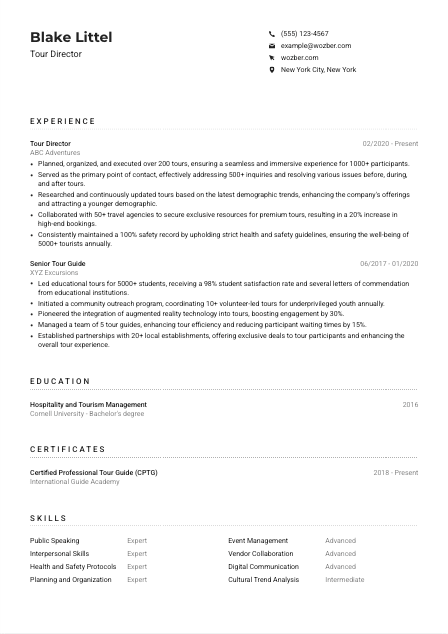
Do not stop at generic statements like "led tours" or "helped guests." Show what changed because of your work. The sample resume does this well by tying tour planning to 200+ completed tours, participant support to 500+ inquiries resolved, and vendor collaboration to a 20% increase in premium bookings.
Quantify the parts of the job that hiring managers actually care about: number of tours run, group size, satisfaction rates, bookings, partnerships, repeat business, response volume, wait-time reduction, or safety record. Metrics make it much easier to understand your scale and reliability in live guest-facing environments.
If you have held adjacent roles such as Tour Guide, Travel Coordinator, or Visitor Experience Lead, focus bullets on the pieces that map to tour operations and participant management. The sample's Senior Tour Guide role works because it highlights group leadership, team management, partnerships, and engagement improvements rather than listing every routine task.
Your experience section should leave little doubt that you can plan tours, manage people in motion, solve problems in real time, and protect the guest experience under pressure. That is the standard Tour Director resumes need to meet.
Education matters here because many employers use it as a baseline check, especially when the role blends tourism knowledge, hospitality awareness, and public-facing coordination. Present it clearly, and match the wording when your degree aligns with the posting.
When a posting requests a bachelor's degree in hospitality, tourism, or a related field, list that credential in a way that is easy to recognize. A degree such as "Bachelor's degree in Hospitality and Tourism Management" directly supports your candidacy for a Tour Director position.
Include your degree, field of study, school name, and graduation year or date. This section should be quick to scan and free of clutter so reviewers can confirm the academic requirement without hunting for details.
If your degree closely fits the job, use wording that reflects the posting naturally. That does not mean forcing exact phrasing, but it does help to make the tourism or hospitality connection obvious, especially in ATS screening.
Relevant coursework can help early-career candidates or people coming from broader programs. Subjects like tourism operations, hospitality management, cultural heritage, event planning, or destination marketing can add useful context if your work history is still developing.
Academic honors, tourism clubs, event leadership, or cultural programming can strengthen this section when they relate to guiding, coordination, or hospitality service. Keep them if they support the story of how you developed into a candidate ready for tour leadership.
This section does not need a lot of detail. It simply needs to confirm that your academic background supports work in tourism, hospitality, or related visitor-facing operations.
Certifications can strengthen a Tour Director resume because they show formal training in guiding, safety, or tourism operations. They are especially helpful when the posting lists tour-guide certification as preferred rather than required.
Review the job description for specific certifications or training references. Here, professional tour guiding certification is preferred, so a credential like Certified Professional Tour Guide supports the application by showing formal preparation for the role.
Prioritize certifications tied to guiding, travel operations, visitor safety, hospitality, first aid, cultural interpretation, or destination knowledge. Relevance matters more than quantity.
Adding the issue date, renewal period, or active status helps employers understand whether your training is current. This is especially useful for certifications tied to safety standards, compliance, or ongoing professional membership.
Tourism changes with traveler expectations, local regulations, and destination trends. Updated certifications or recent training in group management, accessibility, safety, or cultural programming show that you stay current in the operational side of the profession.
For a Tour Director, certifications work best when they add confidence in your training, professionalism, and ability to lead tours responsibly. Keep the list focused and current.
Tour Director skills need to read like tools you use in the field, not a generic personality list. The right mix usually combines guest-facing communication, operational coordination, safety awareness, and the judgment to adapt when tours do not go exactly as planned.
Read the posting for both stated and implied skills. In this case, public speaking, interpersonal communication, English writing, multilingual ability, planning, vendor coordination, and health and safety knowledge all deserve attention because they connect directly to the daily work.
A Tour Director needs both. Include skills that show you can organize tours and manage relationships at the same time, such as planning and organization, event management, vendor collaboration, public speaking, participant support, and issue resolution.
Do not overload this section with every skill you have picked up in hospitality or travel. Choose the capabilities that most clearly support tour delivery. The sample does this well by emphasizing public speaking, interpersonal skills, health and safety protocols, planning, and cultural trend analysis.
By the time someone reaches this section, they should see the core abilities needed to run a smooth, engaging, and safe tour experience. Every skill listed should help support that picture.
Language ability carries real weight in tourism because it affects guest comfort, group communication, and the quality of the experience you can deliver across different audiences. If you speak multiple languages, this section can become a meaningful advantage.
If the employer specifies English proficiency, make that visible first. Here, the role requires effective writing in English, so your English level should be listed clearly and accurately.
After English, list languages that help you serve broader traveler groups or international visitors. Spanish and French, for example, may be especially useful in tourism markets with diverse participants, as shown in the sample resume.
Even when a language is not named in the posting, it can still strengthen your profile if it supports communication with guests, travel partners, or local communities. Keep the list honest and relevant.
Use clear labels such as Native, Fluent, Advanced, or Intermediate. Avoid vague claims. Tour operations rely on practical communication, so employers need a realistic sense of how confidently you can speak, explain, and respond.
For Tour Directors, languages are not decorative extras. They can improve guest rapport, reduce confusion, and make tours more inclusive for multilingual groups. If language skills have helped you in the field, make sure the rest of your resume supports that claim.
A well-presented language section tells employers that you can communicate clearly with the audiences they serve. In tourism, that can directly improve the participant experience.
The summary is where you frame your background in a few lines before the reader gets into the details. For a Tour Director, it should quickly establish your years in tourism, your operational range, and the kind of guest experience you have delivered.
Read the posting closely and decide which two or three themes matter most. For this job, that would include leading tours end to end, serving as the main participant contact, coordinating with external partners, and maintaining safe, well-run experiences.
Start with a direct line such as "Tour Director with 6+ years of experience" or a similar version that accurately reflects your background. This gives immediate context and helps position you at the right experience level.
Use the next sentence to highlight the parts of your background that best match the role. The sample summary works because it mentions immersive experiences, partner collaboration, safety, and participant volume, all of which point to real tour leadership rather than generic enthusiasm.
Aim for a concise paragraph that can be read in seconds. Skip broad claims and make every phrase earn its place through relevant experience, tourism knowledge, or measurable scope.
When your summary is tailored well, it gives the reader an immediate picture of a Tour Director who can lead experiences, manage logistics, and represent the organization confidently from the first interaction onward.
A Tour Director resume should make one thing easy to understand: you can run engaging tours without losing control of the logistics, partnerships, participant communication, or safety standards behind them. When those elements are clear, your application feels grounded in real tour leadership.
Use Wozber's free resume builder, ATS-friendly resume templates, and ATS resume scanner to align your resume with the posting, strengthen role-specific language, and present your experience in an ATS-friendly resume format. The result should make it easy for hiring teams to see that you are ready to lead tours people will remember for the right reasons.




