



Use Wozber and land your dream job
Create Resume
No registration required
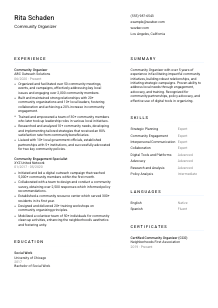
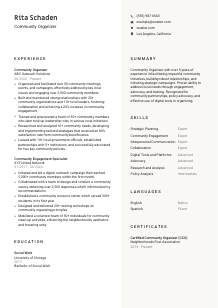
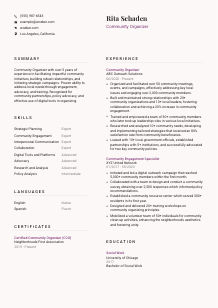
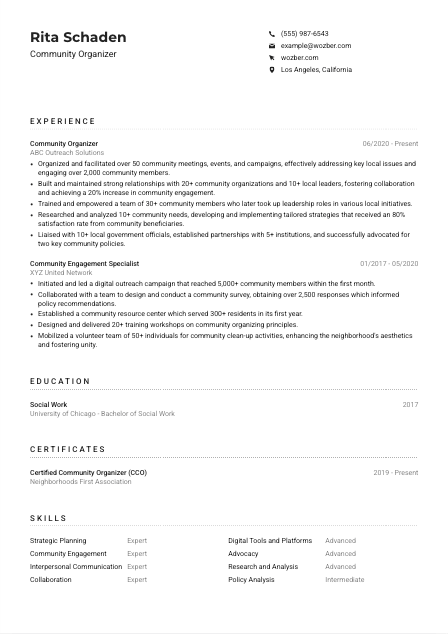
Rallying neighbors, but feeling disorganized? Check out this Community Organizer resume example, created with Wozber free resume builder. Learn how to match your grassroots gusto with job specifics, laying the groundwork for a career that always stands with the people!
Community organizing work is built on trust, follow-through, and visible results in the places you serve. Hiring teams want to see whether you can bring residents together, turn local concerns into campaigns or meetings that move something forward, and build enough credibility with partners, volunteers, and public officials to keep that work going.
A tailored resume helps your organizing record read clearly in both human review and ATS screening. Wozber's free resume builder makes it easier to align your wording with the posting, keep an ATS-friendly resume format, and surface the work that matters most here: community outreach, strategic planning, leadership development, and policy-facing collaboration.
Community organizers work through direct contact, local presence, and public-facing communication. Your personal details should make it easy to reach you and, when relevant to the posting, show that you meet practical requirements such as location and language readiness.
Use your full name in a clean, readable format at the top of the page. For a role built on relationship-building and public trust, a straightforward presentation works best. Keep it professional and easy to scan.
Place "Community Organizer" directly beneath your name if that is the role you are targeting. This immediately connects your resume to the position and helps frame the rest of your experience around organizing, advocacy, outreach, and coalition work.
Make your phone number and email easy to find and accurate. Since this work often moves quickly between interviews, follow-up calls, event coordination, and stakeholder conversations, your contact information should feel current and dependable.
If a job specifies a city or region, include that clearly in your header. Here, listing "Los Angeles, California" directly supports a stated requirement. Keep in mind that this is a tailoring move for this opening, not a rule for every community organizer resume.
Include LinkedIn or a professional website if it reinforces your organizing background. This can be useful when your profile shows campaign work, coalition partnerships, speaking engagements, volunteer leadership, or issue-based advocacy that supports the resume.
This section does not need flair. It needs accuracy, professionalism, and any logistical detail that affects eligibility for the organizing work in front of you.




Community organizing resumes are strongest when they show how you engaged people, built partnerships, developed local leaders, and produced movement on real issues. Titles matter, but hiring teams pay close attention to what changed because you organized, trained, researched, or advocated.
Read the posting closely and underline the operating verbs. For this role, that includes facilitating meetings and campaigns, building relationships across the community, training residents into leadership roles, assessing needs, and working with government or institutional stakeholders. Those phrases tell you what your bullets should emphasize.
List your most recent work first with job title, organization, and dates. For community-facing roles, clear chronology helps employers understand your progression from outreach or engagement work into broader campaign ownership, stakeholder management, or policy advocacy.
Each bullet should show what you organized, who you engaged, and what came from it. Strong examples include leading public meetings, increasing resident participation, launching a neighborhood campaign, training volunteers into captains, or turning survey findings into policy recommendations. The sample resume does this well by pairing actions like organizing events or liaising with officials with concrete results such as policy wins and increased engagement.
Numbers give scale to organizing work. Use counts and percentages that fit the field, such as number of meetings facilitated, residents reached, volunteers mobilized, partner organizations engaged, survey responses collected, workshops delivered, or community satisfaction levels. Figures like "50 community meetings," "2,000 engaged community members," or "30 trained leaders" tell a much clearer story than broad claims about impact.
Focus on organizing work that matches the posting's priorities. If the role leans toward grassroots campaigns, coalition building, and community training, reduce space for less relevant tasks and expand the bullets that show advocacy strategy, local relationship-building, digital outreach, and issue-based mobilization.
Your experience section should make it easy to picture you running meetings, building trust, mobilizing residents, and carrying community priorities into action.
Education matters here because it signals grounding in community systems, social issues, research methods, and people-centered practice. Keep the section concise, but make direct connections when your degree aligns with the kind of organizing work the employer is hiring for.
If the posting asks for a bachelor's degree in social work, community development, or a related field, present your degree clearly and use the exact discipline when it applies. In the example, "Bachelor of Social Work" is a direct match and should be easy to spot.
List degree, field of study, school, and graduation year. Hiring teams do not need a paragraph here. They need fast confirmation that you meet the educational baseline while they spend more time on your fieldwork, campaigns, and community outcomes.
When your academic background directly supports the role, let that connection stand on its own. A degree in social work, community development, public policy, sociology, or a related area helps frame your experience in needs assessment, advocacy, and community engagement.
Early-career candidates can strengthen this section with relevant coursework, capstone projects, field placements, or research tied to community health, social equity, neighborhood development, public policy, or participatory research. Keep it selective and tied to real organizing skills.
Academic honors, scholarships, or leadership in student organizations can be useful if they reflect community-facing work, research discipline, or advocacy leadership. If you already have several years of organizing experience, keep these details brief so the resume stays focused on practice.
This section should quickly show that you have the academic grounding for community-based work, then leave room for the field experience that carries the most weight.
Certifications are rarely the main decision point in community organizing, but they can strengthen your profile when they reflect advocacy, facilitation, leadership development, conflict resolution, or community engagement practice. Use them to support your experience, not to replace it.
Start with the job ad. Some community organizer roles do not require certifications, while others may value training in mediation, organizing methods, nonprofit leadership, or civic engagement. If a certificate is not requested, include only the ones that add clear relevance.
Prioritize credentials that connect to the work itself, such as community organizing, advocacy training, facilitation, volunteer management, or neighborhood leadership programs. A credential like "Certified Community Organizer (CCO)" fits naturally because it reinforces the core practice named in the role.
Show the date earned, and include an active range if the credential remains current. This is especially helpful for certifications linked to active practice, renewal cycles, or current methods in community engagement and campaign strategy.
Community work changes with policy shifts, digital outreach methods, and organizing tactics. Recent training in online mobilization, coalition-building, data-informed outreach, or public meeting facilitation can show that your methods are current and adaptable.
Relevant credentials can deepen your profile, especially when they support the same organizing, advocacy, and leadership work already shown in your experience.
This section should reflect how you actually operate in the field. For community organizers, that means balancing people skills with planning, outreach, research, facilitation, and digital tools that help coordinate campaigns and communication.
Look for both explicit and implied capabilities. In this description, that includes interpersonal communication, relationship-building across diverse communities, strategic planning, digital outreach tools, negotiation in English, research, and stakeholder engagement.
List the skills you genuinely use and phrase them in a way that matches the role. "Community Engagement," "Strategic Planning," "Interpersonal Communication," "Advocacy," and "Digital Tools and Platforms" all align well here because they reflect the actual workflows of meetings, campaigns, outreach, and coalition coordination.
Lead with the abilities most tied to performance in the job. Community organizing resumes usually benefit from putting engagement, facilitation, planning, partnership-building, outreach, research, and policy-facing communication ahead of broad soft skills. A shorter, sharper list is easier to trust and easier for ATS screening to parse.
If a skill appears here, your experience section should show where you used it through meetings led, communities reached, campaigns run, or partnerships built.
Language can shape trust, access, and effectiveness in organizing work. When roles involve public meetings, outreach, negotiation, or advocacy across diverse communities, this section can add real value rather than serving as a minor extra.
Review the posting for explicit language expectations. Here, English negotiation is essential, so English should appear first with an accurate proficiency level. That immediately addresses a stated requirement tied to stakeholder communication and advocacy work.
After the required language, include any others that help you engage residents, volunteers, partner groups, or local institutions. In a city like Los Angeles, Spanish or other widely used community languages may strengthen your application when they reflect real communication ability.
Use clear proficiency labels such as Native, Fluent, Advanced, Conversational, or Basic. Accuracy matters because community meetings, training sessions, and negotiations require real communication range, not inflated claims.
Do not overstate what you can do. If you can conduct outreach but not policy negotiation in a language, be careful how you frame it. Hiring teams may rely on this section when assigning community-facing responsibilities.
When a role is tied to a specific region, think about the language needs of that community. Additional fluency can support outreach, leadership development, and inclusive participation, but only include languages you can use confidently in real organizing settings.
Language skills matter most when they expand your ability to build trust, facilitate participation, and represent community concerns clearly.
The summary should quickly tell the reader what kind of community organizer you are, how much experience you bring, and where your strength shows up in practice. Keep it short, but make it specific enough to distinguish you from a general nonprofit or outreach candidate.
Your summary should reflect the actual emphasis of the job. If the posting leans toward grassroots campaigns, community leadership development, strategic planning, and policy advocacy, those themes should shape the language you choose in the opening lines.
Start with a direct statement such as your profession and years in the field. For example, "Community Organizer with 5+ years of experience" works because it quickly establishes both role identity and seniority without wasting space.
Use one or two sentences to name your strongest areas, such as facilitating campaigns, building coalitions, training community leaders, using digital outreach tools, or translating community needs into strategy and policy action. The sample summary works because it ties experience to engagement, advocacy, partnerships, and practical organizing outcomes.
Aim for a compact paragraph that reads naturally and matches the evidence below. Avoid generic passion statements. Use concrete terms from the field so the reader quickly understands your organizing scope and the kind of communities or initiatives you can lead.
A sharp summary should prepare the reader to see you as someone who can organize people, develop local leadership, and move community priorities into structured action.
A community organizer resume works when it shows more than commitment. It should show how you convene people, build durable partnerships, assess needs, and turn community priorities into meetings, campaigns, training, and policy movement.
Use Wozber's free resume builder to tighten the structure, align your language with the posting, and create an ATS-compliant resume that highlights the organizing work most relevant to the role. The finished document should make your field experience, local relevance, and community leadership easy to recognize.




