




Use Wozber and land your dream job
Create Resume
No registration required
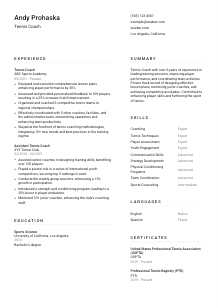
Serving aces, but your resume feels like a double fault? Step into this Tennis Coach resume example, put together with Wozber free resume builder. Learn how to spin your coaching expertise to match any job's court, serving an application that'll never get called out!
Tennis coaching resumes are strongest when they show how you develop players over time, not just that you have spent years on court. Hiring teams want to see how you structure lessons, adjust technique, build conditioning, and guide athletes through match play, especially when working with juniors or team environments. Your resume should make that progression visible through coaching scope, player outcomes, and competition results.
A tailored resume also helps separate general sports instruction from true tennis coaching experience. When your wording reflects the employer's language around lesson plans, player assessment, tournaments, and conditioning, both recruiters and an ATS can identify your relevance faster. Wozber's free resume builder helps shape that alignment into an ATS-compliant resume, so your coaching background reads clearly for the actual work the role needs.
This section is simple, but it still does important work. For a Tennis Coach, the header should confirm who you are, how to reach you, and whether you already meet practical filters such as location and role alignment.
Place your full name at the top in a clean, readable size. Keep the formatting straightforward so it looks professional on both screen and print. In coaching hires, clarity matters. A busy academy director or program lead should be able to identify your profile immediately.
Add "Tennis Coach" directly under your name if that is the role you are applying for. This helps frame the rest of the resume around player instruction, match preparation, and team coaching rather than broader sports or fitness work. If your recent role was assistant coach, you can still target the new title as long as your experience supports the step up.
Include a phone number you answer reliably and a professional email address. Tennis programs often move quickly when filling seasonal, academy, or tournament-facing roles, so missed calls and outdated contact details can cost you an interview. If you include a website or profile, make sure it reflects your coaching background, certifications, or athlete development work.
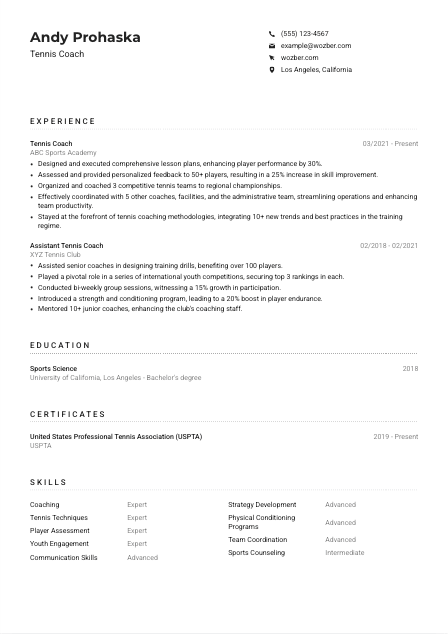
If the job asks for a specific location or relocation readiness, include your city and state. In the example, listing Los Angeles, California immediately addresses a stated requirement. Use this selectively. Location belongs here when it removes friction from the hiring decision, not as filler.
A LinkedIn profile, academy bio, or coaching website can strengthen your application if it shows certifications, competition history, training philosophy, or player results. Skip social links that do not add anything relevant. For tennis coaching, useful online proof usually means coaching credentials, program leadership, or athlete development content rather than generic personal branding.
Your header should answer the basic operational questions fast: who you are, what role you want, how to contact you, and whether you meet any immediate location requirement. That lets the rest of the resume stay focused on coaching quality and player outcomes.




Experience is the section most likely to decide whether you move forward. For a Tennis Coach, hiring teams look for signs that you can run structured sessions, improve performance, manage different player levels, and contribute to team competition or academy operations.
Before you edit a single bullet, identify the work patterns the employer cares about most. Here, that includes lesson planning, player assessment, competition coaching, coordination with other staff, and updated training methods. Your experience section should reflect those priorities in the same language where it is accurate to your background.
List your positions in reverse chronological order, starting with your current or most recent role. For this profession, job titles such as Tennis Coach, Head Coach, Assistant Tennis Coach, or Academy Coach carry important context about your level of responsibility. Employers should not have to hunt for your on-court coaching history.
Each bullet should show what you coached, how you coached it, and what changed because of your work. Strong tennis bullets often include lesson design, technical instruction, tactical development, conditioning integration, tournament preparation, or feedback loops with players and parents. The example does this well by pairing action with outcome, such as improving player performance by 30% through comprehensive lesson plans.
Quantify your impact with measures that make sense in tennis coaching. That can include player improvement rates, number of athletes coached, team placements, tournament results, attendance growth, session volume, or conditioning gains. The sample resume uses metrics like coaching 50+ players and leading teams to regional championships, which gives hiring teams a clearer picture of scale and effectiveness.
Prioritize experience that supports tennis instruction, athlete development, and team coaching. General sports duties, unrelated side jobs, or achievements outside coaching should only stay if they add something useful, such as leadership, youth mentoring, or program operations. The closer each bullet is to lesson planning, skill progression, and competitive coaching, the stronger this section reads.
By the end of this section, an employer should be able to see the level of players you coached, the structure you brought to training, and the results that followed. That is what turns experience from a timeline into a coaching case for interview.
Education matters in tennis coaching when it connects to training knowledge, athlete development, and physical preparation. A degree in Sports Science, Physical Education, or a related field tells employers you understand more than drills. It suggests grounding in movement, conditioning, and instruction.
When the posting names a bachelor's degree in Sports Science, Physical Education, or a related field, make sure that qualification is easy to spot. If your degree matches directly, place it clearly without burying it under extra detail. In the example, a Bachelor's degree in Sports Science aligns cleanly with the requirement.
List the degree, field of study, school, and graduation year or date. This section does not need heavy formatting. Hiring teams reviewing coaching resumes usually want to confirm academic background quickly before returning to experience, certifications, and athlete results.
If your studies included sports science, kinesiology, physical education, exercise physiology, or youth development, make that connection visible. Do not rename your degree to mimic the job posting, but do present the most relevant field wording accurately. The closer the academic focus is to player development and conditioning, the more useful it is here.
Early-career coaches can benefit from listing relevant coursework such as biomechanics, motor learning, strength and conditioning, or sports psychology. Experienced coaches usually do not need this unless a course directly supports the role, such as youth athlete development or injury prevention. Use it to strengthen substance, not to pad the section.
Honors, athletic leadership, or sports-related extracurriculars can help if they support your coaching identity. For example, leading a university tennis club or completing research in athletic performance adds more value than unrelated academic awards. Keep the emphasis on material that ties back to coaching judgment and athlete progress.
This section should confirm that your coaching approach rests on solid training knowledge, not just court experience. When the degree aligns with sports performance or instruction, it reinforces the technical side of your coaching profile.
Certifications carry real weight in tennis coaching because they show formal standards, current methodology, and commitment to the profession. When a posting asks for USPTA or PTR credentials, this section moves from helpful to essential.
Lead with the credentials that the employer explicitly requested. In this case, USPTA and PTR should appear before any broader fitness or coaching courses because they directly confirm tennis-specific coaching preparation. If you hold both, list both clearly rather than assuming one covers the other.
After the required tennis certifications, include other credentials only if they strengthen your candidacy for this kind of work. Useful additions might include youth coaching, first aid, strength and conditioning, or safeguarding certifications. The order should tell the employer what matters most to your coaching practice.
Show when the certification was earned and whether it is current when that information matters. In coaching, active credentials suggest you are maintaining professional standards and staying engaged with updated methods. The sample resume handles this well by showing ongoing status from 2019 to present.
Tennis coaching evolves with new training methods, youth development guidance, and conditioning practices. If you regularly renew credentials or complete continuing education, that supports the responsibility of staying current with coaching best practices. Keep the wording concise, but let employers see that your methods are current, not static.
Your certifications should quickly confirm that you meet formal coaching requirements and stay active in the profession. For jobs that specify USPTA or PTR, this section can be one of the fastest ways to clear an early screening step.
A Tennis Coach skills section should read like the toolkit behind your training sessions and match preparation. Generic soft skills are not enough on their own. Employers want to see tennis instruction, player evaluation, conditioning awareness, and communication skills that work with athletes, parents, and staff.
Start with the skills named or strongly implied in the posting. Here, that includes tennis techniques, strategy, physical conditioning, player assessment, lesson planning, and communication. This keeps the section tied to how the role is actually performed rather than filling space with broad terms.
Only list skills that show up elsewhere in your resume through coaching bullets, certifications, or summary claims. If you include "Youth Engagement" or "Strategy Development," your experience should show group sessions, junior player development, or match preparation that supports those labels. Consistency across sections makes the skills believable.
Balance technical coaching skills with a smaller set of operational and interpersonal ones. For this type of role, tennis techniques, player assessment, physical conditioning programs, and team coordination belong near the top. Communication matters too, especially when working with parents and fellow coaches, but it should sit alongside concrete coaching capabilities, not replace them.
A hiring manager should be able to scan this list and immediately understand how you coach, what areas you can teach, and how you operate within a program. Keep it tight, relevant, and grounded in the rest of your resume.
Language ability matters in coaching because instruction has to be clear in real time. Whether you are correcting technique, explaining strategy between points, or updating parents on progress, communication needs to be accurate and easy to understand.
If the posting states that English is essential, list it clearly with an honest proficiency level. For a Tennis Coach, this matters in daily instruction, safety cues, scheduling, and tournament communication. Do not assume it is obvious just because your resume is written in English.
Extra languages can be useful in academies, clubs, and youth programs with diverse player groups. If you can coach drills, explain match tactics, or speak with parents in another language, include it. In the example, Spanish adds practical value because it can widen communication with players and families.
Stick to standard terms such as Native, Fluent, Advanced, Intermediate, or Basic. Vague wording makes it hard for employers to know whether you can actually coach in that language or only handle casual conversation. Precision matters when communication is part of player development.
Not every tennis role requires multiple languages, but some do benefit from them. International programs, private coaching, tournament travel, and junior academies often involve broader communication needs. Include languages when they add functional coaching value, not simply because they appear impressive.
If you present yourself as strong in communication, the writing across your resume should reflect that. Clear bullets, direct phrasing, and specific feedback-related achievements support the same story. In coaching resumes, communication is most convincing when it appears in both the language section and the experience section.
Use this section to confirm that you can communicate effectively in the environment the role requires. For tennis coaching, that means instruction, feedback, scheduling, and relationship-building all land clearly.
The summary should give an immediate read on your coaching experience, player-development focus, and the kind of environments you have handled. For Tennis Coach roles, this is where you set the frame for the rest of the resume in a few sharp lines.
Read the posting closely and pull out the central identity of the hire. Here, the employer is looking for a coach with tennis-specific experience, structured training ability, youth coaching value, and strong communication. Your summary should reflect that professional shape before adding extra detail.
Lead with a direct statement such as your title and years of experience. "Tennis Coach with 6+ years of experience" works because it immediately anchors your level. If youth development, competitive team coaching, or academy work is a major part of your background, mention that early when it matches the role.
Choose details that matter in tennis hiring, such as designing progressive lesson plans, improving player performance, coaching teams in competition, or integrating conditioning into training. The sample summary points to training sessions, player improvement, and team coordination, which aligns well with the target job. Keep the claims specific enough to sound earned.
Aim for 3 to 5 lines with tight wording. This is not the place to list every certificate or repeat your full skills section. A concise summary helps the reader quickly understand your coaching profile before moving into the details of experience, credentials, and education.
Your summary should make one thing clear right away: what kind of tennis coach you are, who you have coached, and what results usually follow your work. When that is obvious early, the rest of the resume has a stronger frame.
A Tennis Coach resume works best when every section supports the same message: you can build players, run effective sessions, and contribute to competitive results. Keep the language close to the role, use metrics that reflect real coaching impact, and make required qualifications easy to find.
Wozber's free resume builder can help you shape that content into an ATS-friendly resume template, refine role-specific wording with AI support, and check alignment through its ATS resume scanner. The finished resume should make it easy for a hiring team to see your coaching level, training approach, and readiness to lead players on court.




