



Use Wozber and land your dream job
Create Resume
No registration required
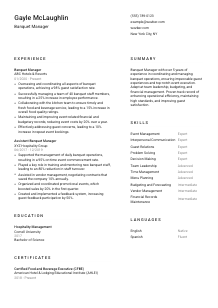
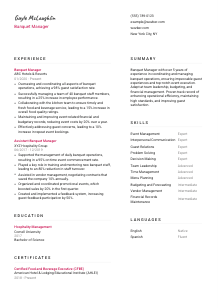
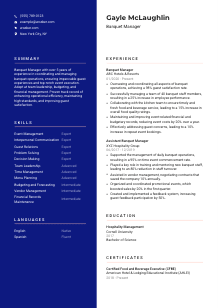
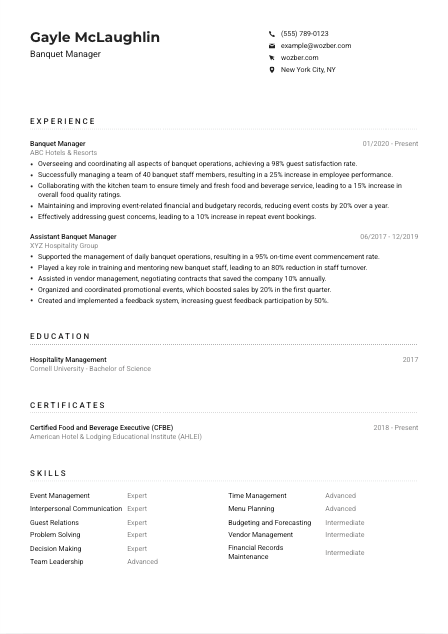
Overseeing grand feasts, but your resume feels like a cold buffet? Sample this Banquet Manager resume example, created with Wozber free resume builder. It shows how to plate your event management prowess to match job requirements, creating a career journey as sumptuous as the occasions you orchestrate!
Banquet management sits where guest experience meets live operations. Hiring teams want to see whether you can keep service timing tight, coordinate floor and kitchen teams under pressure, manage staffing across event calendars, and step in when a guest issue threatens the flow of the function. Your resume should make that operational control visible, not just say you are organized or people-focused.
A tailored resume changes how quickly your event leadership is understood, especially when an ATS screens for banquet operations, team management, budgeting, and hospitality credentials before a human review. Wozber's free resume builder helps you align those terms in an ATS-compliant resume without flattening the real story of your work, so the hiring team can quickly see who has actually run successful events at scale.
This section is simple, but it still does real work. For banquet management roles, it should confirm who you are, what position you target, and whether you meet practical requirements such as location and professional contact availability.
Use your full name in a clean, readable format at the top of the page. In hospitality hiring, resumes often move quickly between HR and operations leaders, so your name should be easy to spot and easy to remember.
Place "Banquet Manager" directly under your name when that is the role you are applying for. Matching the target title helps position you correctly from the start and keeps your resume aligned with the opening.
List a reliable phone number and a professional email address. Banquet hiring can move fast when venues need coverage for event-heavy periods, so one typo in your contact information can cost you an interview.
If the posting asks for a local candidate, show your city and state clearly. Here, listing "New York City, NY" answers a stated requirement right away and removes doubt about relocation or commuting logistics. For other applications, tailor location details to what the employer actually requests.
A LinkedIn profile or professional website can help if it reinforces your hospitality background, event leadership, awards, or venue experience. Keep it updated so it matches the roles, dates, and achievements shown on your resume.
Your personal details do not need personality flourishes. They need to confirm that you are reachable, professionally presented, and immediately aligned with the practical requirements of the banquet role.




For a Banquet Manager, experience carries the most weight because it shows how you run service in real conditions. Employers look for signs that you can coordinate teams, protect event quality, keep timing on track, manage budgets, and respond well when the room does not go exactly as planned.
Read the job description line by line and map its core responsibilities to your work history. If the role emphasizes banquet operations, staff supervision, kitchen coordination, financial records, and guest issue resolution, your bullets should show those exact areas through results and scope. In the example resume, each major responsibility from the posting appears in the experience section with a concrete outcome attached.
Start with your current or most recent banquet, catering, hotel, or events management role. For each entry, include title, employer, and dates so the reader can quickly understand your progression from support or assistant responsibilities into full event leadership.
Banquet managers are hired to deliver smooth execution, strong guest satisfaction, and profitable events. Replace general duties with results tied to service quality, staffing, revenue, costs, or repeat bookings. "Managed banquet operations" is thin. "Oversaw banquet operations across high-volume events, reaching a 98% guest satisfaction rate" gives the hiring team something they can use.
Quantify what matters in hospitality operations. Useful metrics include guest satisfaction, on-time event starts, team size, labor efficiency, food quality scores, cost control, repeat bookings, turnover reduction, and savings from vendor negotiations. The sample resume does this well with figures such as a 25% increase in employee performance and a 20% reduction in event costs.
Keep the focus on roles and achievements that support banquet, event, food and beverage, or hospitality leadership. Earlier experience can stay if it shows guest service, scheduling, vendor coordination, or team supervision, but details that do not support event operations should be minimized.
This section should leave no guesswork about your management range. By the end, a hiring manager should understand the scale of events you handled, the teams you led, and the service and financial results you consistently delivered.
Education matters here because many banquet management postings ask for hospitality training or a related degree. It helps establish that you understand service operations, event planning standards, food and beverage workflows, and the business side of venue management.
When the job asks for a bachelor's degree in Hospitality Management or a related field, make sure that information is easy to find. If your degree matches directly, as it does in the example with a Bachelor of Science in Hospitality Management, that alignment should be obvious at a glance.
List your degree, field of study, school, and graduation year. Hospitality resumes do not need academic styling. They need a format that lets the employer confirm qualifications quickly.
If you are early in your career, include coursework, projects, or campus roles connected to event planning, food and beverage operations, hotel administration, or customer experience. Once you have several years of banquet leadership, keep this section tighter unless a detail is especially relevant.
Student leadership in hospitality associations, event committees, or hotel management programs can help show early operational interest. Use these details only if they add something your work experience does not already prove.
Workshops, executive programs, or hospitality seminars can strengthen this section when they deepen your expertise in service standards, financial control, safety, or event execution. Ongoing education is especially useful if you want to show growth into larger venue or multi-event responsibilities.
Your education section should quickly confirm that you have the training foundation expected for banquet leadership. If your experience is already strong, let education support that story without competing with it.
Certifications are not mandatory in every banquet management opening, but they can add useful weight when the role touches food and beverage standards, supervision, compliance, or leadership development. They work best when they are current and clearly related to banquet operations.
Some employers list food and beverage or hospitality certifications as preferred rather than required. If the job mentions them, include yours clearly. In this case, a Food and Beverage Management-related credential lines up well with the opening, even though every banquet manager role will not ask for the exact same certification.
Choose credentials that strengthen your profile for banquet leadership, such as food and beverage management, hospitality supervision, service excellence, or event operations. The example resume uses CFBE and CHS well because both support management credibility in a hospitality setting.
List the year earned and, if relevant, the active period. This helps the employer see whether the credential is current and whether you have maintained it over time.
Banquet work changes with service standards, guest expectations, cost pressure, and venue operations. Adding relevant certifications over time can show progression from floor supervision into broader food and beverage or hospitality management responsibility.
Well-chosen certifications tell the employer that your development goes beyond day-to-day event execution. They strengthen your credibility in the parts of the role that involve service standards, team leadership, and food and beverage oversight.
The skills section should reflect how banquet managers actually work. That means combining guest-facing strengths with operational abilities such as staff coordination, scheduling, budgeting, service oversight, and communication across front-of-house and kitchen teams.
Review the posting for both stated and implied skill needs. Here, that includes interpersonal communication, cross-functional collaboration, organization, time management, and attention to detail, along with banquet operations knowledge and financial tracking. These should shape the language in your skills section.
Put the highest-value banquet skills first. Event management, guest relations, team leadership, problem solving, menu coordination, and budgeting usually matter more than broad, generic traits. The sample resume gets this mostly right by foregrounding event management, communication, and guest relations.
Do not turn this section into a long inventory. Choose skills that support the role's daily work and that are echoed elsewhere in your experience. A concise list is more persuasive when the same capabilities also appear in accomplishment bullets, staffing examples, or financial results.
A banquet manager's skills should read like the toolkit behind smooth service and well-run events. If the list reflects actual operations, staffing, guest handling, and budget control, it will support the rest of your resume instead of repeating it.
Language ability matters differently across banquet jobs, but communication always matters. In guest-facing hospitality environments, clear English is often essential for service coordination, team direction, and issue handling during live events.
If the job specifically asks for excellent English, list English prominently with an accurate proficiency level. That immediately confirms you can handle guest communication, staff direction, and vendor coordination in the language expected for the role.
List your strongest and most relevant language abilities first. For many banquet roles, that means English at the top, followed by any additional languages that could help with guest service or multicultural event environments.
Extra languages can be useful in hotels, conference venues, and high-volume event spaces where guest groups vary widely. In the example, Spanish adds practical value because it can support both guest interaction and team communication, but additional languages are a bonus, not a substitute for core banquet capability.
Use clear labels such as Native, Fluent, Intermediate, or Basic. Hospitality employers need to know whether you can comfortably manage live conversations, service recovery, and on-the-spot coordination, so accuracy matters more than ambition here.
If a second language has helped you manage guests, train staff, or support international events, that impact can also appear in your experience section. Language skills matter most when they clearly improve service delivery or team communication.
For banquet roles, language proficiency is practical. Include what you can genuinely use in guest service, team communication, or event coordination, and present it with the same honesty as the rest of your resume.
Your summary should quickly tell the employer what kind of banquet manager you are. In a few lines, it should establish your level of experience, your operating strengths, and the type of results you have delivered across events, teams, and guest service.
Before writing the summary, identify the few qualifications that matter most for the role. For banquet management, that usually includes years of experience, event operations leadership, staff management, guest satisfaction, and financial oversight.
Lead with a direct statement such as "Banquet Manager with 5+ years of experience in hotel and event operations." This gives the reader immediate context and helps separate you from candidates coming from adjacent hospitality roles without banquet leadership responsibility.
Use the middle of the summary to highlight the capabilities that define your value. Strong examples include leading banquet teams, improving guest satisfaction, coordinating food and beverage service, or controlling event costs. The sample summary works because it combines operations, team leadership, and measurable service improvement in a compact space.
Aim for 3 to 4 lines. Avoid generic claims about passion or excellence unless they are supported elsewhere on the page. A focused summary should make the employer expect to see strong banquet metrics, leadership examples, and service results in the sections that follow.
A sharp summary gives the hiring team a fast read on your banquet background before they reach the details. When it is tailored well, the rest of the resume feels consistent, credible, and clearly aimed at event operations leadership.
Your Banquet Manager resume should now show more than hospitality experience. It should show control of live event operations, confidence with staff and guest issues, and the ability to keep service quality and budgets on track at the same time.
Use Wozber to tighten the wording, check ATS optimization, and present everything in an ATS-friendly resume format that reflects the language of the job description. When the resume is tailored well, a hiring team can quickly see whether you are ready to run the room.