



Use Wozber and land your dream job
Create Resume
No registration required
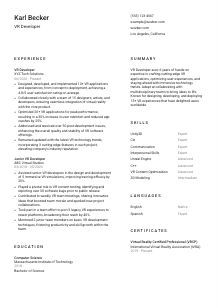
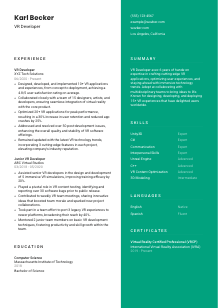
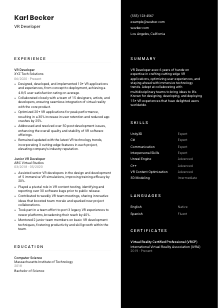
Creating virtual realms, but your resume feels stuck in reality? Check out this VR Developer resume example, created with Wozber free resume builder. It shows how to align your virtual vision with job expectations, virtually turbocharging your career path in immersive wonderlands!
VR development gets reviewed through a very practical lens. Hiring teams want to see whether you can take an immersive product from concept to deployment, work inside engine constraints, and make interaction feel smooth on target hardware. A resume for this field should quickly surface shipped work, engine fluency, programming depth, and the kind of performance tuning that keeps frame rates stable and users engaged.
When those details are tailored to the posting, the resume is easier to rank correctly in both ATS screening and human review. Wozber's free resume builder helps you line up engine names, programming languages, and VR-specific terminology in an ATS-friendly resume format, so recruiters can immediately tell whether your background matches the actual development work, collaboration model, and deployment demands of the role.
For a VR Developer, the top of the resume should feel clean and current, much like a well-prepared project handoff. This section does not need flair. It needs accurate contact details, a clear role label, and any location detail that removes friction for a team trying to fill a studio or on-site development position.
Your name should be the most visible text on the page, using a simple professional format. In a technical hiring flow where resumes are reviewed quickly alongside portfolios, GitHub links, and project histories, easy identification matters.
Use the target title under your name when it reflects your actual work, such as "VR Developer." That helps frame the rest of the resume around immersive application development rather than broader game programming, 3D art, or general software engineering.
List a working phone number and a professional email address without extra labels or clutter. If you include a website, make it worth the click by linking to a portfolio with gameplay footage, build samples, technical breakdowns, or shipped VR projects rather than a placeholder page.
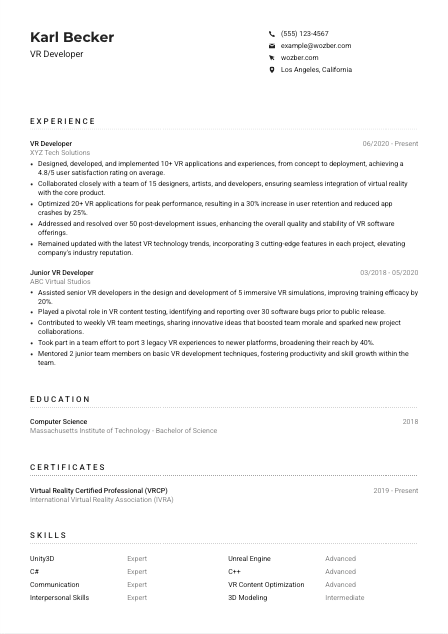
Some VR roles are tied to a studio location because of hardware access, playtesting, or cross-functional collaboration. Here, listing "Los Angeles, California" directly addresses the stated location requirement and removes an avoidable question early in the review.
A LinkedIn profile is useful, but VR hiring often benefits more from a portfolio, GitHub, or project page that shows interaction design, performance work, and engine experience. If your sample projects include Unity scenes, Unreal prototypes, or headset-specific builds, link them here.
This header area should answer three questions immediately: who you are, how to reach you, and whether you match any basic logistics such as location. Keep it tidy, current, and easy to scan so the hiring team can move straight to your technical work.




This is the section most likely to determine whether you move forward. VR teams look for more than generic software output. They want to see immersive applications built in real engines, collaboration with artists and designers, optimization work tied to user experience, and evidence that you can debug and support releases after launch.
Before rewriting your bullets, mark the responsibilities and requirements that define the work. In this posting, that includes end-to-end VR development, collaboration with multidisciplinary teams, optimization, hardware compatibility, debugging, and documentation. Those themes should show up in your experience section using your own real projects and results.
Use reverse chronological order and give each entry enough context to show scale. Include your title, company, and dates, then use bullet points to show what you actually built. For VR roles, scope can mean number of experiences shipped, target platform, training or entertainment use case, or how much of the lifecycle you owned.
Strong VR bullets connect the work to a concrete result. Instead of saying you "worked on VR apps," say you designed and implemented immersive experiences, optimized rendering or interaction systems, reduced crashes, improved retention, or resolved post-release issues. The sample resume does this well by tying development work to user satisfaction, retention, and stability improvements.
Metrics carry weight here because VR development is full of measurable constraints. Use numbers tied to shipped applications, frame-rate improvements, crash reduction, bug volume, retention, satisfaction scores, or team size. A bullet about optimizing 20+ VR applications and reducing crashes by 25% tells a hiring manager far more than a generic claim about improving performance.
Prioritize bullets that reinforce engine work, programming, optimization, testing, deployment, and cross-functional delivery. If an older accomplishment does not connect to immersive development, real-time systems, or interactive product work, trim it or rewrite it. Every line should help explain why you can build VR experiences that work reliably for users and stakeholders.
Your experience section should make your development process legible. After reading it, a reviewer should understand what you built, which tools and languages you used, how you worked with designers and artists, and what happened to product quality, performance, or user outcomes because of your work.
Education usually plays a supporting role for experienced VR Developers, but it still matters when a posting names a degree requirement. Keep the section straightforward and make the field of study easy to spot, especially when the employer is screening for a computer science, game design, or related background.
If the job asks for a bachelor's degree in Computer Science, Game Design, or a related field, present your degree in the same clear terms. A Bachelor of Science in Computer Science, as shown in the example, speaks directly to the requirement without extra explanation.
List the degree, field, school, and graduation year in a consistent order. ATS systems and recruiters both benefit from simple formatting, and there is no advantage in turning this section into a paragraph.
When your education closely matches the posting, make that alignment easy to notice. For VR roles, degrees in computer science, game design, interactive media, graphics, simulation, or related technical fields can all support your application, depending on the employer's wording.
Early-career candidates can strengthen this section with selected coursework, capstone projects, or research tied to graphics, game engines, human-computer interaction, real-time rendering, simulation, or 3D development. Keep it brief and only include work that adds clear relevance to VR production.
Honors, competition results, lab work, or student leadership can be useful when they connect to technical execution or collaborative product development. If you already have several years of professional VR experience, these details should stay secondary to shipped work and measurable outcomes.
For most VR Developers, education confirms the baseline qualification and then gets out of the way. Present it clearly, keep it relevant, and let your project and engine experience carry the heavier argument.
Certifications are optional in many VR hiring processes, but they can still strengthen your profile when they show current knowledge in immersive technology, engine workflows, or related development practices. Use this section to support your main story, not to distract from it.
Check the posting first. If no certification is required, choose credentials that still reinforce the job's core demands, such as VR development, Unity, Unreal, 3D pipelines, or adjacent technical domains that support immersive product work.
A short, relevant list is stronger than a long catalog. For a VR Developer, one respected certificate tied to immersive technology or engine expertise will land better than unrelated course badges. The sample's VR-focused certification works because it supports the role instead of competing with it.
Dates matter in fast-moving technical fields. Including the year earned, and renewal period if applicable, helps show that your knowledge is recent enough to match current engines, workflows, and platform changes.
VR development changes quickly through hardware updates, SDK revisions, rendering techniques, and interaction standards. Ongoing certification or structured learning can reinforce that you stay current, especially if your recent work does not fully show newer tools or platform exposure.
Relevant certifications can strengthen your resume, especially when they align with immersive development tools or current VR practices. They work best when they reinforce the story already told by your experience and skills.
The skills section should give a quick technical snapshot of how you build. For VR roles, that usually means engine proficiency, programming languages, optimization knowledge, and the communication skills needed to work with artists, designers, QA, and product teams through iteration and testing.
Pull the exact technical skills from the posting when they reflect your real background. Here that means Unity3D or Unreal Engine, plus C# or C++. Those terms are central to both ATS matching and human review, so they should appear clearly in your skills list and in your experience bullets.
VR projects are rarely solo efforts. Include interpersonal and communication skills when they are supported by your experience, especially if the role emphasizes multidisciplinary collaboration. In this case, those soft skills matter because the job involves working closely with designers, artists, and other developers to improve the user experience.
Do not overload the section with every tool you have touched once. Prioritize the stack and capabilities most likely to matter for delivery, such as real-time engine development, optimization, debugging, hardware compatibility, VR interaction systems, and related programming languages. A shorter list with Unity3D, Unreal Engine, C#, C++, and VR content optimization is more convincing than a broad inventory with weak relevance.
A hiring manager should be able to scan your skills and quickly understand your engine stack, programming comfort, and readiness for collaborative VR production. Keep the list tight, relevant, and consistent with the work described elsewhere on the resume.
Language skills are usually a secondary section for VR Developers, but they matter when a posting names a required working language. Use this area to confirm communication ability clearly, especially for roles involving documentation, cross-functional reviews, bug reporting, and collaboration with distributed teams or clients.
If the role asks for high fluency in English, list English at the top with an accurate proficiency label. That matters here because the work includes collaboration, testing feedback, documentation, and day-to-day coordination across functions.
Additional languages can be helpful for global teams, international clients, or multilingual content environments, but they should stay secondary to the required language. Keep them if they are real strengths and relevant to the type of products or teams you work with.
Choose clear labels such as Native, Fluent, Intermediate, or Basic. Inflated language claims become obvious in interviews, standups, documentation tasks, or collaborative reviews, so accuracy matters.
If you have worked on international teams, user research across regions, or client-facing builds, extra languages can add context. Otherwise, keep this section brief and factual rather than trying to turn it into a major selling point.
Language ability changes with use. If you are actively improving a language that matters for collaboration or market reach, reflect that accurately. If not, avoid overstating it just to fill space.
For this kind of posting, the main job of the language section is simple: confirm that you can work in English at the level the role requires. Any additional languages should add useful context, not noise.
The summary sits at the top of the resume, so it needs to establish your level, technical focus, and strongest value quickly. For VR roles, that usually means years of experience, engine and language strengths, the kind of immersive products you build, and one or two results that suggest quality, performance, or shipping range.
Review the posting before writing your summary and choose the two or three points that matter most. For this role, those are professional VR development experience, Unity3D or Unreal Engine proficiency, C# or C++ strength, and collaboration across disciplines.
Start with a direct line such as "VR Developer with 6 years of experience" or the equivalent that matches your background. That immediately places you in the right lane and prevents confusion with general game development, XR design, or unrelated software work.
Use the next sentence to anchor your profile in real work. Mention shipped VR applications, optimization wins, user satisfaction, training outcomes, or engine expertise. The example summary points to 15+ VR experiences and collaborative delivery, which gives the reader both scale and context.
Aim for a short paragraph, not a mission statement. Replace vague enthusiasm with specifics like immersive application development, performance optimization, debugging, user interaction, or cross-functional delivery. Also correct any language errors here, because the summary is one of the first sections a reviewer will read.
A well-written summary should quickly tell the reader that you have real VR development experience, the right engine and programming background, and a track record of building experiences that perform well in production. Make those points clear in the first few lines.
A VR Developer resume should read like a record of shipped immersive products, engine-level execution, and practical performance work. If your sections clearly show what you built, how you collaborated, which tools you used, and what improved because of your contribution, the hiring team can make a much faster decision about your fit for the role.
Wozber can help you tighten that alignment through its ATS resume scanner, AI-assisted tailoring, and ATS-friendly resume templates, making it easier to match your language to the posting without losing technical accuracy. The final version should make one thing obvious: you can build VR experiences that hold up in development, testing, and release.




