



Use Wozber and land your dream job
Create Resume
No registration required
Devising digital strategies, but your resume isn't coding correctly? Browse this Software Consultant resume example, created with Wozber free resume builder. Learn how to align your technology insights with job specs, paving the way for your career to compile error-free and with optimal efficiency!
Software consultants are hired to turn messy business needs into workable technical decisions. Hiring teams want to see that you can gather requirements, evaluate existing systems, work credibly with developers and project managers, and explain the solution clearly enough for clients to trust it and use it.
The first screen often comes down to whether your resume makes that client-to-implementation range obvious. Using Wozber's free resume builder to align your wording with the posting and keep an ATS-compliant resume structure helps surface the right mix of consulting, software delivery, and communication so reviewers can quickly see you in front of clients and inside delivery teams.
This section does more than identify you. For a Software Consultant, it establishes practical fit fast, especially when the employer cares about title alignment, client-facing professionalism, and location requirements. Keep it clean, credible, and directly relevant to the role you are targeting.
Use your full name in a larger, readable font so it stands out immediately. In consulting roles, where your resume is often reviewed alongside client-facing candidates, a polished header helps set a professional tone before the reader gets into project work or technical depth.
Place "Software Consultant" directly below your name when that title reflects the work you want. This creates instant alignment with the posting and helps frame your background in consulting terms, even if your recent title was closer to Senior Software Developer or Software Engineer.
Your contact information should be easy to scan and easy to trust. Use the phone number you answer, and an email address that looks professional in a client-services environment.
If the job calls for a candidate based in a specific city, include that in your header. Here, listing San Francisco, California immediately addresses a stated requirement and removes a question that could otherwise slow down your application.
Include LinkedIn, a portfolio, or a professional website only if it supports your resume with matching information. For Software Consultants, this can be useful when it reinforces technical breadth, project history, certifications, or thought leadership around software delivery and system improvement.
Your personal details should answer the basics without friction: who you are, what role you do, how to reach you, and whether you meet practical requirements such as location. When this section is tight, the reader can move straight to your consulting and software delivery experience.




This is the section that usually decides whether a Software Consultant gets serious attention. Employers are looking for more than coding history. They want to see requirement gathering, system analysis, implementation support, cross-functional coordination, and outcomes clients would care about, such as efficiency gains, adoption, delivery speed, or uptime.
Start by marking the parts of the job description that define the role: software development or IT consulting experience, client consultation, system analysis, cross-functional delivery, and training or support. Then shape your bullets so those threads appear clearly in your recent work instead of being buried under generic engineering tasks.
List positions in reverse chronological order with job title, company, and dates. That structure matters because hiring teams want to see how your work progressed from hands-on development into broader consulting, solution design, or stakeholder-facing responsibility.
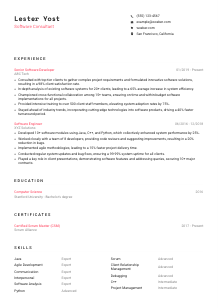
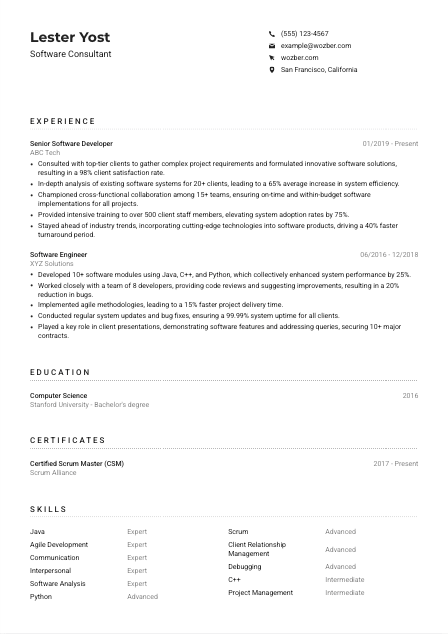
Each bullet should show how you diagnosed a problem, recommended a solution, delivered with others, or helped users adopt the result. The sample resume does this well by emphasizing client requirement gathering, analysis of existing systems, collaboration across teams, and post-implementation training instead of listing routine development duties alone.
Use numbers that reflect how software consulting work is judged: client satisfaction, efficiency improvements, bug reduction, delivery speed, adoption rates, uptime, contract wins, or team scope. Metrics such as a 65% efficiency increase, 75% adoption lift, or 99.99% uptime give your recommendations and implementation work real weight.
If an older role or bullet does not support your case for software consulting, trim it or rewrite it. Keep the focus on work that shows solution design, client interaction, technical analysis, programming depth, or delivery leadership. A shorter, sharper set of bullets is far more useful than a long history that reads like a generic developer resume.
Your experience section should make one thing unmistakable: you can understand a client's problem, translate it into software decisions, and help carry the solution through delivery and adoption. When your bullets show that progression with concrete results, your background reads like true consulting experience rather than adjacent engineering work.
For Software Consultant roles, education usually serves as baseline technical proof rather than the main selling point. Still, when the posting asks for a bachelor's degree in Computer Science, Information Systems, or a related field, this section needs to confirm that requirement clearly and without extra digging.
If the job asks for a bachelor's degree in Computer Science, Information Systems, or a related discipline, list that information plainly. Put the degree, field, school, and graduation year in a standard format so reviewers can verify your academic background in seconds.
Avoid over-formatting here. A clean entry with degree, institution, and date is usually enough for experienced Software Consultants, especially when your experience section already carries the heavier proof of consulting impact and technical delivery.
If your degree directly matches the posting, make that visible. A Bachelor's degree in Computer Science, like the one in the example, immediately supports your credibility for software analysis, architecture discussions, and collaboration with engineering teams.
Early-career candidates can benefit from listing coursework, capstones, or academic projects tied to software engineering, systems analysis, databases, or development methodologies. For more experienced candidates, include these only if they reinforce a specialization that matters to the target role.
Honors, scholarships, technical clubs, or major projects can add value when they relate to leadership, software delivery, or problem-solving. If they do not strengthen your current consulting profile, leave them out and keep the section efficient.
This section does not need to do too much. It needs to show that you meet the academic requirement and have the technical grounding to work credibly with software teams and clients. Clear formatting and relevant field alignment do that well.
Certifications matter most here when they support how you deliver software work, especially in consulting environments where methodology, planning cadence, and stakeholder coordination affect project success. They are rarely the core qualification, but they can strengthen your profile when they match the way teams actually build and implement solutions.
Review the posting for methodology or process cues. When Agile, Scrum, or similar delivery approaches appear, list certifications that support your ability to work inside iterative development cycles and cross-functional implementation teams. In this example, CSM and PMI-ACP align naturally with that expectation.
Choose certifications that deepen your value as a Software Consultant, not every credential you have earned. Methodology, cloud, architecture, or platform certifications can be useful if they connect to the kinds of systems, workflows, or client environments you target.
If a certification is active, renewable, or recently earned, include the date or validity range. That helps employers see whether your training reflects current practices rather than an outdated methodology badge from years ago.
Consultants are often expected to recommend current approaches, tools, and development practices. Updating certifications over time signals that you stay engaged with changing delivery models, emerging technologies, and the standards clients expect when they bring in outside expertise.
A short list of well-chosen certifications can strengthen your consulting profile, especially when it supports Agile delivery, stakeholder coordination, or modern software practices. Keep the focus on credentials that help explain how you lead projects and implement solutions.
Software Consultant resumes need a balanced skills section. Technical ability gets you credibility with engineering teams, but consulting work also depends on analysis, communication, stakeholder management, and implementation support. Your list should show both sides without turning into a keyword dump.
Read the posting for both explicit and implied skill requirements. Here that includes programming languages such as Java, C++, or Python, along with communication, interpersonal strength, client-facing work, and familiarity with software development methodologies.
Lead with capabilities that directly support the target role. A combination like Java, Python, software analysis, Agile development, communication, and client relationship management tells a much fuller consulting story than listing only programming languages or only soft skills.
Do not crowd this section with every framework, library, or tool you have touched. Pick the skills most likely to matter in software consulting work: programming proficiency, systems analysis, debugging, project coordination, training, and client communication. The sample resume works because the skills list mirrors the role without becoming bloated.
A useful skills section shows that you can contribute in technical discussions and in client conversations. When the list is tailored, a hiring team can quickly picture you gathering requirements, evaluating systems, and helping deliver the solution with the right team.
Language skills matter more in consulting than in many purely internal engineering roles because the work often includes workshops, presentations, documentation, training, and support. If the posting names a required language, make that easy to find and state your proficiency honestly.
Start with the job description. In this case, the employer explicitly asks for proficiency in spoken and written English, so your resume should confirm that requirement without making the reviewer search for it.
List English prominently and label your level clearly, whether that is Native, Fluent, or another accurate description. For a Software Consultant, this matters because communication is part of requirement gathering, client training, and day-to-day coordination across teams.
Extra languages can strengthen your profile if you work with multinational stakeholders, distributed delivery teams, or client organizations across regions. They are not mandatory in every role, but they can signal broader client versatility.
Stick to plain descriptions such as Native, Fluent, Intermediate, or Basic. That gives hiring teams a practical sense of how you can contribute in meetings, written documentation, and support situations.
If you speak more than one language, think about where that helps in your work: stakeholder calls, user training, technical documentation, or client workshops. Even when English is the only stated requirement, additional language skills can support implementation and adoption across varied user groups.
For Software Consultants, language ability is valuable when it helps you explain systems, train users, and manage client communication clearly. Keep this section accurate and practical, with English easy to spot and any additional languages positioned as added reach.
Your summary is where the reader gets the quickest version of your profile. For this role, it should establish years of relevant experience, technical range, consulting value, and the kind of outcomes you deliver. Keep it concise, but make it specific enough to separate you from a general software engineer.
Look at the role's main demands before you write: software development background, consulting or advisory work, client communication, system analysis, collaboration, and modern delivery practices. Those should shape the summary more than generic claims about being driven or results-oriented.
Start with your title or professional identity and years of relevant experience. A line such as "Software Consultant with 6+ years in software development and consulting" tells the reader immediately whether your background is in the right lane.
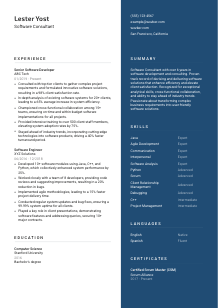
Mention two or three strengths that reflect the role, such as translating business requirements into software solutions, improving system performance, working across delivery teams, or training client users after implementation. The example summary does this effectively by combining consulting experience with efficiency gains, collaboration, and client satisfaction.
Aim for three to five lines with concrete wording. Skip broad adjectives unless they are backed by specifics. Your summary should quickly tell a hiring manager whether you can advise clients, understand systems, and guide software solutions from recommendation to rollout.
A well-written summary helps the reader place you correctly from the first few lines. For a Software Consultant, that means showing technical depth, consulting credibility, and client-facing delivery in one compact paragraph. Get that right, and the rest of the resume lands more clearly.
A Software Consultant resume should make three things easy to recognize: you can understand client requirements, recommend sound technical solutions, and help those solutions succeed in real delivery environments. Every section should support that story, from the title in your header to the metrics in your experience bullets.
Use Wozber's free resume builder, ATS-friendly resume templates, and ATS resume scanner to tighten your wording, align your resume with the job description, and present your background in a format that supports ATS optimization. The result should make your consulting range, technical credibility, and implementation experience easy to judge.




