



Use Wozber and land your dream job
Create Resume
No registration required
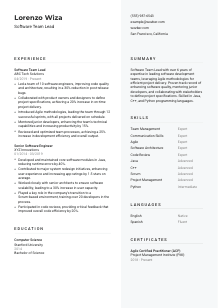
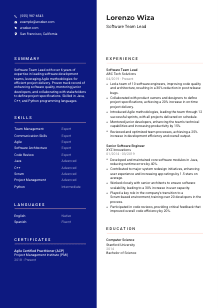
Guiding a crew of code warriors, but your resume seems to be stuck in a version control conflict? Sort out the syntax of success with this Software Team Lead resume example, created with Wozber free resume builder. Learn how to frame your coding leadership to match job prerequisites, scripting a professional journey that puts you at the front of the line.
Software Team Leads sit at the intersection of engineering quality and team execution. Hiring teams want to see more than years of coding experience. They look for proof that you can guide architecture decisions, run delivery in a real sprint cadence, coach engineers through code reviews, and keep cross-functional work moving when priorities shift.
When that leadership scope is buried under generic software bullets, your resume can read like a senior developer profile instead of a team lead one. Wozber's free resume builder helps you shape an ATS-compliant resume around the language of the role, so leadership signals like mentoring, sprint ownership, delivery outcomes, and stakeholder collaboration are easier to surface early.
For a Software Team Lead, the top of the resume should immediately look credible, current, and easy to act on. This section is simple, but it still carries practical value. Hiring teams need a clean way to contact you, confirm location when it matters, and see that your professional profile matches the level of technical leadership you're targeting.
Use your full name in a clean, readable format that suits a senior technical professional. Keep it more prominent than the rest of the header so the document feels polished and organized from the first line.
Place "Software Team Lead" directly under your name when that is the role you are applying for. It frames the rest of the resume correctly, especially if your recent background includes titles such as Senior Software Engineer, Engineering Lead, or Technical Lead.
Use a reliable phone number and a professional email address, ideally in a simple format such as firstname.lastname@email.com. Add a personal website, GitHub, or LinkedIn only if it supports your leadership and technical credibility with relevant projects, architecture work, publications, or team achievements.
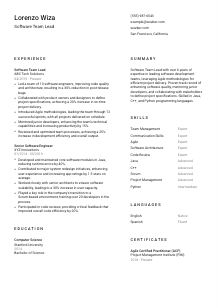
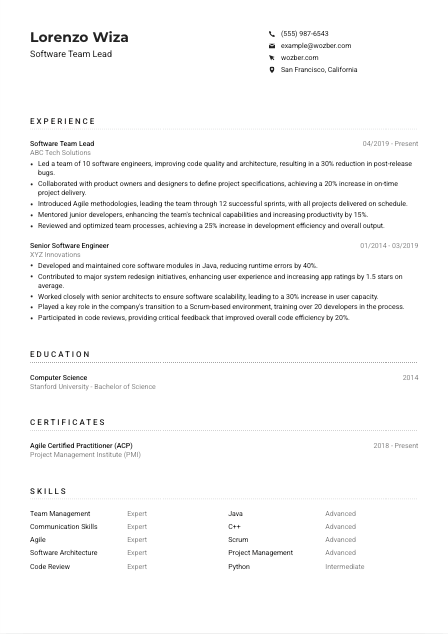
Some Software Team Lead roles are flexible, while others have a firm office or regional requirement. Here, the employer specifies San Francisco, California, so listing that location in your header removes an immediate question. The example resume handles this well by showing city and state clearly without adding unnecessary address detail.
If you include LinkedIn, GitHub, or a portfolio link, keep the titles, dates, and scope consistent with the resume. For leadership roles, mismatches in job level, team size, or dates can raise doubts fast, especially when reviewers are trying to confirm progression from hands-on engineering into people and delivery leadership.
This section does not win the interview on its own, but it can quietly strengthen your application by confirming role target, location fit, and professionalism before the reader reaches your engineering and leadership experience.




This is the section that carries the most weight for a Software Team Lead resume. Employers want to understand how you led engineers, improved delivery, influenced architecture, and worked across product and design without losing technical credibility. Your bullets should show how the team performed under your guidance, not just which tools you used.
Start by marking the responsibilities and requirements that define the role. For this position, that includes leading engineers, improving code quality and architecture, collaborating with product owners and designers, running Agile or Scrum delivery, and supporting hiring or performance conversations. Those themes should appear in your experience section in natural language, backed by real outcomes.
List positions in reverse chronological order and make the move from individual contributor to lead easy to follow. For Software Team Lead hiring, that progression matters. A reader should be able to see how you moved from building systems yourself to guiding other engineers, setting standards, and owning delivery quality across a team.
Use accomplishment bullets that connect your actions to delivery, quality, scale, or productivity. The example does this effectively with results like a 30% reduction in post-release bugs, a 20% increase in on-time delivery, and a 25% gain in development efficiency. Those are the kinds of metrics that make team leadership tangible in software organizations.
Do not overload this section with every feature you ever shipped. Focus on work that shows code review standards, architectural input, sprint leadership, mentoring, cross-functional planning, process improvement, and team growth. If you include earlier engineering roles, select bullets that show the foundations of leadership, such as training peers, guiding redesigns, or influencing development practices.
A Software Team Lead is still expected to understand systems, code quality, and technical tradeoffs. Mention the languages, stacks, or engineering practices you actually used, especially when they connect to outcomes. In the example, Java, Agile, Scrum, code reviews, and scalability work all reinforce that the candidate can lead technical discussions, not only manage people.
By the end of this section, a hiring manager should be able to picture you leading sprints, guiding engineers, improving software quality, and keeping delivery on track across functions. That is the standard this role is hired against.
For a senior software leadership role, education is usually not the main decision point, but it still matters. It confirms the technical baseline, helps satisfy formal requirements, and can support your credibility when the posting asks for a degree in Computer Science, Engineering, or a related discipline.
If you hold a Bachelor's degree in Computer Science, Engineering, or a closely related field, list it clearly and exactly. This posting asks for that academic background, so there is no reason to make a reviewer search for it. The example makes this straightforward with a Bachelor of Science in Computer Science.
Include the degree, field of study, school name, and graduation year. At this level, clarity matters more than detail. Hiring teams usually want to confirm that the educational requirement is met and move on to your engineering and leadership track record.
If your degree aligns closely with software development, distributed systems, computer engineering, or a related technical path, let that work in your favor. It reinforces the foundation behind your architecture decisions, debugging approach, and understanding of software design principles.
Senior candidates do not need to turn the education section into a history lesson. Include standout academic projects, research, or honors only if they strengthen your case for the target role. A systems project, compiler work, or team-based capstone can be worth mentioning if it ties directly to engineering leadership or technical depth.
If recent coursework, cloud training, or architecture programs are more relevant than older academic details, keep the education section clean and let certifications or other sections carry that update. For Software Team Lead roles, current knowledge of delivery methods, tooling, and engineering practices often matters more than expanding old university content.
This section should confirm the required technical foundation quickly, then let your experience carry the argument for leadership, delivery ownership, and software engineering judgment.
Certifications are not mandatory in every Software Team Lead search, but the right ones can add useful context. They are most valuable when they reinforce how you lead delivery, guide engineering practices, or stay current with the methods and platforms your teams use.
Look at the posting before deciding what belongs here. This role emphasizes Agile or Scrum-based delivery, so an Agile certification is relevant because it supports sprint planning, delivery cadence, and team process leadership. That is a much stronger choice than listing unrelated credentials just to fill space.
A few targeted certifications are more convincing than a crowded section. For a Software Team Lead, certifications in Agile delivery, cloud platforms, software architecture, security, or engineering management can all make sense when they connect to your actual responsibilities. The example's Agile Certified Practitioner works because it directly supports the delivery model named in the job description.
Add the issue date and renewal status when the timing helps show currency. This is especially useful for certifications tied to active frameworks, cloud ecosystems, or methodologies that evolve over time. A current certification can strengthen your case that your process knowledge is still in active use.
As you move deeper into team leadership, update certifications to reflect the kind of problems you now solve. That may mean Agile coaching, cloud architecture, DevOps practices, or secure software development rather than entry-level technical badges. The best certification mix supports how you lead software teams today.
This section works best when it supports the delivery methods, technical context, and leadership responsibilities already shown in your experience, rather than trying to introduce a separate story.
The skills section should mirror how Software Team Leads are actually evaluated. That means balancing technical fluency with delivery leadership, communication, and team development. A long inventory of tools is less useful than a focused set of skills that matches the role's engineering environment and management scope.
Use the posting to identify the must-have skills first. Here, that includes proficiency in a major programming language such as Java, C++, or Python, experience with Agile or Scrum, and strong communication for cross-functional collaboration. Those belong near the top because they match the employer's language and ATS screening terms.
For this level, the best mix usually includes leadership skills such as mentoring, team management, sprint planning, stakeholder communication, and performance feedback alongside technical skills such as software architecture, code review, and programming languages. The example resume handles this well by combining Team Management, Communication Skills, Agile, Software Architecture, and Java.
Only include skills you can support in your experience. If you list Scrum, your work history should show sprint ceremonies or delivery ownership. If you list software architecture, your bullets should show system design, scalability work, or technical guidance. A shorter list with clear backing is stronger than a broad list with no proof.
For a Software Team Lead, the right skills section should make it obvious that you can guide engineers, contribute technically, and keep delivery moving across an Agile environment.
Language skills matter more for Software Team Leads than they do for many purely technical roles because the job often includes sprint planning, stakeholder discussions, mentoring, and performance conversations. If the posting specifies communication requirements, treat the section as functional information, not as an afterthought.
This role explicitly requires high-level English communication skills, so English should appear first with an honest proficiency label. If you work in English across architecture reviews, retrospectives, product discussions, and one-on-ones, make that visible immediately.
Additional languages can be useful when teams are distributed, customer-facing, or globally staffed. They are not always a deciding factor for Software Team Lead roles, but they can strengthen your profile when collaboration spans regions or when the company operates across multilingual engineering teams.
Choose straightforward labels such as Native, Fluent, Intermediate, or Basic. Overstating language ability can create real problems in an interview or on the job, especially for leadership roles that rely on precise communication in planning sessions, feedback conversations, and stakeholder updates.
If the target company works across product, design, engineering, customer teams, or international offices, language skills can support smoother execution. Keep that connection practical. The value is not just cultural range. It is your ability to reduce friction in meetings, documentation, and team coordination.
If you actively use another language in technical discussions, documentation, or leadership settings, reflect that. In the example, Spanish is listed as Fluent, which is useful because it adds real communication breadth without distracting from the required English proficiency.
For this role, language skills should clarify how well you can lead discussions, coordinate work, and communicate with technical and non-technical partners, especially when English proficiency is a stated requirement.
The summary should quickly establish that you are already operating at lead level or are ready to step into it. For software leadership roles, that means combining team scope, delivery method, technical foundation, and measurable outcomes in a few tight lines. Skip broad personality claims and focus on how you lead engineering work.
Use the job description as your guide for what belongs here first. For this role, that means leadership experience, software development depth, Agile delivery, cross-functional collaboration, and proficiency in major programming languages. Your summary should reflect those themes in natural wording rather than copying the posting line by line.
Start with a direct statement about your background, such as years in software development and years leading teams if the distinction is meaningful. This helps the reader place you quickly. The example summary does this well by combining team leadership experience with Agile delivery and technical strengths.
Use one or two specifics that show the impact of your leadership, such as improving code quality, mentoring developers, increasing delivery reliability, or shaping project specifications with product and design partners. Keep the examples broad enough to fit the summary, but specific enough to sound earned.
Aim for 3 to 5 lines that a hiring manager can scan in seconds. If every sentence points back to engineering leadership, delivery, and technical credibility, the summary does its job. Save longer detail for the experience section, where metrics and scope can be expanded properly.
When this section works, the reader enters your experience expecting to see a software leader who can guide engineers, collaborate across functions, and deliver well-built systems on schedule.
A Software Team Lead resume needs to show that you can do three things at once: support engineers, make sound technical decisions, and keep delivery moving in a structured development environment. When those strengths are clear across your summary, experience, skills, and supporting sections, your application reads like a lead profile rather than a general senior engineer resume.
Use Wozber's free resume builder, ATS-friendly resume templates, and ATS resume scanner to align your wording with the job description, strengthen ATS optimization, and present your experience in a format that hiring teams can review quickly. The finished resume should make one thing easy to judge. You can lead software work and the people doing it.