



Use Wozber and land your dream job
Create Resume
No registration required
Leading teams and code, but your resume feels like it's caught in a loop? Check out this Director of Software Engineering resume example, created with Wozber free resume builder. Learn how to channel your technical brilliance to match job expectations, keeping your career trajectory error-free and always pushing for the latest release!
A Director of Software Engineering is expected to do far more than oversee delivery. The role sits at the point where architecture choices, engineering process, hiring, and team performance start affecting product strategy and business results. Your resume needs to make that operating range visible, especially through examples of team scale, delivery ownership, and improvements to engineering quality or execution.
Screening for this level often starts with one practical question: can this person lead engineering at scale without losing technical judgment? A tailored resume, built with Wozber's free resume builder and shaped for ATS optimization, makes that easier to answer by surfacing the right combination of leadership scope, system delivery, and process impact in language that matches the role.
At director level, the contact section should feel clean, current, and easy to trust. Hiring teams do not need decoration here. They need quick confirmation that you are reachable, professionally presented, and, when relevant to the posting, already based in the required market.
Use your full name as the visual anchor at the top of the resume. Keep it more prominent than the rest of the contact details so the document reads like an executive profile, not a generic application form.
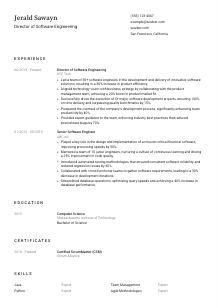
Place the role title directly under your name when it reflects the position you are pursuing. Using "Director of Software Engineering" immediately sets the frame for team leadership, delivery ownership, and technical strategy rather than leaving the reader to infer your level from later sections.
List a reliable phone number and a professional email address. Executive engineering hiring moves through recruiter screens, stakeholder interviews, and follow-up scheduling quickly, so this information needs to be obvious and accurate.
If a role requires a specific location, show it plainly in your contact details. In the example, listing San Francisco, California answers a stated requirement right away and prevents unnecessary questions about relocation or availability.
Include a LinkedIn profile, portfolio site, or company-facing professional website if it reinforces your leadership story. For an engineering director, that might mean a profile that shows progression into people leadership, cross-functional work with product teams, or public technical credibility through talks, writing, or shipped platforms.
This section should confirm the basics fast and support the level of role you want. Clear title alignment, professional contact details, and any stated location requirement help the reader move straight to your leadership record.




For a Director of Software Engineering, experience is where the resume either gains traction or loses it. Hiring teams look for proof that you have led engineers, improved delivery systems, partnered with product leaders, and guided technical decisions in environments where scale, quality, and timelines all matter at once.
Read the posting closely and identify the operating themes behind it. Here, the emphasis is on leading engineers, aligning technology with business strategy, improving development process, and delivering scalable software on time. Those themes should shape which accomplishments you highlight and how you phrase them.
Start with your most recent position and make progression easy to follow. At this level, titles, team scope, and company context matter, so each entry should quickly establish where you led, what level you operated at, and how your responsibilities expanded over time.
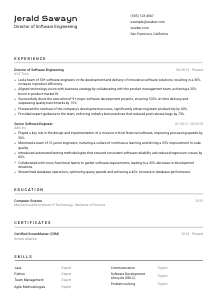
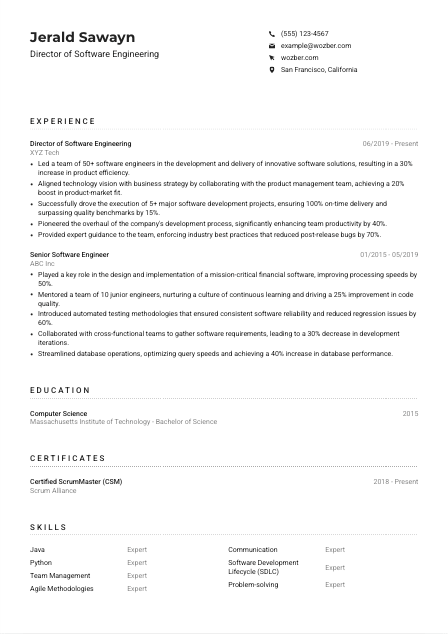
Focus each bullet on leadership decisions and organizational results, not just technical tasks. Strong examples include leading multi-team delivery, raising engineering productivity, reducing defect rates, shaping architecture for scale, or partnering with product to improve roadmap execution. The sample resume does this well by showing a team of 50+ engineers, multiple major projects, and measurable gains in efficiency, quality, and product-market fit.
Numbers carry more weight when they reflect how engineering performance is judged. Use metrics tied to throughput, uptime, release quality, defect reduction, latency, developer productivity, cost efficiency, or delivery predictability. Results like 100% on-time delivery, a 40% productivity increase, or a 70% drop in post-release bugs give concrete shape to leadership impact.
Prioritize achievements that show organizational influence, technical direction, and cross-functional leadership. Earlier hands-on engineering work can stay when it supports your credibility, especially if it shows system design, reliability, or mentoring, but the center of gravity should stay on how you lead teams and improve execution at scale.
Your experience section should leave little doubt about the size of teams you have led, the systems you have helped ship, and the operational improvements you have driven. For this role, that is the material that turns a technical background into a director-level candidacy.
Education matters differently at director level. It is usually not the main reason you get interviewed, but it still confirms the formal technical base behind your engineering judgment, especially when the posting asks for a degree in computer science, software engineering, or a related field.
When a posting specifies an academic background, make sure your education section answers it directly. In this case, a bachelor's degree in Computer Science, Software Engineering, or a related field is requested, so matching that language where accurate helps your resume line up cleanly with the role.
List degree, field of study, school, and graduation year in a simple structure. That keeps the section readable for both ATS parsing and human review, especially when the hiring team is moving quickly through senior candidates.
Use the official degree title rather than a shortened variation. "Bachelor of Science in Computer Science" is stronger and more searchable than a vague reference, and in the example it directly supports the stated requirement.
Most Director of Software Engineering resumes do not need detailed coursework. Include academic projects or specialized study only if they support a niche domain, unusual technical depth, or a transition that your work history alone does not explain.
Honors, clubs, or distinctions are optional at this stage. Include them only if they carry real weight, such as a highly competitive program, standout research, or an achievement that still adds context to your leadership path in engineering.
This section should quickly confirm that you meet the educational baseline and let the rest of the resume do the heavier lifting. Clear degree wording is usually all you need.
Certifications are secondary to execution history for engineering directors, but they can still strengthen the resume when they reinforce how you lead teams, run delivery, or stay current with engineering practices. The key is relevance, not volume.
Start by seeing whether certifications are required or simply useful. If none are listed, choose credentials that support the role's actual work, such as delivery leadership, agile execution, cloud platforms, security, or architecture governance.
A short, targeted list is stronger than a long catalog. In the example, Certified ScrumMaster supports the posting's focus on development methodologies and process improvement. That kind of certificate adds context because it connects to how the engineering organization runs.
Show the year earned and, if relevant, current validity. For software leadership roles, dates help the reader understand whether the credential reflects active knowledge or older training that may no longer match current tooling and delivery practices.
Engineering leaders are expected to evolve with changes in architecture patterns, platform operations, team structures, and delivery methods. If you pursue certifications, choose ones that deepen your ability to lead modern software organizations rather than collecting unrelated badges.
Certificates should reinforce your leadership and technical range, not compete with your experience section. If they sharpen your story around delivery, process, or platform scale, they belong here.
The skills section for a Director of Software Engineering should reflect the blend of technical depth and organizational leadership the role requires. This is where you make it easy to spot the languages, delivery methods, and management capabilities that support your experience.
Review the posting for the core capabilities it names directly and the ones it implies. Here that includes programming languages such as Java, Python, and C++, along with software development methodologies, scalable systems, infrastructure knowledge, communication, and team management.
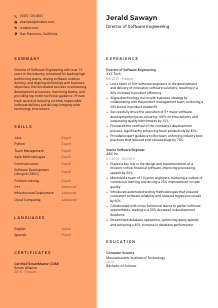
Choose skills that match the level of work you want to lead. For this kind of role, that usually means a mix of engineering languages, SDLC and agile practices, architecture or infrastructure knowledge, and people leadership. The example balances this well with Java, Python, Agile Methodologies, Team Management, SDLC, and Infrastructure Deployment.
Do not overload the section with every tool you have touched. A shorter list of relevant skills reads better and aligns more cleanly with ATS matching. Every skill should be something you can back up through achievements, team oversight, or technical decisions described elsewhere in the resume.
An effective skills section should make your leadership profile and technical fluency visible in one quick scan. That combination matters more than an oversized list of tools.
Language details are usually brief on an engineering resume, but they still matter when the posting names a communication requirement or when the role works across distributed teams, customers, or international stakeholders. Keep this section factual and useful.
If the posting specifies language proficiency, list that language first with an honest level. Here, English is explicitly required, so placing it at the top helps answer that point immediately.
Additional languages can be worth listing when they reflect team coverage, customer communication, or regional business context. For example, Spanish may be useful in some engineering organizations, but it should remain secondary unless the role specifically benefits from it.
Stick to familiar terms such as Native, Fluent, Intermediate, or Basic. They communicate your level quickly and avoid the ambiguity that comes with informal wording.
If you have led distributed engineering teams, worked with offshore partners, or supported products in multiple markets, language capability can add practical value. Include it when it helps explain smoother collaboration across those settings.
Languages are supportive information, not a headline qualification for most software engineering director roles. Keep the section concise and accurate so it complements, rather than distracts from, your leadership and delivery record.
For this role, language details should quickly confirm communication readiness and then step out of the way. Lead with required English proficiency and include additional languages only when they add real context.
The summary at the top of a Director of Software Engineering resume should establish level, scope, and leadership value in a few lines. It works best when it connects engineering execution to business outcomes rather than repeating generic claims about being strategic or results-driven.
Before writing, identify what the job expects this leader to own. In this case, that includes software delivery, scalable systems, engineering process, technical guidance, and alignment with business strategy. Your summary should reflect that mix instead of leaning only on years of experience.
Lead with a direct statement of your professional identity and tenure, such as being a Director of Software Engineering with 10+ years in software engineering and several years in leadership. That immediately places you in the right candidate pool.
Follow with two or three specifics that mirror the role. Strong options include leading high-performing engineering teams, improving development processes, delivering large-scale software systems, and partnering with product leadership. The sample summary works because it connects team leadership, delivery, and technology-business alignment in one concise block.
Avoid broad claims that could describe any senior technology leader. Use wording that points to real outcomes, such as improving release quality, scaling engineering organizations, increasing delivery speed, or guiding technical standards across teams. This section should sound like the top line of your actual track record.
A strong summary gives the reader an immediate sense of your level, your engineering leadership range, and the kind of results you usually deliver. For a Director of Software Engineering, that opening should make the rest of the resume easier to read in the right context.
A Director of Software Engineering resume needs to show how you lead teams, shape execution, and keep technical decisions connected to business outcomes. When those elements are clear across your summary, experience, and skills, the document reads like a leadership case, not just a technical history.
Wozber's free resume builder can help you structure that story in an ATS-friendly resume format, while its AI resume builder and ATS resume scanner make it easier to align your wording with the role's real requirements. The final result should make one thing easy to judge: whether you can lead engineering delivery at scale with strong technical and organizational judgment.




