



Use Wozber and land your dream job
Create Resume
No registration required
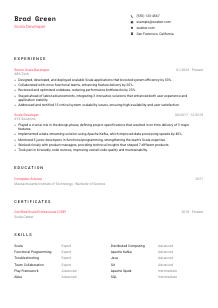
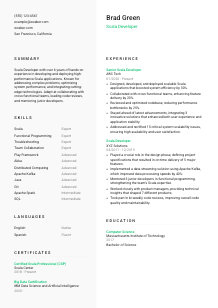
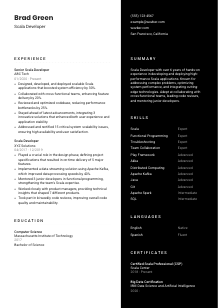
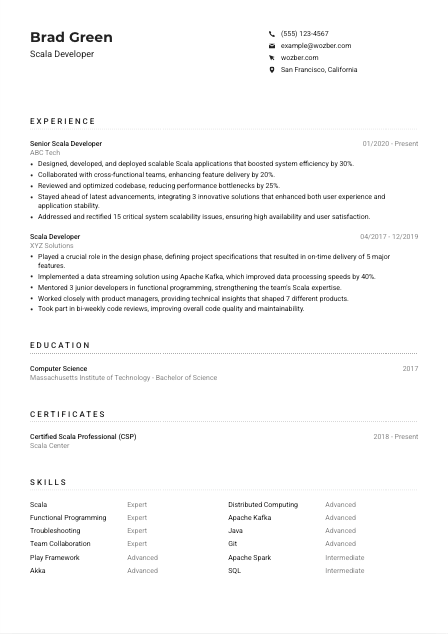
Embracing the functional, but not your resume? Check out this Scala Developer resume example, created with Wozber free resume builder. It shows how to fluently fuse your Scala talents with job requirements, scripting a career as robust and elegant as your code!
Scala hiring usually turns on engineering depth you can describe clearly. Teams want to see where you built reliable services, worked comfortably with functional programming, and improved systems under real load, whether that meant tightening performance, fixing memory pressure, or supporting streaming workloads across distributed environments.
When that work is tailored to the posting, the resume reads faster in both ATS and technical review. Wozber's free resume builder helps you align terms like Scala, Play, Akka, Kafka, and Spark into an ATS-friendly resume format, so hiring teams can quickly recognize whether your background matches the architecture, delivery pace, and collaboration style the role needs.
This section is brief, but it still does useful work. For a Scala Developer, it should confirm who you are, where you are based when location matters, and where someone can review your code or professional background without hunting for it.
Use your full name as the clearest header on the page. Keep it slightly larger than the rest of the text so it anchors the resume without looking styled for style's sake.
Place "Scala Developer" under your name when that is the role you are pursuing. It immediately frames your background around Scala engineering rather than general software development, which helps when recruiters or engineering leads scan several backend profiles in a row.
Include one phone number and one professional email address you check regularly. A simple format such as firstname.lastname@email.com works well. Small errors in this section can block interviews even when the technical experience is strong.
If a posting asks for a specific location, reflect that clearly. In the example, listing San Francisco, California answers the employer's stated requirement and removes avoidable doubt about availability. If relocation is relevant, address it briefly and directly.
A LinkedIn profile is useful. For Scala roles, a GitHub, GitLab, technical portfolio, or conference talk can be even more valuable if it shows service design, functional patterns, libraries, or contributions to backend systems. Only include links that are current and professional.
Your personal details should confirm access, professionalism, and any location requirement in a few lines. Once that is clear, the rest of the resume can stay focused on Scala work, system performance, and delivery.




This is the section most technical reviewers will study first. For Scala roles, they are looking for more than time served. They want to understand what you built, the scale or complexity involved, the frameworks and data technologies you used, and the operational results you produced.
Pull out the engineering themes before you edit a single bullet. Here, the important threads are Scala, functional programming, Play and Akka, distributed computing, streaming, Big Data tooling, code review, and performance tuning. Those priorities should shape which achievements you surface first.
List roles in reverse chronological order, starting with your current or most recent position. For Scala developers, that order should make it easy to see growth from implementation work into architecture decisions, optimization, mentoring, or broader ownership of services and feature delivery.
Focus each role on concrete work: building services, improving throughput, reducing latency, integrating Kafka pipelines, supporting Spark processing, or resolving production issues. The example does this well by tying Scala application work to a 30% efficiency gain and data streaming work to a 40% speed improvement. That kind of result tells a hiring team how your code affected the system, not just what you were assigned to do.
Numbers matter in backend and distributed systems hiring because they make technical impact easier to judge. Use metrics tied to delivery and system health, such as efficiency gains, response time improvement, defect reduction, bottlenecks removed, incidents resolved, features shipped, or services supported. If exact numbers are confidential, use ranges or scope indicators.
Keep bullets aligned to Scala development, platform work, team collaboration, and production results. A resume for this role does not need unrelated achievements if they crowd out stronger material such as code reviews, scalability fixes, concurrency work, data processing, or cross-functional feature delivery.
Your experience section should make it easy to picture you contributing to a live Scala codebase. If the bullets show frameworks, distributed systems context, measurable improvements, and steady collaboration with product and engineering peers, the section is doing its job.
Education matters here because the posting asks for a bachelor's degree in Computer Science, Engineering, or a related field. Keep the section concise, but make sure it supports the core technical background expected for backend and distributed systems work.
If you hold a bachelor's degree in Computer Science, Engineering, or a related discipline, state it plainly. That direct match can satisfy an early screening requirement before anyone gets to your project depth or framework knowledge.
List degree, field of study, school, and graduation year. Clean formatting is enough here. The example's Bachelor of Science in Computer Science from MIT communicates the requirement quickly without extra explanation.
If your degree is in a related area rather than computer science itself, use the field name exactly and let the rest of the resume reinforce the technical foundation. This is especially helpful when your day-to-day work includes algorithms, distributed systems, data processing, or backend engineering practices.
Relevant courses can help early-career candidates or career changers. Prioritize subjects like functional programming, distributed systems, operating systems, database systems, concurrency, or large-scale data processing rather than listing a long transcript.
If you completed a thesis, capstone, or major project involving compilers, concurrent systems, service design, streaming data, or JVM-based development, include it briefly. That kind of detail can support your technical profile when professional experience is still growing.
For most Scala developers, education is a supporting section, not the headline. State the required degree clearly, add relevant detail only when it strengthens your engineering story, and let your production work carry the weight.
Certifications are not always required for Scala roles, but the right ones can reinforce specialized knowledge. They are most useful when they support the kind of systems work the job calls for, such as Scala fluency, data engineering, or distributed processing.
List certifications that connect directly to the role's technical environment. A Scala credential or a Big Data certification makes sense here because the posting references functional programming, Kafka, Spark, and distributed computing.
A short list of well-matched certifications is stronger than a long list of generic courses. The example keeps the focus on Scala and Big Data, which supports the engineering scope of the role instead of distracting from it.
In backend and data-heavy roles, dates help show whether your knowledge is current. This matters more when the certificate covers evolving tools, cloud platforms, streaming systems, or active professional status.
Review this section when your work shifts toward new frameworks or platform responsibilities. If you deepen into streaming, distributed systems, or platform engineering, update certifications to reflect that direction rather than leaving older, less relevant credentials in place.
Certifications work best when they support the rest of the resume. In a Scala application, they should back up your practical work with functional programming, distributed architecture, and data-intensive systems.
For this role, the skills section should read like a believable map of your engineering toolkit. Hiring teams expect to see core Scala strengths, supporting frameworks, and the infrastructure or data technologies that make your backend work production-ready.
Pull the must-have tools and concepts from the posting first. Here that means Scala, functional programming, Play, Akka, distributed computing, Kafka, Spark, and communication skills. Lead with the technologies you genuinely use so the match is immediate and accurate.
Avoid broad labels when a concrete term would say more. "Distributed computing" is better than "backend," and "Apache Kafka" says more than "messaging tools." The example also benefits from naming adjacent strengths like Git, SQL, and Java, which often matter in JVM-based teams.
Organize your skills by type if the list is long. Categories such as Languages, Frameworks, Data and Streaming, and Collaboration or Delivery help engineering leads find the stack details they care about without digging through a flat list.
This section should confirm that you can step into the team's Scala environment without a long translation layer. Keep it honest, specific, and closely matched to the frameworks, data tools, and engineering practices named in the job description.
Language ability matters more in engineering roles than many candidates assume. Scala developers often explain architectural tradeoffs, document design decisions, and work with product managers, data teams, and other developers across the delivery cycle.
If the role calls out English proficiency, list English first and state your level clearly. This posting treats English communication as critical, so the section should confirm that requirement without ambiguity.
Additional languages can be a plus, especially in international teams or client-facing environments. They are secondary here, but they can still support collaboration across distributed teams or multinational organizations.
Use honest levels such as Native, Fluent, Professional, or Conversational. Overstating spoken or written ability can become obvious quickly in interviews, standups, documentation review, or stakeholder meetings.
For Scala developers, communication shows up in code reviews, technical documentation, feature discussions, production incident follow-ups, and explaining complex tradeoffs to non-technical partners. If the rest of your resume shows mentoring, cross-functional work, or review participation, this section gains more weight.
Extra languages are worth listing when they are real and current. They should complement your technical story, not distract from the primary requirement of communicating clearly about systems, code, and delivery decisions.
For this role, language skills should confirm that you can collaborate clearly in English and contribute effectively in technical and cross-functional settings. That matters in design reviews as much as it does in day-to-day development.
Your summary should quickly tell a hiring team what kind of Scala developer you are. In a few lines, connect your years of experience with the kinds of systems you build, the technical strengths you rely on, and the outcomes you consistently deliver.
Start with a direct statement that positions you in the field, such as your years in Scala development and the kind of applications or platforms you have worked on. This helps distinguish you from broader backend developers who only touch Scala occasionally.
Mention the strengths most central to the posting, such as functional programming, scalable application development, performance optimization, distributed systems, or data streaming. The example summary works because it connects years of experience with high-performance Scala applications and complex problem solving.
Aim for three to four sentences. That is enough space to cover your level, your core stack, and one or two outcomes without turning the summary into a duplicate of the experience section.
End on a detail that points naturally into the rest of the resume, such as code review leadership, system optimization, mentoring, or work with Kafka and Spark. The best summaries create a clear technical frame that the experience section then proves.
A well-written summary tells the reader, within seconds, whether your background lines up with the Scala environment they are hiring for. Keep it specific enough to sound experienced and focused enough to match the role.
A Scala Developer resume should leave little doubt about the systems you have built, the stack you can work in, and the results your engineering has produced. When each section reflects the role's real priorities, from Scala frameworks and streaming tools to code review, performance tuning, and cross-functional delivery, the document becomes much easier to trust.
Use Wozber to shape that content into an ATS-compliant resume with language that matches the posting and structure that stays easy to scan. The final version should make one thing clear right away: you can contribute to scalable Scala applications with the technical depth and communication range the team needs.




