



Use Wozber and land your dream job
Create Resume
No registration required
Juggling Kotlin charms, but your resume feels absent-minded? Check out this Kotlin Developer resume example, created with Wozber free resume builder. Learn how to match your Kotlin prowess with job essentials, scripting your career path with an elegance as neat as your code!
Kotlin teams usually need more than someone who can write clean syntax. They need a developer who can ship features across Android or Kotlin-based web stacks, fix production issues without slowing releases, and contribute to code quality through reviews, testing, and steady technical judgment. Your resume should make that operating range visible early, especially where your work improved performance, delivery pace, or product adoption.
When the resume is tailored well, hiring teams can quickly tell whether your Kotlin experience is hands-on and recent or only adjacent. Wozber's free resume builder helps you line up your wording with the job description, keep the structure ATS-friendly, and present the parts that matter most for this kind of screening, such as Kotlin depth, development lifecycle work, collaboration, and mentoring.
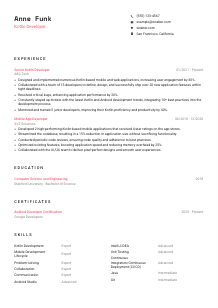
This section is short, but it still carries useful screening information. For a Kotlin Developer application, your header should confirm who you are, how to reach you, what role you target, and whether you meet practical requirements such as location for an on-site or local hire.
Place your full name at the top in a clear, readable format. Keep it simple and professional. For engineering roles, the header should feel clean and structured, much like the codebase you want to be associated with.
Set your title to "Kotlin Developer" when that matches the role you are pursuing. This helps recruiters and ATS tools connect your profile to the opening immediately, especially when the employer is looking for direct Kotlin experience rather than a broader Android or mobile profile.
Add a reliable phone number, a professional email address, and, if relevant, a GitHub, portfolio, or personal site that shows Kotlin projects, shipped apps, or code samples. For this profession, links are most useful when they support what your experience section claims, such as Android work, backend contributions, or maintained repositories.
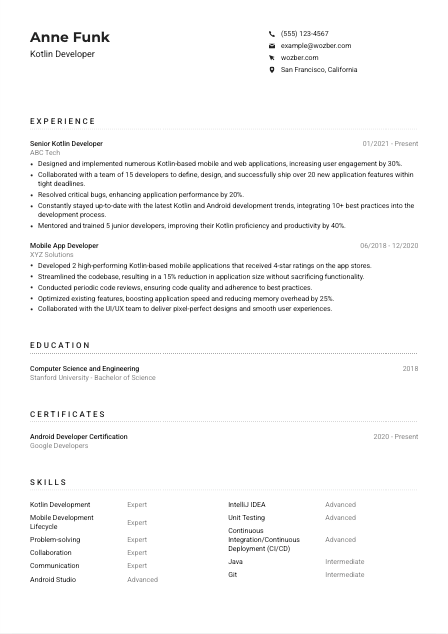
If the employer specifies a location requirement, reflect it clearly in your header. Here, listing San Francisco, California directly addresses a stated requirement and removes avoidable friction in the first review. Treat location as tailoring to this opening, not as a rule for every Kotlin Developer resume.
A strong online link can reinforce your technical credibility. A GitHub profile with Kotlin repositories, Android experiments, test coverage examples, or CI workflows adds more value than a generic social link. Make sure the projects are current and consistent with the tools and experience named on your resume.
Your personal details do not need flair. They need accuracy, professionalism, and a direct match to practical screening points such as role title, contact information, and, when relevant, location.




This is the section most hiring managers will study first. For Kotlin Developer roles, they want to see where you used Kotlin in real production work, how broad your development lifecycle exposure is, and what changed because of your contributions, whether that was feature velocity, app performance, code quality, or team output.
Read the posting closely and pull out the work themes that define the role. In this case, that includes Kotlin development, mobile and web application delivery, bug fixing, performance improvement, cross-functional collaboration, and mentoring. Your experience bullets should echo those themes with concrete examples rather than broad engineering language.
Use reverse-chronological order and include your title, company, and dates for each position. This makes your Kotlin progression easy to follow, especially if you grew from a mobile-focused role into broader Kotlin ownership. A hiring manager should be able to see your development path without hunting through the page.
Write bullet points around outcomes that match the target job. If you built Kotlin-based mobile or web applications, say so directly. The sample resume does this well by tying Kotlin implementation to a 30% increase in user engagement and by showing feature delivery across a team environment. That kind of phrasing tells the reader both what you built and why it mattered.
Numbers help translate engineering work into business and product value. Use metrics that fit the work: feature count, crash reduction, performance gains, release speed, app rating, memory reduction, or team size. Examples such as improving application performance by 20%, shipping 20+ features, or reducing memory overhead by 25% are strong because they connect Kotlin work to outcomes a product team actually tracks.
If the role asks for Android Studio, IntelliJ IDEA, code reviews, or full lifecycle experience, weave those into your bullets where they were part of the real work. Mentioning review participation, debugging, testing, release support, or mentoring helps distinguish you from candidates who only list Kotlin as a skill. This also strengthens ATS optimization because the terminology appears in context instead of as isolated keywords.
Your experience section should leave no doubt that you have applied Kotlin in production, improved software quality, and worked well with designers, product partners, and other developers. Keep every bullet tied to shipped work, measurable results, or clear engineering responsibility.
Education matters most here as a qualification check, not the main proof of your value. For a Kotlin Developer role, it should quickly confirm that you meet the degree expectation and, if useful, show technical grounding that supports your development experience.
If you have a bachelor's degree in Computer Science, Engineering, or a related field, state it clearly and use the full degree name. The example resume handles this neatly with a Bachelor of Science in Computer Science and Engineering, which aligns closely with the posting's requirement.
List the degree, field of study, school, and graduation year or date. For experienced developers, that is usually enough. This section should confirm your academic background without competing with the experience section, where your Kotlin work carries more weight.
If your degree is in a related discipline rather than computer science itself, name it accurately and let the rest of the resume show the technical bridge. A software-heavy engineering degree, for example, can still support a Kotlin application well when paired with Android, web, or backend development experience.
Early-career candidates can include coursework, capstones, or academic projects involving Android development, mobile architecture, APIs, or object-oriented programming. Once you have several years of Kotlin experience, those details become optional unless they are unusually relevant to the target role.
Honors, scholarships, or technical competition results can help if they add something meaningful, especially for newer developers. Leave them out if they distract from stronger professional proof such as production apps, performance improvements, or mentoring work.
Keep this section concise and accurate. It should confirm that your academic background supports the role, while leaving the heavier proof of Kotlin capability to your experience, skills, and summary.
Certifications are not mandatory for every Kotlin Developer role, but relevant ones can strengthen your profile when they reinforce platform knowledge, Android practices, or ongoing professional development. They work best when they support experience you already show elsewhere on the resume.
Prioritize certificates tied to Android development, Kotlin, software engineering practices, or related tooling. An Android Developer Certification is a strong example because it supports the kind of mobile development work described in the posting.
Lead with the certificate that best matches the employer's environment. If the role leans toward Android and Kotlin application work, platform-focused credentials should come before broader learning certificates that are less connected to day-to-day development.
Dates help show whether a certification is current, active, or recent enough to reflect today's practices. In fast-moving environments where frameworks, tooling, and platform guidance change often, recency can add credibility.
A short, focused certificate section signals that you keep your Kotlin and Android knowledge current. One strong credential usually does more than a long list of loosely related courses. Keep the emphasis on technical relevance and current practice.
A relevant certification can strengthen your resume when it clearly supports the Kotlin, Android, or software delivery work you already describe. Keep the list selective and tied to the role's technical context.
This section should read like the toolkit behind your delivery record. For Kotlin Developer positions, employers scan for a mix of core language expertise, platform tools, development lifecycle knowledge, and the collaboration skills needed to ship features and review code in a team setting.
Start with the posting and identify the skills named explicitly or implied by the responsibilities. Here, that includes Kotlin development, mobile and web development lifecycle knowledge, Android Studio, IntelliJ IDEA, problem-solving, collaboration, and communication. If you truly use them, mirror that language closely for both relevance and ATS matching.
Put Kotlin, Android Studio, IntelliJ IDEA, unit testing, CI/CD, Git, and related development capabilities near the top. Soft skills matter, but for engineering hiring they carry more weight when supported by experience bullets such as mentoring juniors, working with UI/UX teams, or participating in code reviews.
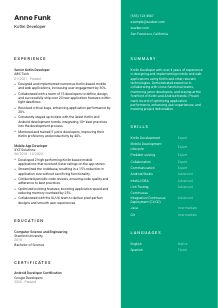
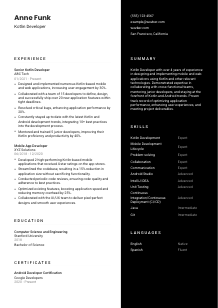
Group or order skills so the reader can quickly understand your profile. A mix like Kotlin Development, Mobile Development Lifecycle, Android Studio, IntelliJ IDEA, Unit Testing, CI/CD, and Git makes the section more useful than an unstructured list. The sample resume also benefits from separating advanced platform tools from broader collaboration strengths.
Every skill on the page should be something you have used in real work and could discuss in detail, whether that means debugging Kotlin code, improving app performance, reviewing pull requests, or supporting a release pipeline.
For software roles, language ability is usually about working clearly with product managers, designers, engineers, and stakeholders across planning, reviews, and issue resolution. If the job calls out English proficiency, make sure that requirement is visible and easy to confirm.
Since the posting asks for proficient English communication, list English prominently and indicate your level clearly. This matters in roles where feature discussions, code review comments, documentation, and cross-functional collaboration all depend on precise communication.
Additional languages can be helpful, especially in global product teams or customer-facing engineering environments. If you are fluent in another language, include it, but only if you can comfortably use it in real professional settings.
Use honest proficiency levels such as Native, Fluent, Advanced, or Conversational. In technical teams, language claims are easy to test during interviews, standups, and collaborative problem-solving discussions.
A second language is a useful addition, not a substitute for core engineering strength. It can help in distributed teams, documentation work, or stakeholder communication, but it should remain secondary to your Kotlin and delivery experience.
There is no need to over-explain this area. A simple list with language and proficiency level is enough. The purpose is to confirm communication capability, particularly for roles that explicitly require strong English.
For a Kotlin Developer, this section should quickly show that you can communicate clearly in the environments where the work happens, from design discussions and sprint planning to code reviews and bug triage.
The summary should give a compact read on your level, technical focus, and the kind of contribution you bring. For Kotlin Developer roles, that usually means clarifying years of experience, platform exposure, delivery strengths, and one or two results that show you can build, improve, and support real applications.
Start from your current professional identity and the kind of Kotlin work you have done most. If your background spans Android, mobile, and Kotlin-based web development, state that clearly instead of using a vague software engineer label.
A direct opening such as "Kotlin Developer with 4+ years of experience" works because it tells the reader your level immediately. From there, add the environments you work in, such as mobile applications, Android development, or Kotlin-based web systems.
Use the summary to surface the strengths most relevant to the job. Good options here include shipping Kotlin applications, improving performance, collaborating across functions, mentoring junior developers, or contributing to code reviews. The sample summary is effective because it combines application delivery, collaboration, mentoring, and optimization in a small space.
Aim for three to five lines with concrete language. Avoid generic claims about passion or innovation unless you tie them to actual work, such as feature releases, performance gains, or platform best practices. The summary should sound like a concise technical profile, not a personal statement.
A well-written summary should make it easy to understand your Kotlin experience, your delivery scope, and the value you bring to a product team. Keep it focused on shipped work, technical depth, and collaboration.
A tailored Kotlin Developer resume should show more than language familiarity. It should show that you can build and improve applications, work across the development lifecycle, collaborate with designers and engineers, and raise code quality through debugging, reviews, and mentoring.
Use Wozber to turn that experience into a structured, ATS-compliant resume with clear role alignment, strong terminology, and an ATS-friendly resume format that supports faster screening. When the document is tuned well, hiring teams can quickly see whether you are ready to contribute in a real Kotlin delivery environment.




