



Use Wozber and land your dream job
Create Resume
No registration required
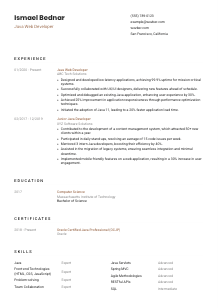
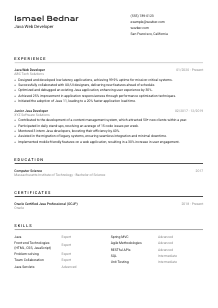
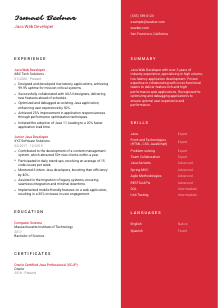
Crafting dynamic websites, but your resume feels static? Check out this Java Web Developer resume example, created with Wozber free resume builder. It shows how you can match your web wisdom to job specifications, scripting a career journey as robust and responsive as your code!

Java web development resumes are read through the lens of production work. Hiring teams want to see whether you have built and maintained web applications that stay responsive under load, recover cleanly when something breaks, and support feature delivery across backend and frontend layers. If your resume only lists Java technologies without showing where you improved uptime, response time, debugging speed, or release quality, it will feel thinner than your actual experience.
A tailored resume changes that first read by making your technical scope obvious early. When the target role mentions Spring MVC, Servlets, JSP, frontend basics, and mission-critical performance, Wozber's free resume builder helps you shape an ATS-compliant resume around those exact requirements so reviewers can quickly connect your past work to high-volume Java web systems. That is the distinction your resume needs to make clear from the top.
For a Java Web Developer, the Personal Details section does more than identify you. It confirms practical basics quickly so the reader can move straight to your application architecture, framework experience, and delivery record without getting stuck on missing contact or location details.
Place your name at the top in a clean, readable format. In software hiring, this section is usually scanned in seconds before the reviewer moves into frameworks, projects, and production experience, so clarity matters more than styling tricks.
Add "Java Web Developer" directly under your name when that matches the role you are pursuing. This helps position you immediately for openings centered on Java web stacks rather than broader software, backend, or full-stack positions where your fit could otherwise look diluted.
Your contact information should be easy to use and error-free. A missed digit or outdated email can stall an application before anyone reads about your Spring MVC work or performance tuning results.
Some Java web roles have an on-site or local requirement. In the example posting, San Francisco, California is explicitly listed, so showing that location in your header removes an immediate question about availability. Treat this as a tailoring choice based on the job, not a universal rule for every application.
Include a GitHub, LinkedIn, portfolio, or personal website only if it supports your resume with current, relevant material. For this profession, that might mean Java web projects, API work, deployment examples, code samples, or architecture notes that reinforce the experience already listed on the page.
This section should confirm that you are reachable, professionally presented, and aligned with any practical requirement the posting calls out. Once those basics are settled, the rest of the resume can stay focused on Java web delivery.




This is the section where Java Web Developers separate themselves. Employers are looking for more than framework familiarity. They want to see how you used Java, Spring MVC, Servlets, JSP, JavaScript, and debugging skills to ship features, stabilize existing systems, and improve performance in live environments.
Read the posting line by line and map each core responsibility to work you have already done. If the role emphasizes high-volume, low-latency applications, feature deployment, debugging, and responsiveness, your bullets should mirror those themes with real outcomes. The sample does this well by matching the requirement for mission-critical performance with a bullet about low-latency applications and 99.9% uptime.
List positions in reverse chronological order and make the structure consistent. Recruiters and engineering managers should be able to spot your job title, employer, and dates instantly before they read deeper into release work, optimization efforts, or cross-functional collaboration.
Focus each bullet on a concrete contribution. Good Java web bullets usually cover feature development, maintenance of existing applications, defect resolution, performance improvements, API or UI enhancements, or collaboration with design and product partners. "Optimized and debugged an existing Java application, enhancing user experience by 30%" works because it connects maintenance work to a measurable result.
Numbers carry real weight in technical hiring when they reflect how systems perform or how delivery improved. Uptime, load time, response time, issue volume, client growth, feature delivery pace, or engagement changes all help translate engineering work into business and operational value. The example's 20% faster load time and 25% improvement in responsiveness are the kind of metrics that make backend and web performance work easier to understand.
Use this space for experience that supports the role: Java development, web architecture, MVC frameworks, frontend integration, debugging, testing, agile delivery, and system improvements. Leave out unrelated filler unless it explains a relevant transferable skill. For this profession, production code, collaboration, and measurable system results deserve the space first.
Your experience section should show how you build, improve, and support Java web applications in real settings. When each bullet ties a technical action to uptime, responsiveness, delivery, or user impact, your value becomes much easier to judge.
Education matters most here as a qualification checkpoint and technical foundation. For Java Web Developer roles, reviewers usually want to confirm that you have formal grounding in computer science concepts that support web architecture, debugging, and software design, then move on to your hands-on experience.
If the posting asks for a bachelor's degree in Computer Science or a related field, reflect that wording clearly in your education entry. In the example, "Bachelor of Science in Computer Science" aligns neatly with the requirement and removes any ambiguity.
List degree, field of study, school name, and graduation year or date in a simple structure. Hiring teams are not looking for design flair here. They are checking whether you meet the educational baseline before turning back to your engineering experience.
For Java web development, the field of study often matters as much as the degree level. Computer Science, Software Engineering, or a closely related discipline helps reinforce that you have formal exposure to programming, data structures, systems thinking, and software development practices.
Early-career candidates can use this section to show relevant web development coursework, software engineering projects, database classes, or capstones involving Java applications. If you already have several years of professional experience, keep it brief unless an academic project is unusually relevant to the job you are targeting.
Honors, academic awards, research work, and student projects can help if you are closer to graduation or moving into your first few developer roles. Once your resume includes production systems, performance metrics, and shipped features, those earlier details should take less space than your experience section.
This section only needs to confirm the academic requirement and support your technical background. Once that is clear, your resume should return quickly to the web applications, frameworks, and results you have delivered.
Certifications are secondary to hands-on delivery for most Java Web Developer roles, but the right one can strengthen your credibility. They are most useful when they reinforce the exact ecosystem the job cares about, such as core Java proficiency or current platform knowledge.
If a certificate directly supports your Java background, include it. The example uses Oracle Certified Java Professional, which is relevant because it reinforces depth in the language behind the web stack. That kind of alignment is more valuable than a longer list of loosely related credentials.
A short list of closely matched certifications works better than a crowded section. For Java web roles, platform certifications, Java credentials, or certifications tied to frameworks, cloud deployment, or testing only help if they support the responsibilities in the posting.
Show when the certification was earned and, if applicable, whether it remains active. In technical hiring, date context helps readers understand whether the credential reflects current knowledge or an earlier stage of your career.
Java development changes through framework updates, language versions, security practices, and deployment patterns. If you continue adding relevant certifications or structured training, you show that your skills are current and that you are paying attention to how the ecosystem evolves.
A certification section should support the story already told by your experience and skills. When the credentials are current and relevant to Java web development, they add useful depth without competing with your hands-on work.
The skills section should read like a practical inventory of how you work, not a broad list of technologies you have touched once. For Java Web Developer roles, that usually means a mix of backend frameworks, web technologies, problem-solving strengths, and collaboration habits that match the team's delivery environment.
Start with the posting. Here, the core technologies are Java, Java Servlets, JSP, Spring MVC, HTML, CSS, and JavaScript, alongside problem-solving and team collaboration. Those are the terms that should anchor your skills section if they reflect your real experience.
Order the list by importance to the target role, not by personal preference. For a Java web opening, core language and framework skills should come before broader supporting tools. If you also bring REST APIs, SQL, unit testing, or agile delivery experience, include them after the primary stack so the hierarchy is clear.
Group skills logically and use wording that matches the job description where accurate. That helps an ATS resume scanner connect your background to the role and makes it easier for a reviewer to confirm that you cover the backend framework, frontend basics, and collaboration needs of the team. Avoid padding the list with unrelated tools that weaken the signal.
Your skills section should back up the experience section, not try to replace it. When the stack, web technologies, and collaboration strengths match the role naturally, the rest of the resume lands with more credibility.
Java Web Developers spend plenty of time explaining implementation choices, discussing bugs, reviewing tickets, and working through requirements with product, design, QA, and other engineers. That makes language proficiency relevant when a role calls it out, especially in teams where day-to-day collaboration depends on clear written and spoken English.
Some developer roles do, and this one explicitly requires strong English communication. When that appears in the description, include English in your Languages section rather than assuming it is understood.
List the required language prominently with an honest proficiency label such as Native, Fluent, or Professional. For a role involving collaborative development, stand-ups, debugging discussions, and feature planning, that detail can matter more than candidates expect.
Additional languages can be worth listing if they support collaboration with distributed teams, clients, or multilingual user groups. They are not a substitute for technical qualifications, but they can widen your value in cross-border engineering environments.
Use straightforward proficiency terms and avoid overstating ability. If you are likely to join technical discussions, document bugs, or explain implementation tradeoffs in a language, make sure the level you claim reflects what you can actually handle.
Language skills become more relevant when the company works across regions, supports international users, or relies on cross-functional communication with non-technical stakeholders. Include them when they add context to how you collaborate, not just to fill space.
If communication is part of the requirement, treat it as one. Clear language skills help complete the picture of a developer who can not only build and debug systems, but also work effectively with the people around them.
Your summary should quickly establish what kind of Java Web Developer you are. In a few lines, it needs to define your level, your core technical lane, and the kind of application work you have handled, so the reader knows what to expect before reaching the experience section.
Start with the parts of the posting that overlap most with your background. For this role, that means Java web development experience, performance-sensitive applications, collaboration across teams, and maintenance of existing systems. Use those themes to decide what belongs in the opening lines.
State your experience level and technical focus early. The example opens with more than 5 years in the field and a specialization in high-volume, low-latency application development, which immediately places the candidate in the right part of the market for a performance-oriented Java web role.
Include two or three strengths tied to the job's actual demands, such as Spring MVC-based web development, debugging and optimization, feature delivery with cross-functional teams, or improving application responsiveness. Keep these grounded in work you can support elsewhere on the resume.
Aim for a concise paragraph, usually three to four sentences. Skip broad statements about passion or hard work and use the space to summarize what you build, what systems you have supported, and what results you are known for delivering.
A strong summary gives the reader an immediate frame for your experience before they reach your bullet points. For Java web roles, that frame should make your technical focus, production experience, and performance-minded contribution clear right away.
A Java Web Developer resume works best when it connects the stack to the outcome. Show where you used Java, Spring MVC, Servlets, JSP, and frontend technologies to ship features, improve responsiveness, debug production issues, and support reliable web applications.
Wozber's AI resume builder can help you align that experience with the job description, strengthen wording around the required stack, and present it in an ATS-friendly resume format that stays easy to scan. With the right tailoring, your resume should make it simple to judge whether you can contribute to high-availability Java web systems from day one.




