



Use Wozber and land your dream job
Create Resume
No registration required
Conquering sales goals, but your resume feels lost? Work through this Territory Sales Rep resume example, created with Wozber free resume builder. It shows how to map your sales prowess to match regional demands, making sure your career trajectory doesn't wander off-grid!

Territory sales work is judged in the field long before anyone talks about personality. Hiring teams want to see whether you can open new business, keep a territory moving, and turn conversations with prospects into booked revenue. Your resume needs to show that pattern clearly through account growth, client retention, pipeline activity, and target attainment.
For this role, weak tailoring usually blurs the difference between general sales support and true territory ownership. Using Wozber's free resume builder helps you line up your experience with the posting's language in an ATS-friendly resume format, so hiring teams can quickly see prospecting range, B2B selling strength, and whether you've actually managed results across a defined market.
This section should read like a clean business card. For a Territory Sales Rep, that means clear identification, direct contact details, and any location information that removes friction for a territory-based role.
Your name should be the most visible text on the resume. Use a professional font and enough size to separate it from the rest of the header. Sales resumes benefit from immediate clarity because the reader should move from your name to your role and contact details without hunting for basic information.
If you are applying for a Territory Sales Rep position, place that title beneath your name or use a close match from your background, such as "Senior Sales Representative" when it supports the move. This helps connect your profile to the opening right away and reduces the chance that your experience looks too broad or misaligned.
Include a reliable phone number, a professional email address, and a LinkedIn profile if it reflects the same job history and performance story as your resume. In sales hiring, missed calls and outdated profile details create unnecessary doubt. Make it easy for a hiring manager or regional sales leader to reach you after one read.
Territory roles often depend on local coverage, travel efficiency, and knowledge of the market. In this example, San Francisco, California is a stated requirement, so listing that location directly supports the application. When a posting names a city or region, include it in your header if it matches your current base.
Do not clutter the header with personal data, photos, or unrelated links. Territory sales resumes work best when the top of the page stays focused on business identity and availability. Save the space for prospecting results, account growth, and customer-facing achievements later in the document.
A clear header removes avoidable questions and supports the practical realities of field sales. The hiring team should immediately know who you are, what role you are targeting, how to contact you, and whether you are positioned to cover the territory.




This is the section that carries the most weight for a Territory Sales Rep. Hiring managers look for proof that you can build pipeline, win new accounts, maintain client relationships, and consistently deliver against quota across a defined market.
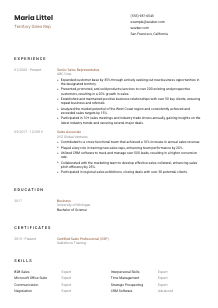
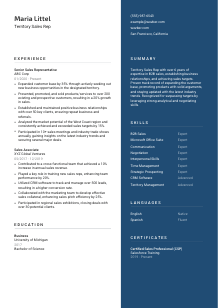
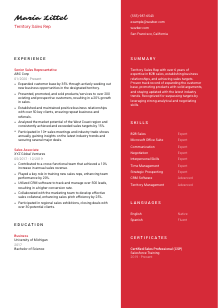
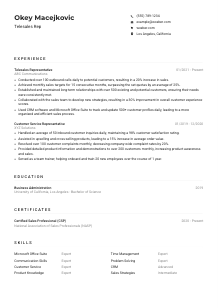
Read the job description closely and pull out the operating priorities. Here, the employer wants new business development, product presentation, relationship management, territory analysis, and target achievement. Your experience section should echo those points with real examples from your work, not generic sales duties. The sample resume does this well by showing customer-base expansion, regional market analysis, and results above target.
List your positions in reverse chronological order with job title, company name, and dates. That structure helps the reader quickly understand your progression from supporting roles into territory ownership, account growth, or senior sales responsibility. For sales hiring, clear chronology also helps place your performance claims in the right stage of your career.
Each bullet should show what you did, how you did it, and what changed because of it. Replace vague lines like "responsible for sales outreach" with specifics such as prospecting into a territory, presenting to decision-makers, or managing a set number of active accounts. In the example, "Expanded customer base by 35%" and "sold products/services to over 200 existing and prospective customers" work because they tie activity to business results.
Metrics matter in territory sales because revenue teams are measured by output. Include figures such as percentage growth, quota attainment, account count, lead volume, conversion gains, repeat business, renewal rates, or territory expansion. The sample bullets use 35% customer growth, 20% sales growth, and 15% above target, which immediately gives the employer a scale for performance.
Not every sales task deserves equal space. Lead with work that shows prospecting, relationship development, negotiation, pipeline control, and market analysis within a region or customer segment. If you have older experience in adjacent roles, keep it brief unless it directly supports B2B selling or territory management. This makes your resume read like a candidate who can step into a book of business and grow it.
A strong experience section should leave little doubt about how you sell, what kind of accounts you handle, and the level of performance you sustain. For a Territory Sales Rep, that usually comes down to revenue growth, account development, and consistent execution across the market you own.
Education usually is not the deciding factor in sales hiring, but it does matter when a posting sets a degree requirement. Keep this section straightforward and make it easy to confirm that you meet the baseline academic expectation.
If the posting asks for a bachelor's degree in Business, Marketing, or a related field, make sure your degree is easy to find and clearly labeled. In the example, a Bachelor of Science in Business lines up directly with the requirement. When your degree is in a related field, name it clearly rather than assuming the connection will be obvious.
List your field of study, degree, school, and graduation year in a consistent order. Recruiters and sales managers are usually scanning quickly, so the value here is fast confirmation rather than detailed storytelling. Keep the layout simple and avoid overloading the section with minor details unless they strengthen your case.
For territory sales, business, marketing, communications, or industry-related study can reinforce your commercial foundation. If your coursework or academic focus connects directly to sales strategy, market analysis, or customer behavior, that can be useful context, especially earlier in your career.
If you are a recent graduate or have limited B2B experience, selected coursework can help bridge the gap. Classes in sales management, consumer behavior, negotiation, or marketing analytics are more useful than a long list of unrelated subjects. Once your work history is established, experience should carry the section.
Academic honors, sales club participation, or business case competitions can add value when they show initiative, communication skill, or commercial interest. For experienced reps, keep these details brief. For newer candidates, they can help show early exposure to presentations, teamwork, and competitive selling environments.
Education should confirm that you meet the stated baseline and support the business side of your profile. Once that is clear, let your sales results do most of the persuading.
Certifications are not mandatory for every Territory Sales Rep role, but the right one can reinforce product knowledge, sales process discipline, or commitment to the industry. Include them when they sharpen your profile, not just to fill space.
Start with credentials that connect to the employer's market, product, or sales methodology. If a posting mentions an industry certification, include the exact one when you have it. In the example, the Certified Sales Professional credential supports the candidate's sales background, even though the requirement is framed as "if applicable."
A short, relevant list is stronger than a long catalog of loosely connected courses. Prioritize certifications tied to B2B selling, CRM platforms, account management, industry compliance, or consultative sales. This keeps the section aligned with real hiring priorities instead of looking padded.
Sales practices, tools, and product standards change over time, so dates help show whether a credential is current. If the certification is ongoing or requires renewal, include that status. The example's "2019 - Present" format works because it signals active standing rather than a one-time course from years ago.
Use this section to show that you keep your sales approach current through structured learning. That may include training in CRM use, negotiation, industry regulations, or product specialization. Keep the wording factual. The value comes from relevance and recency, not from trying to make every certificate sound major.
The right certification can strengthen a Territory Sales Rep resume by adding industry context or sales-process credibility. Keep the list focused on credentials that support the kind of accounts, tools, or market knowledge the role actually requires.
A Territory Sales Rep skills section should read like a practical snapshot of how you win business and manage your market. Focus on tools, sales capabilities, and customer-facing strengths that show up in day-to-day territory work.
Start with the skills the employer named directly. In this case, that includes B2B sales, CRM software, Microsoft Office Suite, communication, negotiation, and interpersonal skills. Add those only if they reflect your actual background, then support them elsewhere in the resume with achievements and examples.
Lead with the abilities most central to territory performance, such as prospecting, territory management, account development, pipeline tracking, negotiation, and client relationship building. Broader strengths like time management are useful, but they should not crowd out the commercial and operational skills that define the role.
Group or list skills in a way that lets a recruiter see your sales toolkit quickly. Avoid long strings of buzzwords or vague soft skills with no anchor in the rest of the resume. The sample resume works because it combines sales capabilities like strategic prospecting and territory management with tool proficiency in CRM software and Microsoft Office.
Your skills section should reinforce the kind of selling you actually do. When it reflects territory growth, CRM discipline, negotiation, and client management, it supports the rest of your resume instead of repeating generic strengths.
Language ability matters when it affects customer communication, internal coordination, or regional coverage. Even when English is the only stated requirement, this section can still support a sales profile if the listed languages connect to the market you serve.
If the posting asks for good English proficiency, state your English level plainly. For customer-facing sales roles, that requirement touches presentations, follow-up emails, proposals, and relationship management. Make it easy for the employer to see that you can handle those interactions confidently.
Additional languages can be useful in territories with diverse customer bases or cross-border accounts. List them when they have practical value for prospecting, negotiations, or ongoing account communication. In the example, Spanish adds commercial relevance because it can support relationship-building with a broader range of clients.
Choose straightforward levels such as Native, Fluent, Intermediate, or Basic. Hiring teams need a realistic sense of how you can operate in calls, meetings, and written communication. Overstating fluency can become obvious quickly in a sales interview.
If a territory includes multilingual customers or industry segments where another language helps with trust and access, that is worth reflecting. Keep it practical. The point is not to look international for its own sake, but to show where language skill can improve client conversations and coverage.
If you are actively improving a language that supports your market, that can be worth noting in the right context, especially early in your career. Sales work often rewards reps who can build rapport across different customer groups, and language development can support that over time.
For a Territory Sales Rep, language skills matter when they expand communication range and strengthen customer relationships. Keep this section accurate and commercially relevant, and it can add useful depth to your profile.
Your summary should give a hiring manager a quick commercial read on you. In a few lines, show the level you operate at, the kind of selling you do, and the results you tend to deliver across a territory or account base.
Use the opening lines to reflect the work at the center of the job, such as B2B sales, new business development, account growth, and territory performance. Avoid broad statements about being motivated or hardworking. A sales summary should immediately sound connected to pipeline generation, customer relationships, and quota delivery.
Open with your title or a close equivalent, followed by years of experience and your main sales environment. The example starts with "Territory Sales Rep with over 6 years of expertise in B2B sales," which quickly tells the reader what level of seller they are looking at. That kind of opening works because it is specific and easy to place.
After the opener, include results that match the employer's goals. Strong options include customer-base expansion, sales growth, target attainment, or relationship retention across a territory. Pull these points from your actual record, just as the sample summary references expanding the customer base and surpassing targets.
Aim for a compact paragraph of 3 to 5 lines. That gives you enough room to show experience, selling focus, and measurable impact without repeating the full experience section. The summary should make a sales manager want to keep reading because the core story is already clear.
A sharp summary helps the reader understand your sales level, market focus, and performance range within seconds. For a Territory Sales Rep, that means showing territory growth, customer development, and the ability to convert activity into revenue.
A Territory Sales Rep resume should make one thing easy to judge fast: can you grow the territory, manage customer relationships, and hit the number. When your results, tools, and market-facing experience are aligned with the posting, the document starts reading like a business case instead of a generic career summary.
Use Wozber to turn that into a polished, ATS-compliant resume with sharper role language, better section focus, and stronger ATS optimization. The finished resume should give hiring teams a clear view of your prospecting strength, territory discipline, and ability to deliver revenue in the market they need covered.




