



Use Wozber and land your dream job
Create Resume
No registration required
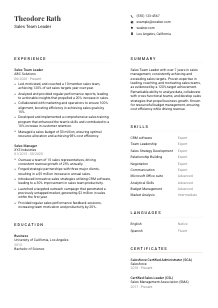
Nailing sales targets, but your resume could use a boost? Lead the way with this Sales Team Leader resume example, created with Wozber free resume builder. Learn how to position your leadership and sales prowess in line with job requirements, paving the way to career summits!
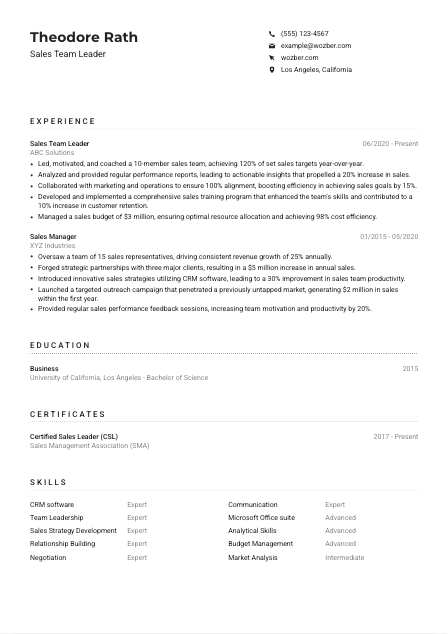
Sales Team Leaders are expected to do more than close deals themselves. They set direction for the team, coach reps through pipeline problems, track performance against quota, and keep cross-functional work with marketing and operations moving in the same direction. Your resume needs to show that you can lead revenue execution through people, process, and reporting, not just individual selling ability.
That distinction gets lost quickly when a resume reads like a general sales profile. Using Wozber's free resume builder helps you shape an ATS-compliant resume around the language hiring teams use for sales leadership, from quota attainment and CRM reporting to training and budget ownership. The clearer that leadership scope appears, the easier it is to see whether you can run a team against target.
For a Sales Team Leader, the header should confirm basic alignment fast and without clutter. Hiring teams look here for a clean professional identity, reliable contact information, and in some cases location match. Keep it sharp and practical.
Use your full name in the most prominent text on the page so the resume is easy to identify in a recruiter inbox, CRM export, or applicant tracking system. Keep the styling clean and readable rather than decorative.
Place the role title directly under your name when it matches the position you want. Using "Sales Team Leader" immediately frames your background around team management, sales performance, and coaching rather than a broader sales label such as Account Executive or Sales Manager.
List a phone number you answer, a professional email address, and if relevant, a website or LinkedIn profile that supports your commercial leadership background. Consistency matters here. If your LinkedIn headline says sales operations and your resume says frontline sales leadership, that mismatch creates unnecessary questions.
If the employer specifies a city or state, include it clearly in your header. In the example, "Los Angeles, California" directly addresses the stated location requirement and removes doubt about local availability. When location is not a factor, city and state are usually enough.
Skip personal information that does not strengthen your candidacy, such as age, marital status, or a full street address. A polished LinkedIn profile can add value, especially for sales leaders whose credibility may also be reflected in recommendations, network strength, or career progression, but only include it if it is current and aligned with the resume.
This section should confirm who you are, what role you are targeting, and whether you meet practical requirements such as location. When that information is clean and aligned, the reader can move straight to your sales leadership record.




This is the section most likely to decide whether you move forward. For Sales Team Leader hiring, employers want to see quota ownership, coaching impact, reporting discipline, and the ability to improve team output through training, process, and coordination across departments.
Before writing bullets, identify what the employer actually needs managed. In this case, the role emphasizes team coaching, target achievement, sales reporting, training, cross-functional coordination, and budget oversight. Those priorities should shape which achievements you lead with and which you cut.
List roles in reverse chronological order and make the move from individual contributor to team leadership easy to follow. Include your title, employer, and dates first, then use accomplishments to show growing responsibility, such as taking over a larger team, owning forecasts, or managing bigger revenue goals.
Focus on team results, not task lists. Strong bullets show how you improved quota attainment, rep productivity, retention, training effectiveness, forecast accuracy, or collaboration with marketing and operations. The example does this well by tying coaching a 10-member team to 120% of target and linking a training program to stronger customer retention.
Numbers carry real weight in sales hiring because they show scale and consistency. Use metrics such as percentage to target, annual revenue growth, team size, customer retention, budget size, productivity gains, or market expansion. The sample resume uses figures like 20% sales growth from reporting insights and $3 million in budget management, which gives hiring teams a concrete read on scope.
Choose experience that supports sales leadership first. If you have older or less relevant roles, trim the detail and give more space to work involving coaching, CRM-driven decision-making, pipeline oversight, or strategic account growth. The point is to make your recent record read like evidence that you can lead a sales team against plan from day one.
A Sales Team Leader resume stands out when the experience section shows how your decisions changed team output. If the reader can quickly see quota results, coaching impact, reporting discipline, and operational ownership, this section is doing its job.
Education usually plays a supporting role at this level, but it still matters when the posting calls for a degree. Present it cleanly and make it easy to see whether you meet the employer's academic baseline.
Start by confirming whether the role asks for a specific academic background. Here, the employer requests a bachelor's degree in Business, Marketing, or a related field, so your degree should be listed in a way that makes that match obvious.
Include degree, field of study, school name, and graduation year or date. This is one of the simplest sections on the resume, and that is exactly how it should read. Clear formatting keeps attention on your qualifications rather than the layout.
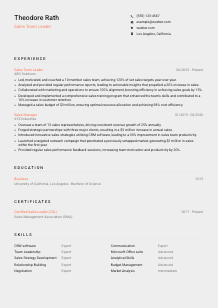
If your degree aligns directly with the posting, say so plainly. In the example, "Bachelor of Science" in "Business" from UCLA immediately supports the requirement. If your degree is in a related field, use the official name and let your experience do the rest.
Earlier-career candidates may benefit from mentioning sales, marketing, analytics, or leadership coursework, along with honors that point to commercial or management potential. For experienced sales leaders, those details are usually secondary to revenue results and team leadership.
Student leadership, case competitions, or business club roles can help if they connect to communication, persuasion, or team management. At a senior sales level, keep these mentions brief unless they are unusually strong or directly relevant to your industry.
For this role, education should confirm the required foundation and then get out of the way. A straightforward entry is enough when your experience already carries the commercial story.
Certifications are not always required for Sales Team Leader roles, but the right ones can strengthen your case, especially when they support leadership development, CRM proficiency, or commercial operations knowledge.
Review the posting for specific credentials or capabilities that certifications can support. This role does not require a named certification, but it does call for CRM proficiency, leadership experience, and strong command of reporting and sales management. Certificates that reinforce those areas can add credibility.
Prioritize credentials tied to sales leadership, sales methodology, CRM administration, pipeline management, or team development. The example includes "Certified Sales Leader" and "Salesforce Certified Administrator," both of which support real parts of the job rather than serving as generic add-ons.
List the year earned and, if relevant, renewal status. This is especially useful for platform-based credentials such as Salesforce, where current product knowledge can affect reporting accuracy, user adoption, and team workflow.
A short list of relevant certifications is more persuasive than a long catalog of outdated training. Refresh this section when you complete meaningful development in coaching, forecasting, CRM systems, or sales enablement so the resume reflects where your expertise is now.
Certificates should strengthen the picture already established in your experience section. When they point to better coaching, better system use, or stronger sales management practice, they add real value.
The skills section should mirror the tools and capabilities behind consistent team results. For a Sales Team Leader, that usually means a mix of coaching, sales execution, reporting, relationship management, and the systems used to run pipeline and performance reviews.
Start with the language in the job description, then add adjacent skills you genuinely use. In this posting, clear priorities include CRM software, Microsoft Office, interpersonal strength, team leadership, reporting, stakeholder collaboration, and budget awareness. Those are the right anchors for this section.
Lead with the abilities that drive day-to-day performance in sales leadership roles, such as team coaching, sales strategy, forecasting, CRM usage, negotiation, and relationship building. In the example, skills like Team Leadership, Sales Strategy Development, and CRM software are placed where they immediately support the target role.
Do not turn this into a master inventory of everything you know. A tighter list is easier to scan and aligns better with ATS optimization when the wording reflects the job description naturally. Grouping high-priority commercial and leadership skills at the top helps the reader understand your operating strengths quickly.
This section works best when it backs up the experience bullets rather than repeating vague strengths. If your bullets show quota growth, coaching, and reporting ownership, your skills should name the tools and capabilities that made those results possible.
Language skills matter in sales because leadership depends on clear coaching, customer communication, and internal coordination. For this role, English proficiency is a stated requirement, and any additional language can be useful when it supports client coverage or team communication.
When a posting specifies language ability, list that language first with an honest proficiency level. Here, English should appear at the top because the employer explicitly requires it, and sales leadership depends heavily on precise communication in meetings, reporting, and rep coaching.
Additional languages can strengthen your profile when they help with customer relationships, regional sales coverage, or leading a diverse team. In the example, Spanish is a useful complement, especially in markets where bilingual communication supports trust and responsiveness.
Choose straightforward levels such as Native, Fluent, Intermediate, or Basic. Avoid vague terms that make your actual ability hard to judge. Hiring teams want to know whether you can negotiate, present, coach, or correspond effectively in that language.
Some Sales Team Leader positions are heavily domestic, while others involve multilingual territories, channel partners, or customer bases. If language ability has practical business value in your target market, make that visible through the order and level you list.
Do not list a language only as a personal detail. Include it because it improves communication with clients, supports team leadership, or helps in expansion efforts. When a language contributes to smoother negotiations or stronger account management, it becomes professionally relevant.
For sales leadership, language ability matters when it supports communication quality and market reach. Start with the required language, then add others that strengthen how you lead, sell, or build relationships.
The summary needs to establish leadership scope fast. In a few lines, it should show your sales background, the size or type of team responsibility you have handled, and the business results you are known for delivering.
Read the posting closely and pull out the themes that define success in the job. Here, that means years in sales, leadership experience, target attainment, team coaching, reporting, cross-functional collaboration, CRM use, and budget control. Those are the ideas your summary should reflect in compact form.
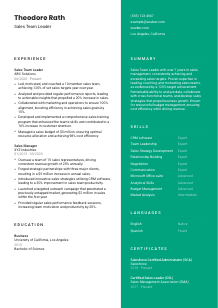
Start with a direct statement of who you are professionally. A line such as "Sales Team Leader with 7+ years in sales and sales management" works because it immediately sets scope and seniority. The sample summary handles this well by anchoring the profile in leadership and target achievement.
Use one or two specific outcomes that show how you lead teams to results. Good examples include exceeding quota, improving retention, raising team productivity, or using reporting to drive action. Keep the details selective so the summary remains readable while still sounding earned.
Aim for three to five lines that read clearly in one pass. Skip broad adjectives and use space for concrete strengths such as coaching reps, analyzing sales data, collaborating across departments, and managing resources efficiently. This section should frame the rest of the resume, not repeat it.
A focused summary helps the reader understand your leadership range before they reach the first job entry. If it makes your sales background, team impact, and operating strengths clear, it has done its job.
A Sales Team Leader resume should make one point unmistakable: you can drive revenue through a team, not just through your own book of business. When your experience shows quota attainment, coaching outcomes, reporting discipline, and coordination across functions, hiring teams can place you quickly in the right leadership lane.
Use Wozber's free resume builder to organize those details into an ATS-friendly resume format, refine the wording with role-specific phrasing, and strengthen ATS optimization without flattening your real achievements. The final resume should make it easy to judge your ability to lead reps, manage performance, and deliver against target.




