



Use Wozber and land your dream job
Create Resume
No registration required
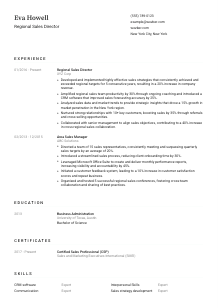
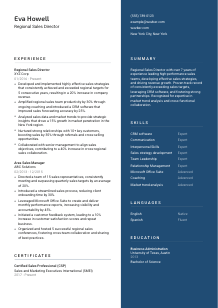
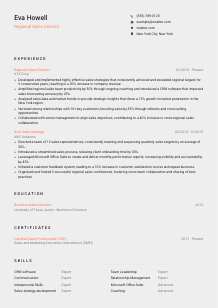
Leading sales across vast territories, but your resume feels like a remote outpost? Explore this Regional Sales Director resume example, created with Wozber free resume builder. Learn how to chart your strategic sales insights to match job coordinates, steering your sales leadership career toward regional summits!
Regional Sales Director resumes are read through a commercial lens first. Hiring teams want to see whether you can set regional strategy, lead managers or field reps across multiple locations, and turn pipeline activity into quota attainment, market share growth, and stronger customer retention. Generic leadership language falls flat here. Your resume needs to show how you drove revenue, improved team performance, and used sales data to make sharper decisions across a territory.
A tailored resume changes how quickly that commercial story comes through in both ATS screening and human review. When your wording matches the job's language around regional targets, coaching, CRM use, and stakeholder management, Wozber's free resume builder helps you shape an ATS-compliant resume that surfaces the right sales indicators early. That makes it easier for a hiring team to see whether your background lines up with the scale, leadership scope, and target ownership the role requires.
For a Regional Sales Director, the top of the resume should immediately confirm who you are, what role you are targeting, and whether any practical requirement could block the process. Keep this section lean, accurate, and aligned with the position you want.
Use your full name in a clean, prominent format. This is standard, but it matters. Senior sales leaders are expected to present information with clarity, and the first line should reflect that same executive-level polish.
Place "Regional Sales Director" directly under your name when that is the role you are applying for. It creates immediate alignment with the posting and helps position your background around regional leadership, target ownership, and multi-site sales execution rather than broader or adjacent sales titles.
Include a professional email address and a phone number you actively monitor. Double-check both. For sales leadership hiring, responsiveness matters, and a missed recruiter call because of an outdated number is an avoidable mistake.
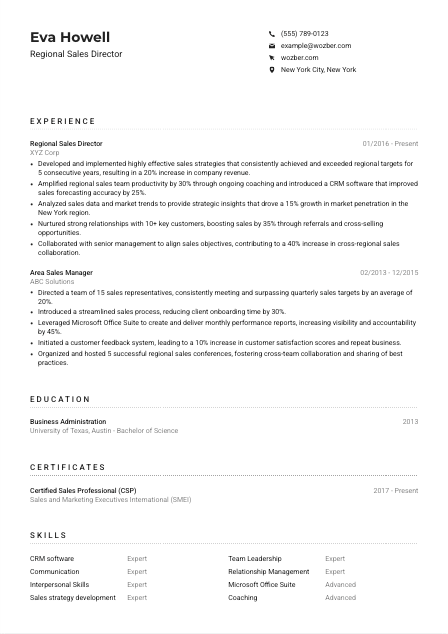
If the employer requires a specific city or market presence, list it clearly. In the example, "New York City, New York" directly supports the stated location requirement and removes uncertainty about territory access or relocation timing. If location is not a hiring filter in another posting, a city and state line is usually enough.
A LinkedIn profile or personal website can support your resume when it expands on leadership scope, sales wins, industry focus, or speaking engagements. Keep it current and consistent with the resume's dates, titles, and major performance results.
Your personal details should answer the basic access questions right away: who you are, what role you are targeting, how to reach you, and whether you meet any location requirement. Then the reader can focus on your sales leadership record.




This section carries the most weight for a Regional Sales Director. Employers want to see ownership of revenue, team leadership across a territory, strategic planning, and evidence that your decisions improved performance in the market, not just that you held senior sales titles.
Before rewriting your bullets, mark the patterns in the posting: regional strategy, coaching, CRM proficiency, target attainment, customer relationships, and collaboration with senior leadership. Those themes should shape which accomplishments you feature and which wording you use. For this example, the employer is clearly hiring for someone who can lead a region, use sales data well, and keep performance tied to company goals.
List your experience in reverse chronological order and make the progression obvious. A move from Area Sales Manager to Regional Sales Director, like in the example, tells a useful leadership story because it shows growing scope, bigger team responsibility, and stronger commercial ownership.
Regional sales hiring depends on results. Replace vague statements like "responsible for managing a sales team" with bullets that show what changed under your leadership. The sample does this well by tying sales strategy to a 20% revenue increase, coaching to a 30% productivity gain, and customer relationship management to 35% sales growth through referrals and cross-selling.
Use the metrics that matter in sales leadership: quota attainment, revenue growth, forecast accuracy, market penetration, productivity, retention, average deal size, or onboarding speed. Numbers make your regional scope more credible. Even one or two strong measures per role can sharply improve how your experience reads.
Choose achievements that support regional leadership. That usually means territory planning, pipeline management, coaching, sales process improvement, strategic account growth, and reporting to senior leadership. Leave out older or unrelated wins that do not strengthen your case. The reader should come away seeing a leader who can direct a region, not simply an individual contributor with a high sales total.
Your experience section should make three things unmistakable: you owned a number, you led people, and your decisions improved performance across a region or market. When those points are clear in the bullets, the rest of the resume becomes much easier to believe.
Education usually plays a supporting role at this level, but it still matters because many Regional Sales Director roles set a bachelor's degree as a firm requirement. Present it clearly so the reader can confirm it quickly and move on to your sales record.
If the job asks for a bachelor's degree in Business, Sales, or a related field, make sure that information is easy to spot. In the example, a Bachelor of Science in Business Administration lines up neatly with the employer's requirement and supports the commercial focus of the role.
List the degree, school, field of study, and graduation year. At senior sales level, clean presentation is enough. You do not need extra detail unless it adds real relevance, such as a sales concentration, honors, or leadership distinction tied to business development.
A business-related degree helps reinforce familiarity with sales planning, market analysis, and commercial operations. If your degree is in another field, that is usually fine, but pair it with experience that clearly shows regional leadership, forecasting, and revenue management.
Honors, concentrations, or executive education can be worth including if they strengthen your leadership or commercial profile. Keep them concise. This section should support your candidacy, not compete with your experience section for attention.
Most Regional Sales Directors do not need coursework or campus activities unless they remain directly relevant to the target role. If you are earlier in your leadership path or pivoting from a related commercial function, those details can help fill context. Otherwise, keep the section compact.
Education should confirm that you meet the stated requirement without slowing down the resume. Clear degree information is enough. Your leadership history and revenue results will do the heavier lifting.
Certifications are rarely the deciding factor for a Regional Sales Director, but the right ones can reinforce expertise in sales process, leadership development, negotiation, or industry-specific selling. Include them when they add real relevance to the role you are targeting.
Start with the job description. If no certification is required, treat this section as an enhancer rather than a must-have. In the example, no certificate was listed as mandatory, but a credential such as Certified Sales Professional still supports the candidate's sales leadership profile.
Choose certifications that connect to the actual demands of the role, such as sales methodology, account management, negotiation, coaching, or commercial leadership. A short, relevant list reads better than a long list of loosely connected courses.
Add the year earned or the active date range when appropriate. This helps the reader understand whether the credential is current and whether you continue to invest in your sales leadership practice.
Sales leaders are expected to keep refining how they coach teams, analyze performance, and adapt strategy. One or two relevant certifications can communicate that well. You do not need to document every webinar or internal training program.
A well-chosen certification can add polish to your profile, especially when it complements your record in regional growth, coaching, or strategic selling. Keep the section selective and tied to the role's commercial demands.
For a Regional Sales Director, the skills section should quickly map your operating strengths. That means a mix of sales leadership capabilities, commercial analysis, relationship management, and the systems you use to run pipeline, forecasting, and team performance.
Use the job description to identify the specific capabilities the employer wants to see. In this case, CRM software, Microsoft Office Suite, leadership, communication, interpersonal skills, sales strategy, and market analysis all belong near the top because they connect directly to the listed responsibilities.
Prioritize skills that show you can lead a regional function, not just close deals personally. Strong examples include sales strategy development, team leadership, coaching, forecasting, relationship management, territory planning, and cross-functional collaboration. The sample resume handles this well by pairing strategic and people-management skills rather than listing only generic sales traits.
Avoid stuffing this section with every platform or soft skill you have ever used. A tighter list is stronger, especially when it mirrors the posting and is supported by evidence in your experience bullets. If you claim CRM expertise or market trend analysis here, the experience section should show how you used those skills to improve forecast accuracy, productivity, or market penetration.
Your skills list should sound like the toolkit of someone who can run a region, coach a team, and steer revenue decisions with data. If the section feels generic, narrow it until it reflects the actual work.
Language ability is usually secondary for a Regional Sales Director unless the territory, customer base, or employer specifically calls for it. Still, when language skills improve communication with clients, partners, or internal teams, they are worth showing clearly.
If the employer specifies a working language, include it exactly and make your proficiency easy to read. Here, effective operation in English is required, so English should appear first and at an appropriate proficiency level.
List English prominently if the role depends on presentations, forecasting discussions, customer meetings, and leadership communication in English. Using "Native" or "Fluent" is usually enough, as long as it is accurate.
Additional languages can strengthen your profile when they help with customer relationships, channel partners, or diverse regional teams. In the example, Spanish adds useful market flexibility, especially in a large metropolitan region, but it is a bonus rather than a universal requirement for every Regional Sales Director position.
Be precise about your ability. Terms like "Native," "Fluent," "Professional," or "Basic" are more useful than vague labels. Sales leadership often involves negotiation, presentations, and relationship management, so overstating language ability can create problems later in the process.
If your target roles involve multilingual customer groups, cross-border accounts, or distributed field teams, languages can become more relevant. If not, keep this section brief. It should support your commercial reach, not distract from your performance record.
List languages when they improve how you lead, sell, or manage relationships in the markets you serve. Put the required language first, then include any additional language that genuinely expands your reach.
The summary needs to establish your level quickly. For a Regional Sales Director, that usually means years in sales leadership, the size or scope of responsibility, and a few commercial outcomes that show you can lead strategy and execution across a region.
Review the posting before writing this section. If the job emphasizes regional strategy, team coaching, CRM proficiency, and target attainment, those ideas should appear in your summary in a natural way. This is where you set the lens for the rest of the resume.
Start with a direct line that identifies you as a Regional Sales Director or senior sales leader and states your experience level. The example summary does this effectively with "over 7 years of experience," which mirrors the role's minimum threshold and immediately establishes seniority.
Choose the strengths most relevant to the role, such as leading high-performance teams, building regional sales strategies, improving forecast quality through CRM discipline, or growing revenue through account expansion and market penetration. Keep the claims anchored in the same themes your experience section will prove.
Aim for 3 to 5 lines. That is enough space to present your leadership identity, core strengths, and one clear performance pattern, such as consistently exceeding sales targets. Avoid buzzwords and broad claims that are not backed up elsewhere on the page.
A good summary tells the reader, in a few lines, what level you operate at and what kind of regional sales results tend to follow when you lead. Once that is clear, the experience section can deliver the proof.
A Regional Sales Director resume should read like a business case for your leadership. The essentials are straightforward: clear role targeting, a verified degree, skills that match regional sales execution, and experience bullets built around quota, revenue, team output, market growth, and customer relationships.
Use Wozber's free resume builder to tighten structure, align language with the posting, and produce an ATS-friendly resume format that keeps your sales results easy to scan. Wozber's ATS resume scanner can also help you spot missing terms around CRM, coaching, regional strategy, and target ownership before you apply. The finished resume should make one thing easy to judge: whether you can lead a region to stronger commercial performance.




