



Use Wozber and land your dream job
Create Resume
No registration required
Ringing success, but your resume's on hold? Dial in to this Call Center Director resume example, created with Wozber free resume builder. Learn how to harmonize your leadership and service skills with job criteria, ensuring your career connects seamlessly with your professional aspirations!
Call center leadership is measured in live operating conditions. Service levels slip, queues spike, quality scores move, and customer satisfaction follows. A Call Center Director resume needs to show that you can run a high-volume operation, improve performance metrics, develop supervisors, and keep service delivery steady when pressure rises.
Resume tailoring changes how quickly that operating scope becomes visible. When your title, metrics, platform experience, and leadership history mirror the language of the job description, both hiring teams and ATS screening can connect you to the role faster. Wozber's free resume builder helps structure that detail into an ATS-compliant resume, so your background reads clearly as call center leadership rather than general operations management.
This section does a small but important job. For a Call Center Director, it should immediately confirm who you are, what role you are targeting, and whether any practical filters such as location or communication requirements are already covered.
Place your name at the top in a clean, readable format. Senior operations roles often move quickly from resume review to stakeholder interviews, so your header should be simple to scan and easy to remember. Skip nicknames or decorative formatting and use the name that appears across your professional records.
Put "Call Center Director" directly under your name when that is the role you are applying for. This helps position you correctly from the first line and prevents your background from being read as a broader customer service or operations profile. If your current title is slightly different, your resume can still target the director-level role as long as the experience supports it.
Use a reliable phone number and a professional email address. In leadership hiring, interview scheduling often involves recruiters, executives, and cross-functional partners, so accuracy matters. Include a website or LinkedIn profile only if it supports your candidacy with relevant leadership history, operational wins, or recommendations.
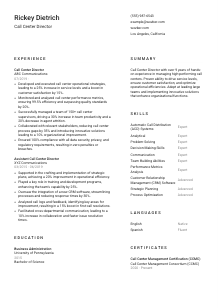
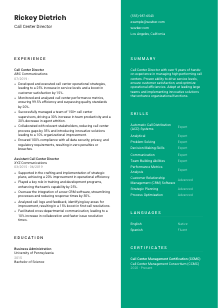
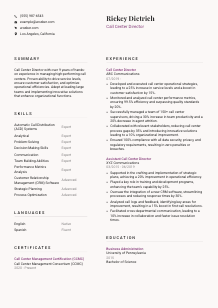
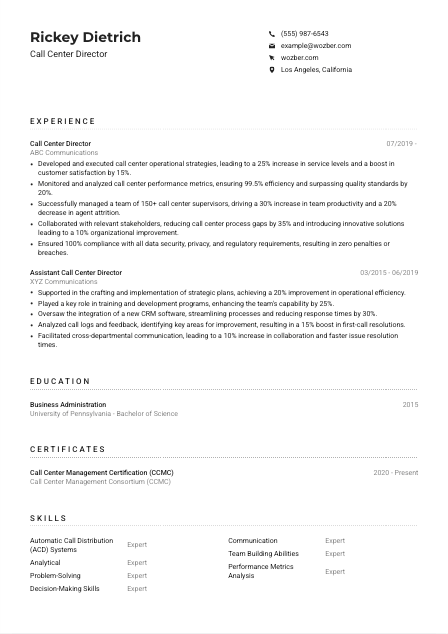
If the employer asks for a local candidate, make that visible in your header. In the example, listing Los Angeles, California directly answers a stated requirement and removes an avoidable question early. Only include location to the level that is useful, usually city and state.
A LinkedIn profile can reinforce your leadership progression, team size, technology exposure, and industry credibility. For a Call Center Director, that profile should align with the resume on titles, dates, and major outcomes such as service-level gains, attrition reduction, or CRM rollout work. If it is outdated, leave it off until it matches the story you are telling here.
When your personal details confirm role target, contact access, and any stated location requirement, the reader can move straight to your operating experience. That is exactly where a director-level resume should earn attention.




This is the section hiring teams study most closely for a Call Center Director. They want to see scale, leadership depth, operational discipline, and measurable improvements across service, quality, efficiency, and team performance. Your bullets should sound like someone who owns outcomes, not someone who only supports them.
Start by identifying what the employer is trying to improve or protect. In this case, the emphasis is on operational strategy, performance metrics, supervisor management, cross-functional process improvement, and compliance. Those themes should shape which achievements you feature first and which language you mirror in your bullet points.
List roles in reverse chronological order and make the movement in responsibility easy to follow. Director and assistant director roles, larger teams, broader reporting scope, or added ownership of systems and compliance all help show progression. The sample resume does this well by moving from Assistant Call Center Director to Call Center Director within the same field.
Choose bullets that reflect how call centers are actually evaluated. Strong examples include service level improvement, customer satisfaction gains, lower attrition, better first-call resolution, shorter response times, stronger quality scores, or successful process changes across departments. In the example, a 25% increase in service levels and a 15% boost in customer satisfaction immediately support the director-level target.
Numbers matter here because call center performance is tracked constantly. Add percentages, team size, efficiency rates, compliance results, or speed improvements when they are real and defensible. Metrics such as 99.5% efficiency, leadership of 150+ supervisors, or zero penalties tied to privacy compliance give hiring teams a clearer picture of scale and control.
Every line should reinforce leadership in a contact center environment. Prioritize workforce performance, strategic planning, platform implementation, coaching structure, process redesign, and regulatory compliance over generic management statements. If a bullet could sit on a resume for almost any department head, rewrite it until the call center context is unmistakable.
A strong experience section makes it easy to see that you have led call center teams, improved core metrics, and managed the systems and standards behind customer operations. That combination is what moves a candidate into serious consideration for a director seat.
Education usually will not outweigh your operating record at this level, but it still matters when the job posting sets a degree requirement. Keep the section straightforward and make it easy for recruiters and ATS filters to confirm that you meet the baseline qualification.
If the role asks for a Bachelor's degree in Business, Communications, or a related field, list your degree in a way that makes the match obvious. A Business Administration degree, as shown in the example, aligns cleanly with a leadership role that combines customer operations, staffing, and performance management.
Include degree, field of study, school name, and graduation year. That is usually enough for an experienced Call Center Director. Clean formatting helps ATS parsing and keeps the focus on the qualification itself rather than unnecessary detail.
When you hold multiple credentials, lead with the one that best supports leadership in service operations, communications, business management, or a related area. The goal is not to showcase every academic detail. It is to make the required education easy to confirm in seconds.
Most senior candidates do not need a course list. Include it only if it directly supports the target role, such as operations management, organizational communication, analytics, or customer experience. Early-career applicants moving toward director-level leadership may benefit from that extra context more than seasoned leaders will.
If you are completing additional education in leadership, analytics, business operations, or customer experience, it can support your profile, especially when your target employer is focused on transformation or growth. Keep it concise and clearly secondary to your field experience.
For this role, education should confirm that you meet the stated requirement without distracting from your operating track record. Once that box is checked, the resume can stay focused on leadership results.
Certifications are not always mandatory for Call Center Director roles, but they can strengthen your credibility when they connect to operations leadership, customer contact strategy, quality management, or platform knowledge. Include them when they add real relevance, not just extra lines.
Start with the job description. If no certification is required, treat this section as added support rather than a substitute for experience. In the provided example, the Call Center Management Certification helps reinforce specialization even though the posting does not make it mandatory.
Focus on credentials that support running a call center operation. That can include call center management, customer experience leadership, workforce management, quality assurance, privacy or compliance training, or platform-specific expertise when those systems are central to the role.
List the certification name, issuing organization, and date earned or active period. Current dates matter when the credential reflects up-to-date practice in areas such as service operations, data security, or process management. The sample's active certification period is a useful model.
Call center leadership keeps changing with new routing tools, reporting methods, CRM workflows, and compliance expectations. Recent certifications can show that you stay current on the operational side of the job, especially if you are targeting organizations that are scaling, modernizing, or tightening service standards.
When a certification supports the realities of call center leadership, it helps round out your profile. Keep the list selective so each entry adds something meaningful to your case.
A Call Center Director skills section should not read like a generic leadership checklist. It should combine operational tools, analytical capabilities, and people leadership in a way that matches how contact centers are run and measured every day.
Pull skills from both the requirements and the responsibilities. Here, that includes ACD systems, CRM software, analytical strength, decision-making, communication, team building, and performance metrics analysis. These terms help the resume align with both ATS screening and human review without drifting into keyword stuffing.
Director-level hiring usually expects both technical fluency and team leadership. Include the systems and workflows you can operate around, such as ACD, CRM, reporting, process optimization, or workforce-related tools, alongside skills like coaching leaders, problem-solving, and strategic planning. The example strikes that balance well.
Do not turn this into a master inventory of everything you have ever used. Choose the skills that support your target job and that already appear elsewhere in your experience. That keeps the section credible and gives hiring teams a quick view of your operating range.
The right mix here shows that you understand call center systems, can read performance data, and can lead the people responsible for day-to-day execution. That is the profile employers look for at director level.
Language ability matters differently depending on the call center's customers, channels, and team makeup. For a director, it is less about listing every language you know and more about showing communication capability that is relevant to service operations and leadership scope.
If the posting requires English, list it clearly with an honest proficiency level. That is especially important in leadership roles where you will report performance, coach supervisors, handle escalations, and work across departments. The requirement in this job description makes English a must-have, not a nice-to-have.
Additional languages can strengthen your profile when the call center serves multilingual customers or manages diverse internal teams. For example, Spanish may be useful in some U.S. contact center environments, but it should be presented as added value rather than a universal requirement unless the job says otherwise.
Use clear labels such as Native, Fluent, Professional, or Conversational. Overstating proficiency can become a problem quickly in interviews or on the job, especially when communication is central to customer outcomes, supervisor coaching, and stakeholder coordination.
If you have led multilingual teams, supported regional operations, or helped improve service for specific customer groups, your language section becomes more meaningful when the rest of the resume supports it. That context matters more than simply listing extra languages for appearance.
For a Call Center Director, language skill is useful when it improves coaching, escalation handling, customer understanding, or cross-functional coordination. Include languages that genuinely support those parts of the role and leave out marginal additions that do not affect your candidacy.
When language skills connect to customer communication or team leadership, they add practical value to your resume. Present them clearly and keep them grounded in how the call center actually works.
Your summary should establish operating scope fast. In a few lines, it needs to tell the reader that you have led call center teams, improved measurable outcomes, and managed the systems, people, and standards behind consistent service delivery.
Before writing, identify the job's core priorities. For this opening, that means strategic operations, service levels, customer satisfaction, metrics analysis, supervisor leadership, cross-functional process improvement, and compliance. Your summary should touch the themes that best match your background rather than trying to cover everything at once.
Start with your title or closest equivalent and your years of experience in call center leadership. Phrasing such as "Call Center Director with 9+ years in contact center operations" quickly places you in the right lane and separates you from broader customer service managers or operations leaders.
Include capabilities that matter for director-level work, such as improving service levels, raising customer satisfaction, leading large teams, reducing attrition, or implementing CRM and process changes. The sample summary works because it connects leadership, operational efficiency, and customer outcomes in plain language.
Aim for a short paragraph that can be read in seconds. Three to five lines is enough if each sentence carries real information about scope, results, and expertise. Avoid generic claims about being dynamic or results-driven unless the next words prove it with call center-specific substance.
A well-written summary tells the reader, early and clearly, that you can lead a call center operation, improve performance, and manage the people and systems behind the numbers. That sets up the rest of the resume to confirm it.
A Call Center Director resume works when every section points to the same conclusion: you can lead supervisors, improve service metrics, manage core platforms, and keep the operation compliant and stable under pressure.
Use Wozber's free resume builder to shape that story into an ATS-friendly resume format, align your wording with the job description, and tighten each section around the results that matter most in contact center leadership. When the resume is tailored well, hiring teams can quickly see your readiness to run the floor and the strategy behind it.




