




Use Wozber and land your dream job
Create Resume
No registration required
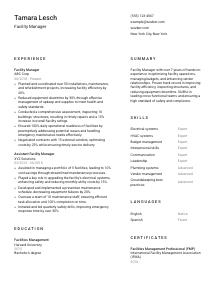
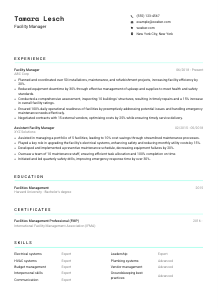
Juggling spaces but cramped on resume layout? Step into this Facility Manager resume example, created with Wozber free resume builder. Learn how to present your facility expertise to match job needs, unfolding your career as smoothly as a perfectly laid-out floor plan.

Facility managers are trusted with buildings that need to run safely, efficiently, and without disruption. Hiring teams look for proof that you can keep operations moving, control maintenance costs, coordinate vendors, and respond quickly when HVAC, electrical, plumbing, or structural issues threaten daily use. Your resume should make that operating range visible early, not bury it under generic management language.
A targeted resume changes how quickly your maintenance scope, budget ownership, and site oversight come into focus, especially in an ATS review. Wozber's free resume builder helps you align your wording with the job description in an ATS-friendly resume format, so responsibilities like preventive maintenance, safety compliance, and vendor negotiation are easier to surface. That makes it easier for the employer to see whether you can keep a facility ready for daily operations.
For facility management, the header does more than identify you. It confirms practical details that affect hiring from the start, especially title alignment, contact reliability, and location when an on-site presence is required. Keep this section clean, direct, and matched to the role you're targeting.
Place your name prominently at the top of the resume in a slightly larger font than the body text. Facility management roles often move through HR, operations leaders, and site leadership, so your document should be easy to reference at a glance.
Add the role title directly below your name and match the posting when it fits your background, such as "Facility Manager." This immediately connects your resume to the opening and supports ATS optimization by reinforcing the core role language.
Include a current phone number and a professional email address. Use a simple format such as firstname.lastname@email.com so vendors, recruiters, or operations contacts can reach you without friction.
If the job requires you to be based in a specific city, show that clearly in your header. For the example here, listing "New York City, New York" addresses a stated requirement and removes doubt about local availability for an on-site facility leadership role.
Include LinkedIn or a professional website if it reinforces your background in property operations, maintenance planning, capital projects, or vendor oversight. Make sure the information matches your resume, especially job titles, dates, and major responsibilities.
Your header should tell the employer, within seconds, that you are reachable, locally viable when required, and applying specifically for facility management work. That clarity helps the rest of the resume land faster.




This section carries the most weight for facility managers because the work is judged through operational outcomes. Hiring teams want to see the scale of sites or assets you handled, the systems you oversaw, the vendors you managed, and the measurable effect of your decisions on uptime, safety, cost, and daily readiness.
Read the job description line by line and mark the duties that define the role. Here, the employer emphasizes installations, maintenance, refurbishments, health and safety standards, building inspections, emergency response, and vendor cost control. Use those themes to choose which achievements deserve space in your experience section.
List roles in reverse chronological order so the most relevant and recent facility management work appears first. For this profession, recent experience matters because systems oversight, compliance practices, contractor management, and maintenance workflows change over time.
Each bullet should show an action, the facility function involved, and the result. The example resume does this well with points like coordinating more than 50 installations and refurbishment projects, reducing equipment downtime by 30%, and negotiating vendor contracts for 25% cost savings. Those are the kinds of outcomes that show you can run a facility, not just support one.
Quantify your impact with numbers tied to building operations. Useful measures include downtime reduction, maintenance completion rates, safety improvements, utility savings, vendor savings, inspection coverage, emergency response time, occupancy readiness, or facility efficiency. Metrics like these tell a hiring manager how you perform under real operating conditions.
Keep the section focused on maintenance coordination, building systems knowledge, compliance, refurbishment planning, budgeting, and contractor oversight. If you have unrelated management achievements, trim them unless they support site operations or cost control. For a Facility Manager opening, relevance usually means building performance, service continuity, and safe daily operations.
Your experience section should read like a record of facilities kept running, problems solved early, and budgets managed with discipline. When the bullets are specific, a hiring manager can picture you handling the building before they ever meet you.
Education matters in facility management because it helps establish your grounding in operations, business, compliance, and building systems. Keep the section straightforward, with enough detail to show you meet the stated requirement without crowding out the experience that usually drives the hiring decision.
If the posting asks for a bachelor's degree in Facilities Management, Business, or a related field, make that visible without forcing the reader to search for it. In the example, a bachelor's degree in Facilities Management directly supports the requirement and should appear plainly in the education entry.
List the degree, school, field of study, and graduation year or date. Facility management resumes usually benefit from concise presentation here so the reader can move quickly back to operational experience, systems knowledge, and project results.
If your degree is not an exact title match, keep it honest and let adjacent relevance do the work. Degrees in business, engineering, construction management, or related disciplines can still fit well when your experience shows responsibility for maintenance programs, budgets, vendor contracts, or facility operations.
Relevant coursework can help when you are earlier in your career or when the role leans heavily on technical or compliance-heavy work. Courses tied to building systems, safety, operations management, or project planning are more useful than general academic detail.
Honors, projects, or extracurriculars are optional for experienced facility managers. Include them only if they reinforce something the employer cares about, such as leadership, operational planning, engineering exposure, or sustainability work.
This section should confirm that you meet the academic requirement and support the story told by your experience. For most facility managers, that means clear credentials and no extra clutter.
Certifications can strengthen a facility manager resume because they point to current standards, technical fluency, and professional development. They are especially helpful when the role touches compliance, building systems, safety programs, or multi-site operations, even when the posting does not list a credential as mandatory.
Check whether the employer names a required or preferred certification. If not, list credentials that still deepen your profile, such as the Facilities Management Professional designation shown in the example. That kind of credential reinforces your commitment to structured facility operations and industry practice.
Choose certifications connected to facilities, maintenance, safety, project delivery, or building operations. A short list of meaningful credentials is stronger than a long list that wanders away from vendor management, compliance, or systems oversight.
Include the year earned and, if applicable, the active period or renewal status. In facility management, current credentials can matter when they reflect up-to-date knowledge of safety expectations, maintenance planning, or operational standards.
The field evolves through energy management, compliance demands, workplace standards, and maintenance technology. Ongoing certification work shows that you stay current, which is valuable when employers need someone who can manage both day-to-day upkeep and longer-term facility improvements.
Well-chosen certifications strengthen your profile by showing discipline and current industry knowledge. They work best when they clearly support the kind of facility environment you want to manage.
Facility management requires a mix of technical understanding and operational judgment. Your skills section should reflect that balance by showing knowledge of building systems alongside the management abilities needed to run maintenance work, control spend, and coordinate people across the site.
Start with the language in the job description. For this opening, electrical systems, HVAC, plumbing, groundskeeping, budget management, vendor relations, communication, and leadership all belong near the top because they reflect the employer's day-to-day priorities.
List hard skills tied to facility operations first, then add the management capabilities that make those skills useful in practice. The example resume handles this well by combining systems knowledge with budget management, vendor management, interpersonal strength, and leadership.
Avoid turning this into a long inventory of every tool or soft skill you have ever used. Include the competencies most likely to matter in a facility environment, especially those linked to maintenance oversight, safety, inspections, cost control, and service delivery.
A focused skills list helps the employer see your operating range quickly, from building systems knowledge to team and vendor coordination. Every item should support the case that you can keep the facility functioning safely and efficiently.
Language skills are usually secondary on a facility manager resume, but they can matter in buildings where you work across maintenance staff, contractors, tenants, front-of-house teams, or diverse site populations. Present them clearly and in the right order, with English first when the role asks for it explicitly.
If the posting calls for strong English, list English prominently and state your level plainly. For a facility manager, this matters because safety instructions, vendor communication, incident reporting, and daily coordination all depend on clear communication.
If you speak additional languages, include them when they could help with staff coordination, contractor communication, or service interactions on-site. In a large urban market, language range can be a practical advantage rather than a decorative detail.
Additional languages can support smoother work with maintenance teams, vendors, and occupants across a varied facility population. That matters most when your role includes frequent in-person communication and fast issue resolution.
Use clear labels such as Native, Fluent, Intermediate, or Basic. Honest proficiency levels matter because facilities work often involves urgent requests, work orders, safety messaging, and escalation communication.
If you are applying to a property or portfolio where multilingual communication is common, this section deserves more attention. The example resume lists Spanish as well as English, which can be useful in some site environments, though it is not a universal requirement for every facility management role.
Handled well, this section adds useful context about how you communicate across the site. Keep it honest, relevant, and tied to the realities of facility operations.
The summary should give a hiring manager a fast read on the kind of facility operation you can handle. In a few lines, it should establish your level of experience, the operational areas you manage well, and the outcomes you are known for delivering.
Before writing the summary, identify the role's main demands. Here, that includes facility upkeep, building systems knowledge, budget control, vendor management, safety standards, and operational readiness. Your opening lines should reflect that mix instead of relying on broad management claims.
Start with your title, years of experience, and the kind of facility work you handle. The example summary uses "over 7 years" and immediately connects that experience to facility operations, budgets, and vendor relationships, which makes the candidate's level clear right away.
Use the middle of the summary to call out the responsibilities most relevant to the target position, such as maintenance planning, inspections, refurbishments, contractor coordination, cost control, and safety compliance. Choose the few that best match the posting rather than trying to cover everything.
Aim for three to five lines with concrete language. A facility manager summary should read like an operations snapshot, not a personal statement. If possible, reference outcomes such as efficiency gains, downtime reduction, or facility readiness without cramming in too many numbers.
When this section is tailored well, it quickly tells the reader what scale of facility work you can manage and where you create value. That sets up the rest of the resume to confirm the details.
A facility manager resume works best when it shows how you keep buildings functional, safe, and cost-efficient day after day. Focus on operational results, building systems knowledge, vendor control, and the practical decisions that keep downtime low and sites ready for use.
Use Wozber's free resume builder to shape that experience into an ATS-compliant resume, refine wording with role-specific terminology, and check alignment with an ATS resume scanner. The finished document should make one thing easy to judge: whether you can step in and run the facility with confidence from day one.




