



Use Wozber and land your dream job
Create Resume
No registration required
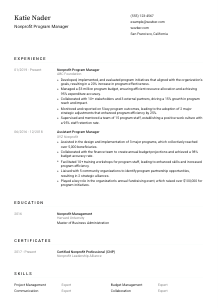
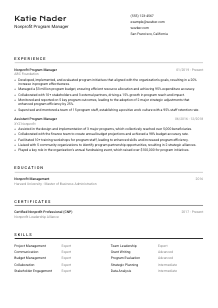
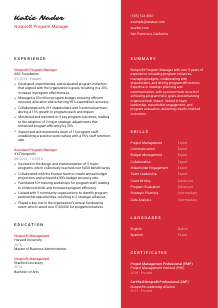
Crafting initiatives, but your resume doesn't raise funds? Check out this Nonprofit Program Manager resume example, created with Wozber free resume builder. It shows how to spotlight your social impact expertise to match job requirements, steering your career toward the heart of service and success!
Nonprofit Program Managers are trusted with work that has to hold up on two fronts at once: mission impact and operational discipline. A resume for this field needs to show that you can turn strategy into running programs, manage people and budgets responsibly, and track outcomes in a way that leadership, funders, and community partners can rely on.
Screening often gets difficult when candidates sound passionate about the mission but leave their program scope vague. Wozber's free resume builder helps you shape an ATS-compliant resume around the language of program delivery, evaluation, budgeting, and staff leadership, so hiring teams can quickly see whether you've managed initiatives at the level the role requires.
For nonprofit leadership roles, the header should do one practical job well: make it easy to contact you and immediately confirm the basics the employer asked for. Keep this section clean, accurate, and closely aligned with the posting.
Use your full name in the largest, clearest text on the page. This is a simple section, but presentation still matters. Nonprofit hiring often involves several reviewers, from HR to program leadership, so your name should be easy to find in a printed packet or ATS export.
Place "Nonprofit Program Manager" directly below your name if that is the role you are pursuing. Matching the title used in the posting helps frame your experience correctly from the first line and supports ATS alignment, especially when your recent title was something adjacent such as Program Coordinator or Assistant Program Manager.
Include a phone number and a professional email address you check regularly. Small errors here cause real problems, especially when employers are scheduling panel interviews or follow-up calls. If you include a website or portfolio, make sure it adds relevant material such as program summaries, speaking engagements, or nonprofit leadership work.
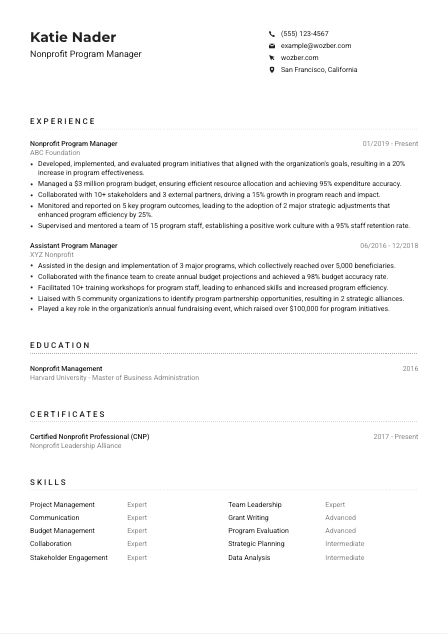
If a role requires a specific location, state your city and state plainly. In the example, listing San Francisco, California directly addresses the employer's requirement and removes uncertainty about local availability. When location is not a stated filter, city and state are usually enough.
LinkedIn, a professional website, or a portfolio can strengthen this section if they reinforce your nonprofit management background. Make sure the content matches your resume, especially around titles, dates, program scope, and public-facing achievements such as partnerships, board presentations, or community initiatives.
Your personal details should confirm that you are reachable, professionally presented, and aligned with any stated logistics. For a Nonprofit Program Manager, that means no friction around title, contact information, or required location.




This is where nonprofit employers look for proof that you have actually run programs, not just supported them. Strong experience bullets show the scale of your work, the outcomes you measured, the resources you managed, and the people or partners you coordinated.
Start by pulling out the core responsibilities in the job description and matching them with real examples from your background. For this role, that includes developing initiatives, managing budgets, monitoring outcomes, working with stakeholders, and supervising staff. The example resume does this well by using similar language, then backing it up with outcomes such as increased program effectiveness and expanded reach.
For each position, list your title, organization, and dates clearly, then use bullets that show the level at which you operated. Nonprofit hiring teams want to know whether you owned a program, supported a director, managed a team, or coordinated cross-functional delivery. A title like "Nonprofit Program Manager" carries more weight when the bullets also show budget authority, staff supervision, and program design responsibility.
Use numbers that reflect how programs are judged in this field: budget size, number of beneficiaries served, partner count, staff supervised, retention, program growth, efficiency gains, or outcome improvement. In the sample, details like managing a $3 million budget, improving program efficiency by 25%, and reaching over 5,000 beneficiaries make the work concrete and credible.
Avoid generic management statements. Each bullet should show what changed because of your work, whether that was stronger program outcomes, better resource allocation, improved reporting, or a healthier team environment. If you mention collaboration, name the context, such as community partners, finance teams, funders, or internal program staff, so the reader understands how you worked across the organization.
Use the same terminology the employer uses when it reflects your actual work, including phrases such as "program initiatives," "program outcomes," "resource allocation," and "program staff." Wozber's ATS resume scanner can help you spot missing terms and strengthen phrasing so your experience reads clearly in both ATS optimization and hiring-manager review.
Your experience section should make your operating range obvious: the programs you led, the budgets you handled, the partners you managed, and the results you improved. That is what separates nonprofit program leadership from general coordination work.
Education matters here because many nonprofit program management roles ask for a degree in nonprofit management, business administration, or a related field. Present your academic background clearly so employers can confirm you meet the baseline requirement without having to search for it.
If the posting calls for a bachelor's degree, make sure that credential is easy to find. If you also have a master's degree, list it first. In the example, both the bachelor's and master's degrees align closely with nonprofit management, which directly supports the role's stated preferences.
List degree, field of study, school, and graduation year in a consistent order. Clean formatting matters because this section is usually scanned quickly. A straightforward entry such as "Master of Business Administration, Nonprofit Management, Harvard University, 2016" gives the reviewer everything needed at a glance.
When your degree field connects directly to program work, administration, public service, education, or social impact, include it in full. That added specificity helps hiring teams distinguish between general academic background and education that supports nonprofit operations, budgeting, and program planning.
For experienced candidates, you usually do not need to list coursework or student activities unless they are unusually relevant, such as nonprofit consulting projects, research on program evaluation, or leadership in service organizations. Let your professional record carry the most weight once you have several years of sector experience.
If you have more than 5 years in nonprofit program management, keep this section concise and let experience lead. Earlier-career candidates can add one or two relevant academic details to show preparation for work involving community engagement, operations, or program design.
Your education section should confirm that you meet the role's requirements and, where applicable, show added preparation for nonprofit leadership. Clear degree information is enough when the rest of the resume already demonstrates strong program results.
Certifications are especially useful in nonprofit program management when they support the practical side of the work, such as planning, execution, reporting, or sector knowledge. They should reinforce your ability to run programs with structure and accountability.
Lead with certifications that strengthen your case for program oversight, cross-functional coordination, or performance tracking. In this job description, PMP is listed as a plus, so a Project Management Professional credential deserves prominent placement if you hold it.
Nonprofit-specific certifications can also be valuable when they show familiarity with governance, fundraising environments, ethics, or sector operations. The sample's Certified Nonprofit Professional credential works well alongside PMP because together they suggest both mission familiarity and execution discipline.
List the issue date or active range for certifications that require renewal or continuing education. That is particularly helpful for credentials like PMP, where current status suggests you are maintaining formal project management standards and practices.
This field changes with funding pressures, reporting expectations, community needs, and operational tools. Relevant certifications can show that you invest in stronger methods for planning, evaluation, budget stewardship, or team leadership, especially when your day-to-day work already reflects those capabilities.
Certifications will not replace experience, but they can strengthen the picture of you as a program leader who brings structure, current practice, and nonprofit-specific understanding to the role.
A Nonprofit Program Manager skills section should read like the toolkit behind your results. Choose abilities that connect directly to program delivery, stakeholder coordination, reporting, budgeting, and team oversight rather than listing broad strengths in the abstract.
Start with the capabilities the employer named. Here, that includes project management tools, communication, presentation, stakeholder collaboration, budget management, and staff supervision. If those match your background, use the same language so both ATS systems and hiring teams can connect your skills to the role quickly.
Nonprofit program management sits at the intersection of execution and relationships. Include hard skills such as program evaluation, budget management, data analysis, grant writing, or project management software, along with people-facing skills such as stakeholder engagement, staff leadership, and communication. The example strikes that balance well.
Keep the list focused on skills you can support elsewhere in the resume. A shorter, targeted list is stronger than a long inventory of generic capabilities. Every skill should connect back to actual work, whether that means supervising teams, presenting results, managing resources, or coordinating with external partners.
This section should echo the work you have already shown in your experience bullets. When the skills match your program results, budget scope, reporting work, and stakeholder coordination, the resume reads as consistent and credible.
Language ability can matter in nonprofit work because programs often depend on trust, outreach, and communication across different communities. Even when only one language is required, this section can still add useful context about the populations and partners you can serve effectively.
If the posting specifies language fluency, list that language first with an honest proficiency level. Here, English fluency is required, so English should be clearly stated near the top of the section.
After the required language, include other languages you can use in professional settings. In nonprofit environments, additional language skills may support community outreach, partnership building, volunteer coordination, or beneficiary communication, especially in multilingual service areas.
A second language can be particularly valuable when your programs serve diverse populations or rely on local partnerships. The sample's Spanish fluency is a good example of an added skill that could strengthen community engagement, even though the posting only explicitly requires English.
Choose standard terms such as Native, Fluent, Advanced, Intermediate, or Basic. Avoid overstating your level. If you are likely to use a language in presentations, meetings, written communication, or program delivery, your listed proficiency should accurately reflect that reality.
Languages should support the overall story of your candidacy, not distract from core program management qualifications. Include them when they add real value to the role, especially in community-based, donor-facing, or partnership-heavy nonprofit settings.
Language skills are most useful when they help explain how you communicate with staff, partners, or communities. For nonprofit employers, that context can make this small section surprisingly meaningful.
For a Nonprofit Program Manager, the summary should quickly tell the reader what scale of work you handle and what kind of outcomes follow. It needs to connect mission focus with operational credibility in a few disciplined lines.
Read the posting closely and identify the two or three themes that define the job. Here, those include program development, budget management, stakeholder collaboration, outcome reporting, and staff supervision. Your summary should bring those themes together in language that reflects your real background.
Start with your title and years of experience in nonprofit program management or a close equivalent. That immediately gives hiring teams the context they need. The sample summary does this effectively by establishing more than 9 years of relevant experience at the outset.
Choose strengths that connect to measurable nonprofit performance, such as improving program effectiveness, managing multimillion-dollar budgets, expanding reach, or leading teams through strategic changes. Keep the claims grounded in achievements that appear later in the resume.
Aim for 3 to 5 lines with no filler. Avoid broad statements about passion, dedication, or making a difference unless they are attached to actual work. A concise summary that mentions program leadership, evaluation, stakeholder engagement, and budget oversight will do far more for this role than a generic mission-driven introduction.
By the time someone finishes this section, they should already understand your level of nonprofit program ownership, the kinds of teams and resources you manage, and the results you tend to deliver.
A well-tailored Nonprofit Program Manager resume makes your program scope easy to follow from top to bottom. It should show how you plan initiatives, manage budgets, guide staff, work across partners, and report outcomes in ways that support both mission goals and organizational accountability.
Use Wozber's free resume builder to organize those details into an ATS-friendly resume format, then refine the language with the ATS resume scanner so the final version reflects the employer's priorities clearly. When that alignment is done well, hiring teams can quickly recognize you as someone ready to lead nonprofit programs with structure and impact.




