



Use Wozber and land your dream job
Create Resume
No registration required
Padding policies, but your resume doesn't click for coverage? Check out this Insurance Product Manager resume example, created with Wozber free resume builder. Learn how to align your product-shaping prowess with job specifications, ensuring your career trajectory remains as secure as the premiums you oversee!
Insurance product management sits at the intersection of growth strategy, pricing logic, market demand, and compliance. Hiring teams want to see how you have shaped product direction, worked across underwriting, actuarial, legal, operations, and sales, and improved performance through measurable results such as revenue growth, retention, launch success, or customer adoption.
A tailored resume changes how quickly that story comes through, especially when product work can look broad or get confused with adjacent roles in marketing or operations. Wozber's free resume builder helps you align your experience with the posting's language and build an ATS-compliant resume that clearly shows insurance product ownership, commercial impact, and the ability to move product decisions from analysis to launch.
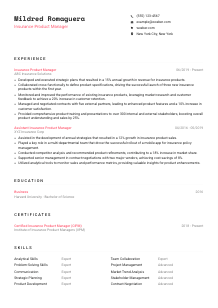
For an Insurance Product Manager, the header should establish professional credibility fast and remove basic screening questions before the reader gets to your experience. Keep it clean, accurate, and aligned with any practical requirement named in the posting.
Set your full name in a clear, readable format so it anchors the page immediately. Insurance leadership and product roles are often reviewed quickly alongside revenue, portfolio, and launch history, so your header should look polished and businesslike rather than styled for effect.
Place "Insurance Product Manager" beneath your name when that is the role you are pursuing. Matching the target title helps frame the rest of the resume correctly, especially for ATS parsing and for hiring managers deciding whether your background is in product ownership, product support, or broader insurance operations.
List a reliable phone number and a professional email address, then double-check both. For roles that involve stakeholder presentations, partner negotiations, and sales support, small details matter. A clean contact line reinforces that you handle communication with care.
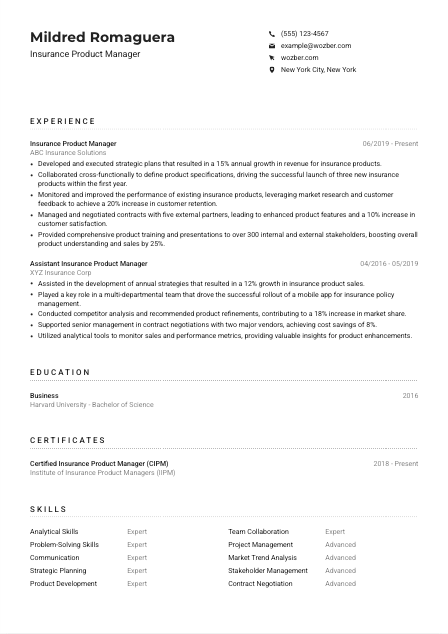
If the employer specifies location, reflect it plainly in your header. Here, New York City, New York is a stated requirement, so including it removes uncertainty early. Use this only when it is relevant to the posting, not as a default rule for every Insurance Product Manager resume.
Include LinkedIn or a professional website if it supports your product background with consistent details, such as product launches, insurance specialties, or speaking engagements. Make sure the content matches your resume. If your profile is sparse or outdated, leave it off until it reflects your current level of work.
Your personal details should confirm who you are, what role you are targeting, and whether any practical requirement such as location is already covered. That lets the reader move straight to your product record without avoidable friction.




This section carries the most weight for an Insurance Product Manager because the role is measured by what happened under your product direction. Focus on growth, profitability, launches, product refinements, partner management, and the cross-functional execution behind those results.
Start by identifying the work the employer is hiring for, then reorganize your experience to match it. In this case, that means emphasizing insurance product strategy, market research, regulatory awareness, cross-functional development, vendor negotiation, and stakeholder training. If you have broader product or insurance work, lead with the parts tied most closely to portfolio growth and product decisions.
List each position in reverse chronological order with title, company, and dates. That structure helps the reader track your progression from supporting product work to owning strategy and performance. In the sample, the move from Assistant Insurance Product Manager to Insurance Product Manager supports the required 5+ years of insurance product management experience without needing extra explanation.
Each bullet should show what you owned, what you changed, and what business result followed. Strong bullets in this field often start with actions such as developed, launched, analyzed, negotiated, refined, or trained. The sample works well here by tying strategic planning to 15% annual revenue growth and product development collaboration to three successful launches.
Quantify results with measures that matter in insurance product management, such as premium growth, retention, market share, launch count, customer satisfaction, cost savings, or sales lift. Numbers give shape to your decisions. A 20% increase in customer retention or a 10% gain in satisfaction tells far more than saying you "improved product performance."
Prioritize experience that supports your ability to grow and manage insurance products. If an older role does not connect to market analysis, product development, portfolio performance, vendor coordination, or stakeholder support, condense it. The section should leave a clear impression that you can take a product from strategic planning through launch and refinement in an insurance environment.
By the end of your experience section, the reader should understand the scale of your product ownership, the commercial results you influenced, and how you work across teams to move insurance products forward.
Education matters here because many insurance product roles still screen for a business-related degree before the deeper review begins. Present your academic background in a way that confirms you meet the baseline requirement and supports your commercial understanding of the role.
If you hold a bachelor's degree in Business, Marketing, or a related field, name it clearly so it is easy to confirm. This posting asks for that directly, and the sample's Bachelor of Science in Business lines up well. When your degree is related rather than exact, use the formal field name and let the rest of your resume reinforce relevance.
List degree, field of study, school, and graduation year in a simple structure. Insurance hiring teams do not need decorative formatting here. They need to confirm qualifications quickly and move back to your product track record.
If your coursework, capstone work, or concentration touched product strategy, finance, risk, consumer behavior, or market analysis, include it when you are early in your career or when it strengthens a nontraditional background. For experienced candidates, the degree usually stays brief unless it adds something specific to insurance product work.
Academic honors can help if they show analytical strength or business performance, but only keep them if they still support your current level. Once your resume includes measurable product outcomes, education should stay concise unless the distinction is especially notable.
Additional training, industry coursework, or university-affiliated programs can fit here when they sharpen your understanding of insurance markets, regulation, or product management. If they are more professional than academic, they may fit better in the certificates section instead.
Your education entry should quickly answer the degree requirement and support the business grounding behind your product decisions. Keep it clean, relevant, and easy to scan.
Certifications are especially useful in insurance because they show continued engagement with product knowledge, regulation, and industry practice. They can reinforce your specialization when the job posting wants depth in insurance products and market awareness, even if no specific certification is required.
List certifications that strengthen your product management credibility inside the insurance industry. A credential such as Certified Insurance Product Manager directly supports the role because it signals focused knowledge beyond general product methods. Use general product certificates only when they clearly add value to your insurance background.
Choose certificates that relate to insurance products, compliance, financial services, or stakeholder-facing product work. A shorter list with clear relevance reads better than a long collection of unrelated training. In the sample, CIPM and Series 6 both add context that fits regulated product environments.
Add completion dates, renewal periods, or active status where applicable. In insurance and financial services, current credentials carry weight because regulations, product structures, and market standards change over time.
Recent or maintained certifications tell employers you are keeping pace with regulation, product changes, and industry expectations. That matters when the role involves refining existing products and evaluating new market opportunities, not just maintaining a static portfolio.
The right certifications should deepen your insurance product profile, not pad the page. Include the ones that support regulatory awareness, product knowledge, and professional credibility in the market you want to work in.
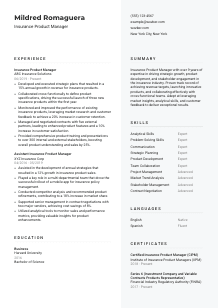
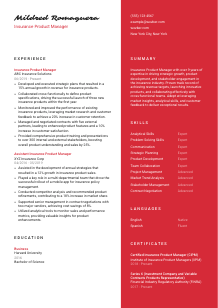
Insurance Product Managers are expected to balance analysis, strategy, execution, and stakeholder influence. Your skills section should reflect that mix clearly enough for both ATS screening and a quick human review.
Extract the skills that define the work, then mirror that language where it matches your background. For this role, that includes analytical skills, project management, problem-solving, communication, strategic planning, and knowledge of insurance products and market trends. These terms help position you correctly in ATS optimization when they also appear naturally in your experience.
Feature skills that support product planning, launch, refinement, and performance management. Contract negotiation, stakeholder management, market analysis, product development, and cross-functional collaboration are especially relevant because they connect directly to responsibilities named in the posting. The sample skills list does this well by balancing strategic, analytical, and execution-oriented strengths.
Do not fill this section with broad business terms that could belong to any manager. Choose the skills that best support insurance product ownership and can be backed up by bullet points elsewhere on the resume. A focused list creates a clearer profile than a long inventory of vague strengths.
Your skills section should quickly confirm that you can analyze product performance, coordinate development work, handle partner discussions, and communicate with the internal and external groups that shape insurance product success.
Language skills matter most when they affect communication with clients, brokers, partners, or internal teams. For Insurance Product Managers, English proficiency is often a practical requirement because the role involves presentations, training, product documentation, and cross-functional coordination.
When the posting asks for advanced English, list English first with an accurate proficiency level. This is especially important in roles that involve presentations, sales support, product training, and written communication across departments. The sample's "Native" English covers that requirement clearly.
Stick with standard terms such as Native, Fluent, Advanced, or Conversational. Hiring teams need a practical read on how you communicate, not a creative interpretation. Consistent labels also help avoid confusion during screening.
Extra languages can strengthen your profile when the market, customer base, or stakeholder mix is multilingual. Spanish, for example, may be useful in client-facing or regional product contexts, but it should remain secondary unless the employer specifically asks for it.
State your proficiency honestly. If you may need to present product updates, explain policy features, or discuss contract details in that language, your listed level should reflect what you can do comfortably in a professional setting.
Languages are a supporting section for most Insurance Product Manager resumes, not a headline item. Include them cleanly, meet the stated requirement, and let the core product story stay in the experience and summary sections.
This section should confirm that you can handle the communication demands of the job and, where relevant, support a broader customer or partner base without distracting from your product management track record.
The summary should establish your level, your insurance product focus, and the kind of outcomes you deliver. For this role, a short paragraph works best when it links product strategy with measurable business results and cross-functional execution.
Start with your title and years of relevant experience so the reader can place you immediately. A line such as "Insurance Product Manager with 9+ years of experience in the insurance industry" works because it covers both role identity and tenure without wasting space.
Use the next sentence to define your scope. Mention areas such as strategic planning, product development, market analysis, portfolio growth, or stakeholder engagement, depending on your background. Keep the wording close to the work you can prove in the experience section.
Include measurable results that reflect how your product decisions performed. The sample summary does this effectively by pointing to revenue targets, innovative product launches, and customer-focused improvements. Choose metrics that fit your history rather than trying to cover every responsibility in one paragraph.
Aim for 3 to 5 lines with direct language and no generic adjectives. This section should quickly tell a hiring manager whether your background fits their insurance product portfolio, growth goals, and cross-functional operating environment.
A well-targeted summary gives the reader an immediate sense of your insurance product scope, business impact, and seniority. It should make the rest of the resume feel like proof, not explanation.
With the structure in place, refine every section so the resume consistently points back to insurance product strategy, measurable portfolio results, and collaboration across functions such as sales, operations, compliance, and external partners. Wozber's AI resume builder can help you align that content with the job description, strengthen ATS optimization, and present it in an ATS-friendly resume format.
When the resume is tailored well, a hiring team can quickly see that you understand insurance products, can improve performance, and can lead the work required to bring profitable product changes to market.




