



Use Wozber and land your dream job
Create Resume
No registration required
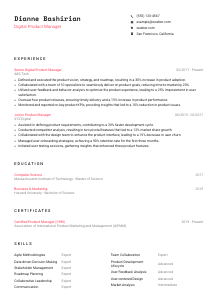
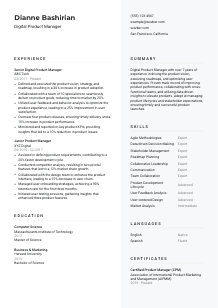
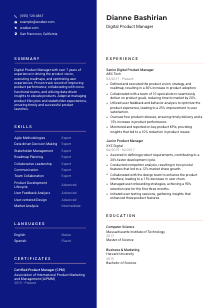
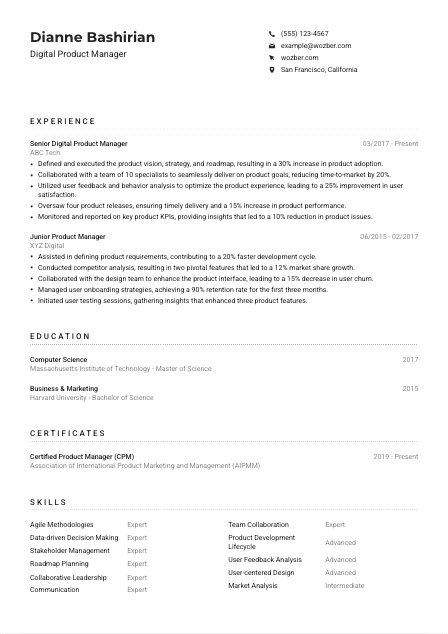
Steering digital products, but your resume seems off-course? Set your sights on this Digital Product Manager resume example, created with Wozber free resume builder. It shows how to bring together your tech-tailored leadership with job standards, so your career trajectory stays right on the product roadmap!
Digital product management sits at the intersection of customer behavior, business priorities, and shipping reality. Hiring teams want to see whether you can turn research, product judgment, and cross-functional execution into measurable outcomes like adoption, retention, release quality, and roadmap progress. Your resume should make that operating range visible quickly.
A tailored resume changes how your product work is interpreted in an ATS and by the people reading after it. When the language clearly reflects roadmap ownership, Agile delivery, KPI tracking, and collaboration with design, engineering, and marketing, your scope is easier to place against the opening. Wozber's free resume builder helps structure that alignment in an ATS-friendly resume format so the hiring team can quickly understand where you have led product decisions and delivered results.
For a Digital Product Manager, the header should establish professional alignment fast. Keep it clean, credible, and easy to scan so the reader can move straight into your roadmap work, product outcomes, and cross-functional leadership.
Set your name in a clear, readable style that stands apart from the rest of the page. Product roles often move through recruiters, hiring managers, and leadership stakeholders, so basic scanability matters more than design flair.
Place "Digital Product Manager" directly beneath your name when that matches the role you are pursuing. This immediately positions your background in the right lane, especially when your past titles include variations such as Product Manager or Senior Digital Product Manager.
List a reliable phone number and a professional email address, ideally one built around your name. If you include a website or LinkedIn profile, make sure it supports your product story with consistent dates, titles, and evidence of work such as launches, market focus, or product thinking.
If the job specifies a location, show it clearly in your personal details. In this example, listing San Francisco, California directly addresses a stated requirement and removes uncertainty before the reader reaches the rest of your resume.
A LinkedIn profile, portfolio, or personal site can strengthen a product application when it adds substance. For Digital Product Managers, that might include shipped products, case studies, experiments, or concise write-ups on strategy, user research, or feature prioritization. Keep it directly relevant to product work.
Your personal details should answer the practical questions immediately: who you are, what role you are targeting, how to reach you, and whether you meet any stated location requirement. Then the reader can focus on your product judgment and delivery record.




This is the section where product management experience becomes concrete. Hiring teams look for signs that you have shaped roadmap decisions, worked across design and engineering, used customer and usage data well, and moved releases from planning into market impact.
Start by identifying the work that defines the opening. Here, that includes product vision, roadmap execution, user feedback analysis, release management, and performance reporting. Build your bullets so those themes appear through real achievements rather than copied job-description phrasing.
Each entry should clarify the product context you managed. Include your title, company, dates, and bullets that show whether you owned strategy, supported senior product leads, partnered with engineering, or drove optimization. The example resume does this well by showing a progression from Junior Product Manager to Senior Digital Product Manager, which signals growth in ownership.
Digital product management is measured through product and delivery outcomes. Quantify gains in adoption, churn, satisfaction, retention, release cadence, issue reduction, conversion, or time-to-market when those numbers are real. The sample bullets are strong because they connect actions to product results, such as increasing adoption by 30 percent and reducing time-to-market by 20 percent.
Agile is not a keyword by itself. Show how you used sprint planning, backlog prioritization, release coordination, experiments, or feedback loops to move the product forward. Pair that with user behavior analysis, testing, or feedback synthesis so the reader sees both delivery discipline and product judgment.
Prioritize experience that speaks to digital product strategy, execution, analytics, and stakeholder coordination. Older or unrelated work can stay brief unless it adds something useful, such as market analysis, technical collaboration, or customer insight. Keep the section centered on decisions you influenced and outcomes you helped create.
Your experience section should leave little doubt that you can guide a digital product from strategy through release and iteration. Focus on roadmap decisions, collaboration patterns, and product metrics that show business and user impact.
Education usually is not the deciding factor for experienced Digital Product Managers, but it still matters when the role asks for a specific academic foundation. Present it clearly so the reader can confirm you meet the requirement without digging.
If the posting asks for a bachelor's degree in Business, Marketing, Computer Science, or a related field, make that easy to verify. In the example, a Bachelor of Science in Business & Marketing aligns well, while the additional master's degree strengthens the technical side of the profile.
List school, degree, field of study, and graduation year in a consistent format. For most product roles, this section should be quick to scan so the emphasis stays on your roadmap work, product decisions, and cross-functional delivery record.
If you hold a master's degree or another advanced qualification, include it when it reinforces your product background. A degree in Computer Science, data, design, or business can help explain stronger fluency in engineering tradeoffs, analytics, or product strategy.
Coursework is most useful when you are early in your career or when a program included directly relevant work such as product strategy, user research, analytics, software development, or marketing. Add it only if it strengthens your case more than another line of experience would.
Honors, scholarships, leadership roles, or substantial university projects can be worth noting if they connect to product work. Keep them brief and relevant. For an experienced candidate, the strongest academic line is usually the one that confirms qualification without distracting from delivery results.
Education should confirm that you meet the stated academic requirement and, when relevant, show the mix of business, technical, or market training behind your product decisions.
Certifications are rarely the main reason a Digital Product Manager gets hired, but the right ones can reinforce your working style and development focus. They are most useful when they support the way you build, prioritize, and improve products.
Choose certifications that support core product responsibilities, such as product management, Agile delivery, analytics, experimentation, or user experience. The example includes a Certified Product Manager credential, which fits the role well even though the job description does not require a specific certification.
A short, relevant list is more effective than a long catalog of unrelated courses. If you have certifications in Scrum, Agile, product discovery, growth, or UX, include the ones that best match the opening and your recent experience.
List the certification name, issuing organization, and date earned or current status. That gives the credential context and shows whether it reflects current practice, which matters in product environments where methods and tools evolve quickly.
Product managers are expected to keep sharpening how they prioritize, test, analyze, and communicate. Updating certifications over time can support that story, especially when your recent learning aligns with areas like Agile execution, data-informed decision-making, or product-led growth.
Certifications should reinforce your product practice, not try to replace real delivery experience. Include the ones that support how you lead roadmaps, work with teams, and improve digital products over time.
A Digital Product Manager skills section should read like a focused operating toolkit. It should support what appears in your experience section, using the language of strategy, delivery, analysis, and cross-functional execution rather than a generic list of strengths.
Use the job description to identify the capabilities the employer cares about most. In this case, that includes Agile methodologies, product development lifecycle knowledge, analytical decision-making, communication, collaboration, and stakeholder management. Add them only if your experience backs them up.
Feature the skills that help you define roadmap priorities, interpret user behavior, work across teams, and report on performance. The sample resume handles this well by emphasizing Agile methodologies, roadmap planning, stakeholder management, and user feedback analysis, all of which connect directly to the role's responsibilities.
Group hard skills and working capabilities in a way that is easy to scan. Product strategy, analytics, backlog prioritization, release management, user research, stakeholder communication, and cross-functional leadership are more informative than broad filler terms. If you use proficiency levels, keep them believable and consistent with your experience.
Your skills section should quickly confirm that you can plan, prioritize, collaborate, analyze, and ship in a digital product environment. Every item should support the story already told in your experience bullets.
Language listings matter most when the role names a required working language or when the product serves multiple markets. For Digital Product Managers, communication is part of the job itself, from stakeholder updates to writing product requirements and interpreting user feedback.
If the role requires English, list your English proficiency clearly. The posting here calls for effective communication in English, so that should appear plainly in the languages section and align with the communication quality across the rest of the resume.
Additional languages can be useful when products serve multilingual users, international markets, or cross-border teams. Spanish, for example, may be worth listing if it supports customer research, market expansion, or collaboration in your actual work.
Choose levels that match what you can comfortably do in real settings, such as leading meetings, writing documentation, or interviewing users. "Native," "Fluent," and "Intermediate" should reflect practical working ability, not optimistic labeling.
Only give this section extra space when language capability changes how you can perform in the product role. If the work is domestic and English-only, one required language and one additional useful language is usually enough.
List languages clearly and credibly. For product roles, they matter when they support stakeholder communication, user research, or market reach.
Your summary should present a concise view of your product management level, decision-making style, and strongest outcomes. It is most effective when it connects years of experience with the kind of product work and results the employer wants to see.
Read the posting closely and identify the few themes that deserve space at the top of the resume. Here, those themes are product vision, roadmap execution, data-driven optimization, cross-functional collaboration, and release delivery. Use them to shape the summary instead of writing a broad career statement.
Start with a direct line such as "Digital Product Manager with 7+ years of experience." That gives immediate context about your seniority and specialization, which matters in roles asking for at least 5 years of experience.
Include outcomes that reflect how you work, not just what you have done. The example summary is effective because it references improved product performance, user experience optimization, and successful launches. If possible, use one memorable metric drawn from your experience section to anchor the claim.
Aim for three to five lines with enough specificity to establish direction. Mention the mix of strategy, analytics, and cross-functional leadership that defines your product work, then leave the detail for the experience section. Brevity works best when each phrase points to real roadmap ownership or measurable product impact.
Your summary should quickly explain what kind of Digital Product Manager you are, how you make decisions, and what results tend to follow your work. That gives the rest of the resume a clear product narrative.
A Digital Product Manager resume works when it makes your decision-making range easy to follow. Product vision, prioritization, Agile delivery, user insight, and KPI ownership should appear as connected parts of how you work, not as isolated keywords.
Use Wozber to tighten that alignment with ATS optimization, clear section structure, and language that reflects the job description without sounding copied. The finished resume should make it easy to judge whether you can lead roadmap decisions, coordinate cross-functional delivery, and improve product performance in a real operating environment.




