



Use Wozber and land your dream job
Create Resume
No registration required
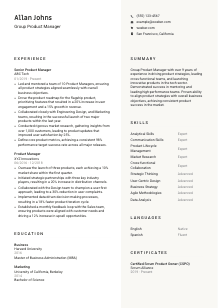
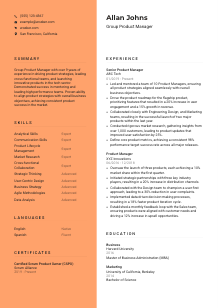
Steering product vision, but your resume feels a bit scattered? Check out this Group Product Manager resume example, created with Wozber free resume builder. Learn how to bring together your leadership and strategic insight to match job specifications, charting a career trajectory as clear and market-ready as your product roadmaps!
Group Product Managers are hired to bring order to competing priorities. Teams look to them to set direction across multiple products or product lines, make tradeoffs that hold up under scrutiny, and keep engineering, design, and go-to-market work moving toward business goals. Your resume should make that operating range visible through roadmap ownership, team leadership, product launches, and measurable product outcomes.
A tailored resume quickly separates strategic product leaders from candidates whose background is limited to feature delivery. Using Wozber's free resume builder helps you line up your language with the job description, build an ATS-compliant resume, and present the parts of your experience that matter most first, such as portfolio impact, cross-functional leadership, and the metrics you owned.
For a Group Product Manager, the header should read like a clean product brief: direct, current, and easy to act on. Hiring teams do not need decoration here. They need immediate confirmation of who you are, what level you operate at, and whether basic logistics match the opening.
Use your full name in the most prominent text on the page. Keep it simple and professional so the focus stays on your product leadership background, not on formatting choices. This section should make you easy to identify at a glance.
Place "Group Product Manager" directly under your name if that is the role you are targeting. Matching the job title helps frame the rest of the resume correctly, especially when recruiters are sorting candidates across Product Manager, Senior Product Manager, and Group Product Manager levels.
Your phone number and email should be current and professional. Product leadership searches often move through recruiter screens, stakeholder interviews, and panel scheduling quickly, so make it easy for teams to reach you without confusion.
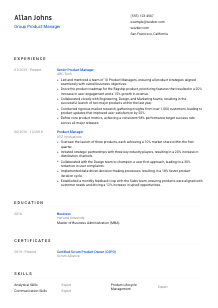
If the role requires you to be in a specific market, state your city and state clearly. In the example, listing San Francisco, California directly addresses the employer's location requirement and removes a common source of back-and-forth early in the process.
Include LinkedIn and, if applicable, a personal site that shows product writing, launches, speaking, or thought leadership. Make sure those profiles match your resume in title history, scope, and dates. Inconsistencies around team size, launch ownership, or tenure can create unnecessary doubt.
This section should confirm the basics fast: identity, target role, contact path, and any location detail the employer flagged. For a Group Product Manager, that clarity helps the reader get straight to your product judgment, leadership scope, and execution record.




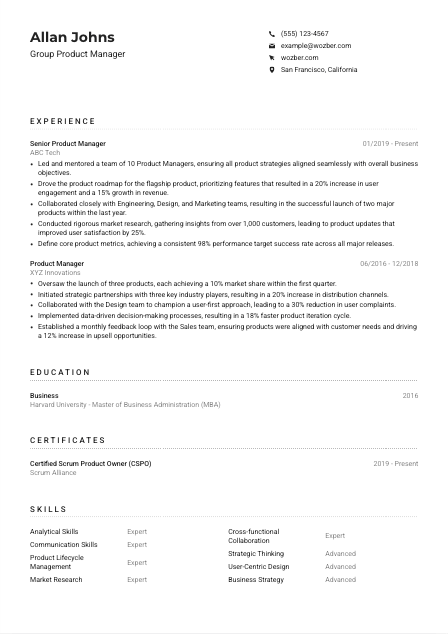
This is the section hiring teams read most closely for a Group Product Manager. They want to see how you set roadmap direction, led Product Managers, partnered with Engineering and Design, and moved products into market with measurable results. Scope matters here. So do outcomes.
Pull out the responsibilities and operating expectations before you edit a single bullet. For this role, the core themes are team leadership, roadmap prioritization, cross-functional execution, customer insight, and product metrics. Those themes should shape what you highlight from each role, especially if your background includes adjacent work such as growth, platform, or strategy.
List your roles in reverse chronological order and make the growth in your remit easy to follow. A Group Product Manager resume should show movement from managing features or a single product toward leading PMs, owning broader strategy, or steering a portfolio. The example does this well by moving from Product Manager to Senior Product Manager with larger launch and leadership scope.
Each bullet should answer a business question: what changed because you led the work? Strong product bullets often include adoption, engagement, revenue, retention, launch timing, customer satisfaction, iteration speed, or target attainment. For example, "20% increase in user engagement" and "15% growth in revenue" tell a much stronger story than "managed roadmap priorities."
Use the employer's wording where it reflects your real experience. If the posting emphasizes "cross-functional teams," "user-centric design," or "key product metrics," incorporate those phrases into your bullets with context. That improves ATS optimization while also helping the reader connect your work to the operating model of the job.
Do not try to summarize every responsibility you have ever had. Prioritize accomplishments that show product strategy, team leadership, launch execution, market insight, and performance accountability. In the sample resume, mentoring 10 Product Managers, launching major products, and defining core metrics all reinforce Group Product Manager-level scope more effectively than a long list of routine tasks would.
A hiring team should be able to scan this section and understand what you owned, who you led, how you worked with partner teams, and which product results improved under your direction. That is the clearest path to showing you can operate at Group Product Manager level.
Education carries different weight depending on career stage, but for Group Product Manager roles it still helps frame your business grounding and strategic toolkit. When a posting asks for a bachelor's degree and prefers an MBA, this section should answer that requirement cleanly and without clutter.
Start with degrees that support product strategy, market understanding, or business judgment. A bachelor's degree in Business, Marketing, or a related field aligns directly with many Group Product Manager postings. In the example, a Marketing bachelor's degree maps neatly to the employer's stated requirement.
For each entry, include school, degree, field of study, and graduation year or date. Put the highest or most advanced degree first. Hiring teams should not have to hunt through dense formatting to confirm that you meet baseline education criteria.
If the employer notes an MBA as preferred and you have one, make sure it is highly visible. The sample resume does this by listing the MBA first, which immediately strengthens the candidate's positioning for a strategic leadership role with commercial and organizational scope.
Most experienced product leaders do not need a long course list. Include relevant coursework only if it sharpens your story, such as analytics, product strategy, consumer behavior, or innovation management. Use it selectively, especially if you are earlier in your career or shifting into a broader product leadership role.
Academic honors, relevant research, entrepreneurship programs, or leadership activities can be worth noting if they support your product background. Keep these short. The main purpose of this section is to confirm the educational foundation behind your business and product decisions.
For this level of product role, education is usually a supporting section rather than the main proof point. Keep it crisp, relevant, and aligned with the posting so the reader can move back to the leadership and product results that carry the most weight.
Certifications are most useful when they reinforce how you work. For Group Product Managers, that usually means showing fluency in product operating methods, agile delivery, experimentation, or customer-centered development. The right credential can strengthen your profile. A generic list rarely does.
Lead with certifications that connect directly to product planning, agile execution, or team leadership. A CSPO, for instance, supports product backlog ownership and agile collaboration in a way hiring teams immediately understand.
A short, focused certification section usually reads better than a long inventory. Include the credentials that help explain your product operating style or domain depth. If a certificate does not support roadmap ownership, product delivery, or leadership scope, it can usually stay off the page.
List the certificate name, issuing organization, and date or active status. That context matters. In the example, showing "Certified Scrum Product Owner (CSPO)" with a current date range makes the credential feel current and usable rather than historical.
For senior product roles, certifications are less about entry-level qualification and more about ongoing refinement. Recent credentials can signal that you stay current with modern product practices, delivery frameworks, and collaboration models across engineering and design.
The best certifications section supports the story already visible in your experience. It should tell the reader that your product judgment is backed by current methods, not distract them with unrelated credentials.
A Group Product Manager skill list should capture how you make decisions, how you lead, and how you move products through the organization. Think in terms of strategy, execution, customer insight, and cross-functional influence. Generic soft-skill lists are rarely enough at this level.
Start with the language the employer uses to describe the role. In this case, that includes analytical thinking, strategic thinking, communication, cross-functional collaboration, market research, and product performance tracking. If those reflect your real background, use them in your skills section and reinforce them in your experience bullets.
Place the most role-relevant capabilities first. For a Group Product Manager, that often means product strategy, roadmap prioritization, product lifecycle management, data analysis, experimentation, user research, and stakeholder leadership. The sample resume also includes collaboration and communication skills, which matter because this role depends on alignment across Engineering, Design, and Marketing.
Keep the list clean and grouped logically if your format allows it. You might separate strategic skills, delivery skills, and collaboration skills, or simply order them by relevance. Avoid padding the section with obvious traits that are already visible through your accomplishments.
When this section is tailored well, it reinforces the same picture your experience section creates: a product leader who can set direction, read the market, guide teams, and deliver against business targets.
Language fluency matters when the role depends on reading market inputs, customer feedback, research, or technical and business documentation. For Group Product Manager positions, language details are usually brief, but they can still help clarify whether you meet a stated requirement or bring added reach across teams and markets.
If the posting names a language requirement, list it clearly. Here, the employer specifies the ability to read complex texts in English, so English proficiency should appear first and at an accurate level.
Additional languages can be useful when products serve international users, multilingual markets, or distributed teams. They are usually secondary for this role, but they can still add value. In the example, Spanish fluency broadens the candidate's communication range without distracting from core product qualifications.
Choose straightforward descriptors such as Native, Fluent, Professional, or Conversational. Product roles often involve nuanced communication with executives, customers, and partner teams, so accuracy matters more than trying to sound impressive.
List the strongest and most job-relevant language first. That keeps the section aligned with the posting and avoids burying a required qualification under less important details.
Unless language capability is central to the job, this section should stay concise. Its purpose is to confirm any stated requirement and, where applicable, show added market or communication flexibility.
For most Group Product Manager resumes, this section is short. Done well, it confirms required proficiency and adds context without pulling attention away from roadmap ownership, team leadership, and product results.
Your summary should quickly tell the reader what level you operate at and what kind of product leadership you bring. For a Group Product Manager, that usually means strategy, people leadership, cross-functional execution, and measurable product impact. Keep it tight, specific, and anchored in real outcomes.
Open with your current level or target level and your years of product management experience. If you have 8+ years, say so directly, since that aligns with many senior product leadership postings. The sample summary does this effectively with "over 9 years of experience."
Follow with two or three strengths that match the role, such as leading Product Managers, driving product strategy, launching products, or translating data into action. Use the priorities in the job description as your guide rather than trying to summarize your whole career.
Aim for three to five lines that communicate scope and results. Skip vague claims like "dynamic leader" unless you immediately support them with specifics such as portfolio growth, launch success, or team leadership.
Adjust your summary for each application so it reflects the role's emphasis. If one employer cares most about team leadership and strategic alignment, lead there. If another prioritizes user research and performance metrics, shift the emphasis. Wozber's AI resume builder can help you refine that wording so the summary aligns with the posting while staying true to your actual experience.
A well-written summary gives the reader a fast, accurate read on your scope. By the time they move into your experience section, they should already expect to see strategic direction, cross-functional leadership, and product results that match a Group Product Manager brief.
Your resume should now show the full picture: product strategy, leadership of Product Managers, cross-functional execution, customer-informed decisions, and the metrics you used to judge success. Those are the details that help a hiring team place you at Group Product Manager level rather than a narrower product role.
Use Wozber to tighten the language, improve ATS optimization, and map your experience to the job description with more precision. The finished resume should make it easy to judge your ability to lead product direction, align teams, and deliver products that meet business targets.