



Use Wozber and land your dream job
Create Resume
No registration required
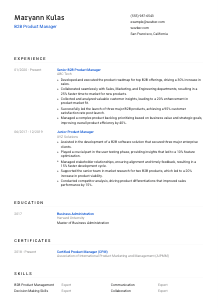
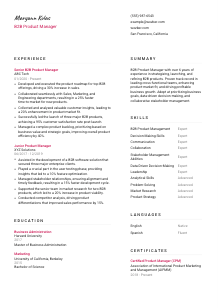
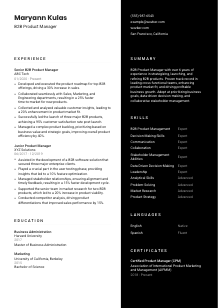
Guiding B2B products, but your resume seems like a beta version? Check out this B2B Product Manager resume example, created with Wozber free resume builder, to learn how to tailor your product prowess to match job requirements. Craft your career trajectory as seamlessly as your product roadmap!
B2B Product Managers are hired to make hard tradeoffs visible. Teams want someone who can turn customer problems, commercial goals, and engineering constraints into a roadmap that ships. Your resume should reflect that operating reality. It needs to show how you prioritized backlog work, influenced cross-functional teams, and moved products toward stronger adoption, revenue, or product-market fit.
Hiring teams often sort B2B product candidates by whether their background reads like true ownership or adjacent support work. A tailored resume makes that difference clear by using the language of roadmap planning, launches, customer insight, and business value in an ATS-compliant resume. Wozber's free resume builder helps you align those terms cleanly so both the ATS and the hiring team can quickly see where you have already led product decisions.
This section does more than identify you. For a B2B Product Manager, it should immediately confirm role alignment, professional presentation, and any practical requirement that would otherwise slow down a recruiter or hiring manager.
Use your full name in a clear, readable style at the top of the page. Keep it slightly more prominent than the rest of the text so the resume feels well organized from the first line. Product roles involve clarity, prioritization, and structure, and even this small formatting choice reinforces that tone.
Place the target title directly under your name when it matches your background. Using "B2B Product Manager" here helps frame the rest of the document before the reader reaches your experience. If your recent title was more senior, such as "Senior B2B Product Manager," you can still target the broader title when applying, as long as the experience supports it.
List a reliable phone number and a professional email address that uses your name rather than a casual handle. Make it easy for recruiters, founders, or product leaders to contact you after a screen or panel review. If you include a website, it should add value, such as a portfolio with launch case studies, product writing, or market analysis.
Some B2B product roles are flexible, but others are tied to a market, office, or customer base. Here, the employer asks for San Francisco, California, so stating that location directly in Personal Details removes a common screening question. Treat this as tailoring to the posting, not a universal rule for every B2B Product Manager resume.
A current LinkedIn profile can reinforce your resume with fuller context on product scope, industries served, and launch history. Make sure the titles, dates, and headline match your resume. If your profile mentions roadmap ownership, enterprise product launches, or cross-functional leadership, those points should line up cleanly with the claims in the resume itself.
Personal details should confirm that you are professionally presented, reachable, and aligned with the basic logistics of the role. That gives the hiring team a clean start before they evaluate how you build roadmaps, work with engineering, and deliver B2B product outcomes.




For B2B Product Manager hiring, experience is where your resume either proves ownership or gets read as support work. This section should show how you drove decisions, collaborated across functions, and improved product or business results through roadmap choices and launch execution.
Start by marking the responsibilities and requirements that define the role. In this posting, the clearest priorities are roadmap ownership, collaboration with Sales, Marketing, and Engineering, customer insight analysis, product launches, backlog prioritization, and at least 5 years in B2B product management or related work. Those are the themes your experience bullets should reflect first.
List your most recent role first, then work backward. For each position, include title, company, and dates in a consistent format. That helps the reader quickly track your progression from supporting product work to leading strategy, launches, or cross-functional delivery.
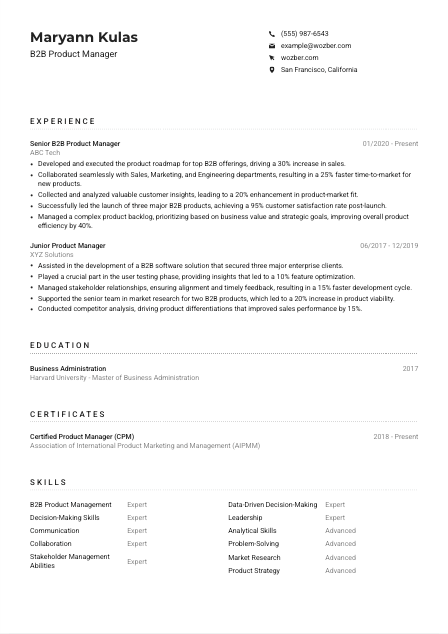
Each bullet should connect an action you led to a result the business cared about. For B2B product roles, that often means roadmap execution, faster release cycles, stronger adoption, improved customer satisfaction, or better product-market fit. A bullet like "Developed and executed the product roadmap for top B2B offerings, driving a 30% increase in sales" works because it ties product strategy to a commercial result.
Use metrics that belong naturally in product work. Sales growth, time-to-market, customer satisfaction, feature adoption, launch volume, retention lift, backlog efficiency, beta feedback conversion, or reduced development cycle time all make your impact easier to judge. The sample resume does this well with outcomes such as 25% faster time-to-market, 20% improvement in product-market fit, and three major launches.
Prioritize work that shows B2B product judgment over generic task lists. If an older role included market research, stakeholder coordination, user testing, or competitor analysis, keep those bullets only when they support a product decision story. The strongest experience sections show how those activities informed roadmap choices, launch readiness, or business value, not just that they happened.
When this section is tailored well, the reader can trace your path from product contributor to product owner without guessing. Your bullets should make it obvious that you can manage a backlog, work across teams, and launch B2B products with measurable business impact.
Education usually is not the deciding factor for an experienced B2B Product Manager, but it still helps confirm foundation and relevance. Present it clearly, and use it to reinforce your business, technical, or market-facing background without overexplaining it.
The posting asks for a bachelor's degree in Business, Marketing, Engineering, or a related field, so make sure that qualification is easy to find. If you also hold an MBA or another advanced degree, include it above the bachelor's degree to show added strategic and commercial training. In the example, both the MBA and the marketing degree support a product role that sits between customer need and business growth.
Use a consistent order such as degree, field, school, and graduation year. Recruiters and hiring managers do not need dense educational detail here. They want to confirm that your academic background supports the product work shown elsewhere in the resume.
If your degree is in Marketing, Business, Engineering, Information Systems, or another related area, include the field clearly because it adds context to how you approach product decisions. A business-focused degree can support pricing, go-to-market, and stakeholder communication. A technical field can support work with engineers, system constraints, and implementation tradeoffs.
Academic honors, research, capstone work, or leadership activities are most useful early in your career or when they connect directly to product strategy, technology, or market analysis. For someone with several years of product experience, this section should stay concise and let your roadmap and launch work carry more weight.
Your education section should confirm that you meet the baseline and add helpful context about your commercial or technical grounding. For most B2B Product Managers, that is enough. The heavier proof belongs in experience, launches, and product outcomes.
Certifications are rarely the main hiring filter for B2B Product Managers, but they can strengthen your profile when they point to real product discipline. Use this section to support your experience, especially in roadmap planning, product strategy, or market-facing product work.
Start with the job description. This one does not require a certification, so treat credentials as supporting proof rather than a substitute for experience. Relevant product certifications can still help signal continued investment in the craft, particularly when paired with launch and roadmap results.
List certifications that strengthen your case for B2B product ownership. A credential such as Certified Product Manager fits because it relates directly to product planning, prioritization, and lifecycle thinking. Pick certificates that support the role you want, not every course you have completed.
Add the year earned, and if the credential remains active, note the active range when appropriate. That helps the reader understand whether the training is recent and still relevant. In product roles, current knowledge matters when the work involves evolving customer expectations, launch practices, and go-to-market collaboration.
B2B product work changes with market behavior, buyer expectations, analytics practices, and delivery models. Relevant certifications can support a story of continued learning, especially if your experience spans software launches, customer research, beta programs, or strategic backlog decisions. Keep the section focused and practical.
A well-chosen certification adds credibility when it reinforces the product decisions and results shown elsewhere in your resume. Keep the emphasis on credentials that make your B2B product background easier to trust.
The skills section should read like the operating toolkit of a B2B Product Manager. Focus on skills that map to roadmap decisions, customer insight, cross-functional execution, and business outcomes rather than listing broad strengths with no product context.
Use the job description to identify the capabilities that must be visible. Here, the employer names analytical thinking, problem-solving, data-driven decision-making, communication, collaboration, and stakeholder management. Those should appear in your skills section if they are genuinely part of your background, and they should also be reinforced in your experience bullets.
Include skills that reflect both the posting and your real day-to-day product work. For a B2B Product Manager, that may include product strategy, roadmap planning, backlog prioritization, market research, launch management, customer feedback analysis, stakeholder management, and cross-functional collaboration. If you use ratings, keep them honest and consistent.
Avoid padding the section with generic business terms. A tighter list is stronger, especially when it includes skills the hiring team expects to see in a product context. The example resume gets this mostly right by emphasizing B2B Product Management, Data-Driven Decision-Making, Market Research, Product Strategy, Collaboration, and Analytical Skills rather than unrelated software or office tools.
This section should quickly confirm that you have the core capabilities to run discovery, shape priorities, work across teams, and make commercially sound product calls. Keep it specific enough that a product leader can immediately connect the skills list to the experience section.
Language requirements matter differently in product roles depending on customer base, internal teams, and market coverage. Present this section clearly, with the role's communication needs in mind rather than treating it as filler.
This job explicitly requires fluent English, so English should appear clearly in your languages section with an accurate proficiency level. That matters for product reviews, customer interviews, launch communication, and cross-functional alignment. If the posting names a language requirement, do not leave it implied.
Lead with the language the role depends on most. For many B2B Product Manager roles, that will be English because of stakeholder meetings, product documentation, customer discovery, and launch coordination. Additional languages can follow in order of practical relevance.
Extra languages can be valuable when the product serves international buyers, distributed customer teams, or global sales organizations. For example, fluent Spanish may be useful in certain markets or customer segments, even when it is not a stated requirement. Treat extra languages as added range, not as a replacement for core product qualifications.
Choose clear labels such as Native, Fluent, Intermediate, or Basic so the reader knows what to expect. Product work involves nuance in interviews, feedback synthesis, roadmap communication, and stakeholder alignment, so inflated language claims can quickly backfire in conversation.
If a position involves enterprise customers across regions, multilingual ability can support discovery calls, sales enablement, or launch communication. If the role is centered on one market, language breadth may be less important. Let the job's customer and stakeholder environment determine how much emphasis this section deserves.
For B2B Product Managers, language skills matter when they improve communication with customers, internal teams, or target markets. Present them clearly, give English its proper place when required, and keep the emphasis on where language supports product work.
Your summary should quickly establish the kind of B2B Product Manager you are. Use it to connect years of experience, product scope, and business results in a few lines that sound grounded in real product work.
Before writing the summary, identify the few points this employer is likely to screen for first. In this case, that includes 5+ years in B2B product management, product launch history, roadmap ownership, data-driven decision-making, and cross-functional collaboration. Those are the ideas your summary should bring forward immediately.
Your first sentence should state who you are professionally in a way that fits the target role. A line such as "B2B Product Manager with over 6 years of experience in strategizing, launching, and refining B2B products" works because it establishes tenure and domain quickly. If your experience is concentrated in SaaS, enterprise platforms, or marketplace products, you can add that when it strengthens relevance.
Use the next sentence to show how you operate. Strong options include roadmap execution, translating customer feedback into product changes, partnering with Sales, Marketing, and Engineering, and prioritizing by business value. The sample summary also works well because it connects cross-functional leadership and product-market fit instead of stopping at vague management language.
Aim for three to five lines with no filler. Avoid generic claims about passion or innovation unless they are supported by real product outcomes. A concise summary that mentions launches, growth impact, decision-making style, and stakeholder management will do more for a B2B product application than a paragraph full of broad adjectives.
A sharp summary helps the hiring team place you correctly before they read the rest of the resume. For a B2B Product Manager, it should make your product ownership, cross-functional range, and business impact clear within a few seconds.
A well-tailored B2B Product Manager resume should show more than familiarity with product language. It should make your roadmap decisions, launch execution, customer insight work, and cross-functional leadership easy to connect to real business results.
Use Wozber's AI resume builder and ATS resume scanner to tighten wording, map job requirements to the right sections, and build an ATS-friendly resume format that reflects how B2B product teams actually hire. The finished resume should make it easy to judge one thing fast: whether you can own a B2B product from strategy through iteration.




