



Use Wozber and land your dream job
Create Resume
No registration required
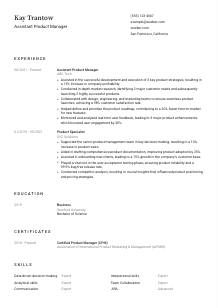
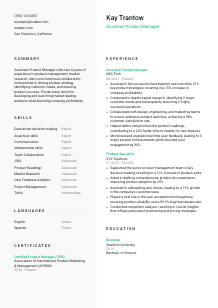
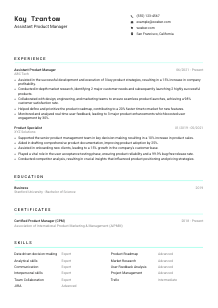
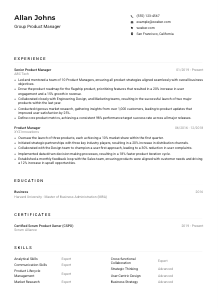
Nurturing products, but your resume needs development? Check out this Assistant Product Manager resume example, created with Wozber free resume builder. Learn how to highlight your growth potential and key contributions to match job standards, putting your career on a path to product stardom!
Assistant Product Managers sit close to product decisions without owning the whole roadmap alone, which means hiring teams look for people who can turn research, feedback, and cross-functional input into practical next steps. Your resume needs to show how you support product strategy, help prioritize work, and contribute to launches or improvements that move adoption, engagement, or revenue.
A tailored resume changes how quickly your product judgment comes through. When the language reflects the posting's priorities, from market research to roadmap support and tool familiarity, Wozber's free resume builder helps shape an ATS-compliant resume that surfaces the right product work early. That matters when reviewers are sorting candidates who all sound broadly collaborative, but differ in how clearly they show decision support, execution, and measurable product impact.
This section should confirm the basics fast and remove friction before anyone gets to your product work. For Assistant Product Manager roles, that means a clear title, reliable contact details, and any location match the posting asks for.
Put your full name at the top in a clean, easy-to-read format, then follow it with the title you are targeting. For this role, using "Assistant Product Manager" directly under your name helps frame the rest of the resume around product strategy support, roadmap coordination, and cross-functional execution.
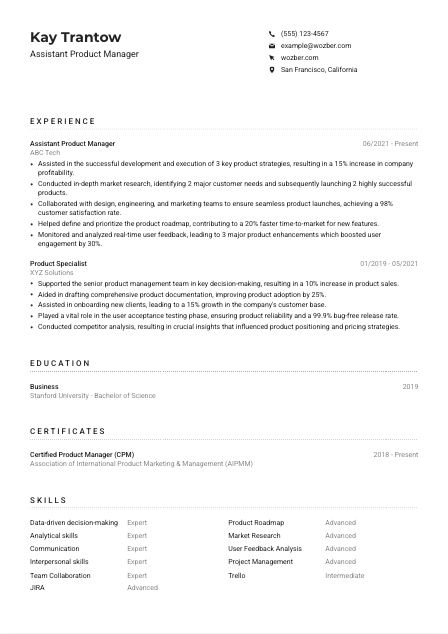
Use the same role title the employer uses unless your background calls for a close variant that is still accurate. If you already hold an Assistant Product Manager title, as in the sample resume, that immediate match makes your application easier to classify than a vague label such as "Business Professional" or "Product Enthusiast".
Include a current phone number and a professional email address. Add a website or LinkedIn profile only if it supports your candidacy with relevant product work, portfolio pieces, launch history, or thought-out career progression.
Some product roles are flexible, others are not. Here, the employer explicitly asks for someone located in San Francisco, California, so listing "San Francisco, California" in your contact block answers that requirement immediately. Use this only when it is true and relevant to the posting.
If you include LinkedIn or a personal site, make sure the content supports the same story as the resume. Product managers are often judged by how clearly they communicate decisions, priorities, and outcomes, so inconsistent titles, dates, or achievements can weaken credibility quickly.
Your contact block should do more than identify you. It should confirm that you are applying for the right product role, easy to reach, and aligned with any practical requirement the employer screens first.




For Assistant Product Manager hiring, experience is where employers look for proof that you can support product decisions and move work forward with engineering, design, and marketing. Focus less on general coordination and more on what you researched, influenced, launched, improved, or measured.
Start by marking the recurring responsibilities in the job description. In this case, they include helping shape product strategy, conducting market and competitive research, prioritizing roadmap items, coordinating with cross-functional teams, and tracking product performance. Those themes should appear in your bullet points using language that matches your actual work.
List roles in reverse chronological order so hiring teams see your latest product exposure first. If your current role already sits in product, as the ABC Tech example does, that placement helps reviewers connect your recent work to roadmap support, launch execution, and customer feedback analysis without extra digging.
Rewrite generic task bullets into action-and-result statements. "Assisted with product strategy" is thin. A stronger bullet explains what you did and what changed, such as contributing to three product strategies that increased profitability by 15 percent or helping prioritize features that cut time-to-market by 20 percent.
Numbers are especially persuasive in product roles when they reflect business or user outcomes. Include metrics tied to launch success, engagement, adoption, satisfaction, conversion, revenue lift, time-to-market, release quality, or backlog efficiency. The sample resume works because the metrics connect directly to product decisions, not because numbers appear for their own sake.
Keep the section centered on product-adjacent work. Bullets about documentation, onboarding, testing, or analysis belong here only if you connect them to product outcomes, customer insight, release quality, or go-to-market support. The strongest experience section reads like someone already operating inside a product workflow, not someone listing every duty they have handled.
By the end of your experience section, a reviewer should understand how you contribute to product strategy, how you work with partner teams, and what results followed from your decisions, analysis, or execution support.
Education carries real weight for early-career product candidates, especially when the employer asks for a specific academic foundation. Keep this section straightforward and use it to confirm that you meet the degree expectation without forcing extra detail.
This posting asks for a bachelor's degree in Business, Marketing, or a related field. Make sure your degree is listed clearly enough that the connection is obvious. A Bachelor of Science in Business, like the one in the sample, fits neatly and should be easy to spot.
List degree, field of study, school, and graduation year in a consistent order. Hiring teams do not need a paragraph here. They need to confirm the credential quickly and move back to your product experience.
If your degree aligns well with product work, let that relevance show through the wording. Business, marketing, economics, information systems, and similar fields often connect naturally to market analysis, customer research, and product planning, which are common Assistant Product Manager responsibilities.
Relevant coursework can help if you are early in your career or your experience is still developing. Choose subjects that support the role, such as product development, consumer behavior, analytics, market research, pricing, or project management. Skip long lists that do not sharpen your positioning.
Honors, leadership roles, case competitions, or startup and product club work can add value when they show initiative, analysis, or teamwork. If those items reinforce how you approach product decisions or collaboration, they are worth including. If not, keep the section lean.
Your education section should quickly answer one question: do you meet the academic bar for the role? If the answer is clear and relevant, the reader can move on to the experience that carries the heavier decision weight.
Certifications are not always required for Assistant Product Manager roles, but they can strengthen your profile when they add credible product knowledge or show recent professional development. Treat this section as supporting material, not the center of the resume.
This job description does not require a certification, so use this section to reinforce your product foundation rather than to compensate for missing experience. The best certificates here point to product thinking, prioritization, market understanding, agile workflow, or customer-centered development.
Choose credentials that connect directly to the role. A certification such as Certified Product Manager aligns well because it speaks to product lifecycle knowledge and structured product decision-making. General certificates with no tie to roadmap, market analysis, or delivery should stay off the page.
Listing the completion date helps employers place the credential in your timeline and judge how current it is. This is especially useful for product frameworks, agile methods, or tool-based training that may influence how you work with engineering and design teams today.
Product roles change with user behavior, market shifts, and team processes, so ongoing learning matters. If you have recent coursework or certificates related to analytics, experimentation, user research, agile delivery, or product discovery, they can reinforce that you keep your methods current.
Used well, certificates add another layer to your product profile. They should support the story your experience already tells about analysis, prioritization, and contribution to successful product outcomes.
Assistant Product Manager skills should reflect how you actually operate in a product team. That usually means a mix of analysis, communication, prioritization, research, and working knowledge of the tools used to manage product work and cross-functional delivery.
Pull the skill terms that appear in the job description and map them to your real capabilities. Here, that includes analytical skills, data-driven decision-making, communication, interpersonal skills, and proficiency with product management tools such as JIRA or Trello. Matching this language improves both ATS alignment and human readability.
Lead with skills that matter in day-to-day product work. For this kind of opening, that often means market research, roadmap support, user feedback analysis, product strategy support, cross-functional collaboration, and backlog or project tools. The sample resume does this well by pairing product workflow skills with tools and communication strengths.
A crowded skills section weakens prioritization, which is ironic for a product role. Group or order skills so the reader can quickly see your strongest product-relevant capabilities. If you use proficiency labels, make sure they are believable and consistent with the experience section.
Your skills section should make it easy to picture you inside a product team, analyzing customer needs, coordinating with stakeholders, and using the tools and language that keep roadmap work moving.
Language requirements are usually simple on paper, but they can matter in product environments where you are gathering feedback, writing documentation, presenting insights, or coordinating with multiple teams. List them clearly and keep the emphasis on usable communication.
If the posting requires English fluency, include English with an accurate proficiency level. Do not bury it. For this role, that line confirms you can handle meetings, documentation, product discussions, and stakeholder communication in the team's working language.
Extra languages can be useful when products serve diverse customer groups or when teams collaborate across markets. They are not mandatory for every Assistant Product Manager role, but they can support work in research, support feedback loops, or partner communication.
Terms such as "Native," "Fluent," "Intermediate," and "Basic" are easy to scan and widely understood. Avoid vague descriptions. If you can participate in product discussions, user interviews, or written communication in another language, your stated level should reflect that accurately.
A second language matters most when it improves research reach, customer empathy, market understanding, or coordination with distributed teams. If that context exists in your target role or background, the language section becomes more than a formality.
Product roles often involve live conversations, from internal planning to customer-facing research. Overstating fluency can become obvious quickly. List only the levels you can support in a real working setting.
Your language section should quickly confirm required fluency and, when applicable, show added communication range that could support research, collaboration, or customer understanding.
The summary is where you frame your product story before the reader gets to the details. For an Assistant Product Manager, it should quickly establish your level, your product focus, and the kind of outcomes you have helped deliver.
Read the posting for its recurring themes, then reflect them in two to four lines. For this role, that means product strategy support, market and competitive research, roadmap contribution, cross-functional collaboration, and performance analysis. Use only the parts you can genuinely back up elsewhere on the resume.
Start with your title or closest relevant profile, then add years of experience and core strengths. A line such as "Assistant Product Manager with 4+ years of experience in product management, market research, and cross-functional collaboration" works because it establishes scope fast and matches the discipline of the role.
Add one or two examples of impact that connect to product work. That could be improving profitability, speeding feature delivery, increasing engagement, supporting successful launches, or identifying customer needs that shaped product enhancements. Keep the claims specific enough to sound credible, even in a short paragraph.
Your summary should be brief enough to scan in seconds but specific enough to separate you from generalist applicants. Three to five lines is usually enough. Every phrase should point toward the kind of product contribution the employer wants to hire for.
A focused summary gives the reader a usable frame for the rest of your resume. It should make your product background, your area of contribution, and your likely value to the team clear before they reach the first bullet point.
An Assistant Product Manager resume should read like someone who can support product decisions with real analysis, work smoothly across design, engineering, and marketing, and connect feature work to measurable outcomes. Keep the language close to the posting, keep the metrics meaningful, and keep the emphasis on product contribution rather than generic coordination.
Wozber's free resume builder can help you turn that experience into an ATS-friendly resume format, refine phrasing with AI support, and check alignment with an ATS resume scanner before you apply. The finished resume should make one thing easy to judge: you can step into a product team and contribute from day one.




