



Use Wozber and land your dream job
Create Resume
No registration required
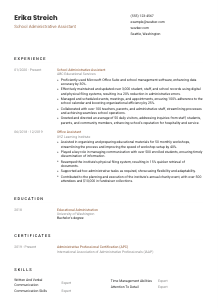
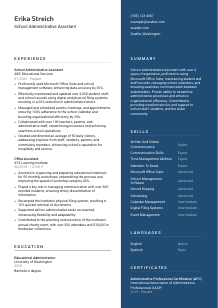
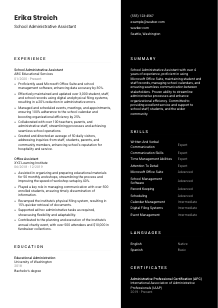
Running school errands, but your resume keeps getting detention? Master the formula with this School Administrative Assistant resume example, created with Wozber free resume builder. Learn how to showcase your administrative skills in a way that matches school requirements, leading your career to be as orderly and successful as the bell schedule!
A school front office runs on accuracy, calm communication, and follow-through. School Administrative Assistants are often the first point of contact for students, parents, teachers, and visitors, while also keeping records current, calendars organized, and routine paperwork moving without delays. Your resume should make that operational reliability easy to see from the first section.
Hiring teams often need to separate candidates with general office experience from people who already understand the pace and responsibilities of an education setting. A tailored resume, built in Wozber's free resume builder with clear ATS optimization, helps surface school-relevant experience like record maintenance, parent communication, scheduling, and document handling so your background reads as ready for day-to-day school operations.
School administrators usually see contact details before they see your experience, and small errors here can undermine the precision the job requires. Keep this section clean, professional, and aligned with any practical requirements named in the posting.
Use your full name in a larger, easy-to-read font so it stands out immediately. For an administrative role built on accuracy and professionalism, even this first line should feel orderly and polished.
Place "School Administrative Assistant" directly under your name if that is the role you are pursuing. Matching the posted title helps frame your background correctly, especially when schools are sorting candidates across office assistant, registrar, receptionist, and broader administrative roles.
List a reliable phone number and a professional email address, then review them carefully. School offices handle time-sensitive calls, parent inquiries, scheduling updates, and document requests, so a typo here creates the wrong impression before anyone reaches your experience.
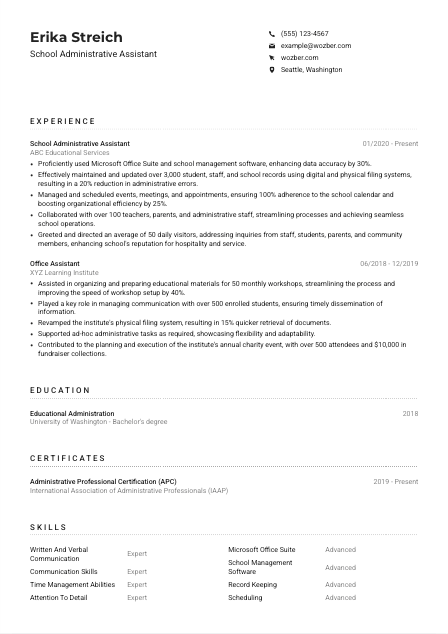
If the posting names a location requirement, reflect that clearly. In the example, listing "Seattle, Washington" supports a role that specifically asks for someone based there or willing to relocate. Use this approach when geography affects availability, district requirements, or commuting expectations.
If you include LinkedIn or a professional website, make sure it supports your application with consistent titles, dates, and school-facing administrative experience. Skip it if it is outdated or thin. For this role, consistency matters more than simply adding another link.
This section should confirm that you are reachable, professional, and aligned with the practical terms of the job. In school administration, that level of care already says something about how you handle records and communication.




This section carries the most weight because school administrators want to know how you handle daily operations, documentation, scheduling, and front-office communication in a live environment. Focus less on generic clerical duties and more on the volume, accuracy, coordination, and service standards behind your work.
Start by marking the responsibilities and tools that define the job. Here, that includes greeting visitors, responding to staff and parent inquiries, maintaining student and staff records, managing the school calendar, preparing documents, and using Microsoft Office Suite plus school management software. Those are the terms and workflows your experience should reflect naturally.
List positions in reverse chronological order and give priority to experience in schools, colleges, training centers, or other education settings when you have it. A title like "School Administrative Assistant" should appear prominently, but related office roles can also work if the bullets show scheduling, recordkeeping, educational support, or stakeholder communication.
Each bullet should show what you handled and what improved because of your work. Instead of writing "maintained records," specify the scope, system, and outcome. The sample does this well by noting more than 3,000 records managed and a 20% reduction in administrative errors, which immediately gives the hiring team a sense of scale and care.
Metrics are especially useful when they reflect office workload and service quality. Strong examples include number of records updated, daily visitor volume, meeting or event scheduling accuracy, response times, reduction in filing errors, or process efficiency gains. In the example, greeting about 50 daily visitors and improving data accuracy by 30% makes the work feel concrete rather than generic.
Keep bullets tied to administrative support in an education environment. If an older role includes planning workshops, student communication, document retrieval, or event coordination, keep those. Remove details that do not strengthen your case for handling calendars, records, school correspondence, and front-desk interaction. Every line should help a principal or office manager picture you in the office.
A hiring team should be able to see how you keep a school office organized, responsive, and accurate under daily pressure. When your bullets show systems, volume, and outcomes, your experience reads as immediately usable.
Education matters here because it helps place your administrative background in context, especially when a posting prefers a bachelor's degree or training connected to education, administration, or office operations. Present it clearly and keep the emphasis on relevance.
Check the posting for the minimum or preferred credential and make sure your degree is easy to find. In this case, a bachelor's degree is preferred, so listing it clearly helps you meet an early screening point before the reviewer gets deeper into your resume.
Include the institution, degree, field of study, and graduation year or date. School administrators reviewing resumes are often moving quickly between staffing needs and operational tasks, so this section should be easy to scan without extra wording.
If your degree is tied to Educational Administration, Education, Business Administration, or a related area, show that field clearly. The example's bachelor's degree in Educational Administration is a strong match because it reinforces familiarity with school systems and administrative structure, though other relevant degrees can also work well.
Include relevant coursework, short programs, or training if they connect to school operations, records management, office systems, or education policy. This is especially useful when you are early in your career or when the training fills a gap the posting emphasizes.
Academic honors, leadership roles, or recognition can be included if they add useful context, particularly for newer candidates. Choose items that reflect responsibility, organization, or commitment to education rather than filling space with unrelated achievements.
This section should quickly confirm that you meet the educational baseline and, where applicable, that your studies connect naturally to school administration. Clarity works better than extra detail here.
Certificates are optional for many School Administrative Assistant roles, but the right one can strengthen your case by showing formal training in office procedures, administrative support, or professional standards. Use this section to add relevance, not volume.
If the posting does not require certification, treat this section as a useful enhancer rather than a centerpiece. Administrative credentials, records-related training, software certificates, or professional office certifications can all help. The APC in the example adds credibility because it supports core administrative competencies.
Prioritize certificates that reinforce how you manage documents, communication, scheduling, systems, or compliance-heavy tasks. A short list of relevant certifications will help more than a long list with no connection to school office work.
Include earned or active dates when they clarify recency. For roles that rely on current software knowledge, modern office practices, or updated procedural awareness, dates can show that your training is not stale.
If you plan to add new credentials, look for training in student information systems, Microsoft Office, records administration, FERPA-related compliance awareness, or education office procedures. Ongoing development is especially useful when you want to move from general administration into a school setting or grow within one.
The right certificate tells a school that your administrative skills are backed by formal learning, not just job title history. Keep the list relevant and current enough to support the rest of your resume.
A school office depends on a mix of software fluency, organized execution, and steady communication with many audiences. Your Skills section should reflect the tools and working habits that keep daily operations moving, not a generic list of office buzzwords.
Scan the posting for hard skills and soft skills that appear in the responsibilities and requirements. Here that includes Microsoft Office Suite, school management software, written and verbal communication, organization, time management, and attention to detail. Those should appear in your resume if they reflect your real experience.
School Administrative Assistants need both administrative tools and people-facing strengths. Pair software and recordkeeping skills with communication, scheduling, and coordination skills so the section reflects the actual job. The sample's mix of Microsoft Office Suite, school management software, record keeping, scheduling, and communication is a useful model.
Avoid stacking near-duplicate entries or adding every skill you have used once. For example, if you list both "Written and Verbal Communication" and "Communication Skills," consider whether one stronger label is enough. A tighter list is easier to read and gives more room to the software, systems, and administrative strengths the school is actively seeking.
This section should help a reviewer quickly spot the tools and work habits behind your office performance. When the list reflects the posting and your actual experience, it strengthens both human review and ATS matching.
Language ability matters in school administration because front-office staff often handle questions from families, students, staff, and community members in real time. Present language skills clearly, especially when the posting names a required level of English fluency.
If the job asks for high fluency in English, list English prominently with an accurate proficiency level. For a School Administrative Assistant, this supports everything from writing letters and reports to answering parent questions and relaying information clearly to staff.
Additional languages can be valuable, especially in diverse school communities where bilingual communication helps families feel informed and welcomed. They are usually a bonus rather than a requirement, but they can strengthen your profile when the school serves multilingual households.
Use clear labels such as Native, Fluent, Advanced, Intermediate, or Basic. Schools may rely on this section when deciding who can handle family communication, translation support, or community-facing interactions, so accuracy matters.
If you speak another language, frame it as part of your ability to support school operations and community communication. In the example, basic Spanish is not a headline qualification, but it still adds context for a role that may involve varied family interactions.
For this role, languages are useful when they support communication across the school community. List them clearly and truthfully so hiring teams know where you can add value.
Your summary should quickly establish that you can handle the pace, detail, and communication demands of a school office. Keep it compact, but make sure it covers the kind of experience and operational strengths that matter most for administrative support in education.
Start with your title or closest equivalent and your years of experience. For this posting, noting more than 4 years in school or office administration immediately places you above the minimum 2 years requested and gives context for the rest of the resume.
Use the next sentence to name the work you actually do well, such as maintaining student and staff records, managing calendars, preparing documents, supporting administrators, and using Microsoft Office Suite or school management systems. The sample summary does this effectively by combining systems use with office coordination and communication support.
Aim for 3 to 5 lines that sound grounded in your real work. Skip broad adjectives and focus on administrative outcomes, service quality, and school-facing support. A concise summary with clear duties and a couple of strengths will land better than a paragraph full of vague claims.
When written well, this section tells the reviewer exactly what kind of administrative support you bring to a school environment. It should make the experience section feel like proof, not a surprise.
A well-tailored School Administrative Assistant resume should show that you can keep records accurate, manage calendars, communicate clearly with families and staff, and support smooth school operations without constant oversight.
Use Wozber's free resume builder to organize that experience in an ATS-compliant resume, and use the ATS resume scanner to align your wording with the posting's software, communication, and administrative requirements. The result should make your school office readiness easy to recognize.




