



Use Wozber and land your dream job
Create Resume
No registration required
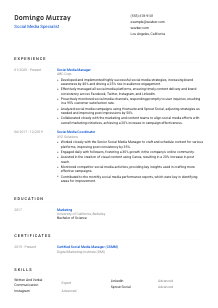
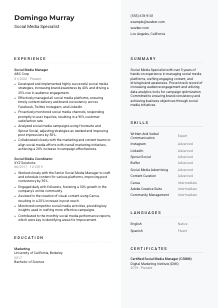
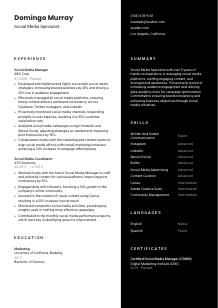
Scrolling, but your resume gets no likes? Check out this Social Media Specialist resume example, created with Wozber free resume builder. Learn to present your digital influence and content creation skills to match job specifics, keeping your social career always trending!
Social Media Specialists are hired to turn day-to-day posting into measurable audience growth, sharper brand presence, and stronger community response. A resume for this role needs to show more than platform familiarity. It should make your content judgment, campaign thinking, and performance tracking easy to see through real work such as engagement gains, response quality, and cross-channel execution.
When the resume mirrors the language of the role, hiring teams can quickly separate someone who has simply scheduled posts from someone who can run social channels with a plan. Wozber's free resume builder helps structure that story in an ATS-friendly resume format, so your experience with content calendars, analytics tools, and brand voice comes through clearly for both screening systems and marketing leads.
Social media work sits close to brand reputation, so even the contact section should feel current, professional, and easy to use. Keep it clean and practical, the same way you would present a brand profile that people need to trust at a glance.
Use your full name in a clear, readable font and give it the most visual weight on the page. For a Social Media Specialist, this should feel polished rather than flashy. Save creative expression for your portfolio, campaign examples, or linked work, not for hard-to-read styling in the header.
Place "Social Media Specialist" under your name when that is the role you are targeting. Matching the title used in the job post helps frame your background immediately and supports ATS alignment. If your recent title was "Social Media Manager" or "Social Media Coordinator," your experience section will still show progression, but the headline should reflect the job you want.
List a phone number you answer and a professional email address that looks current and credible. This role depends on communication, responsiveness, and brand judgment, so avoid casual email handles. One small error in your contact details can block an interview just as easily as a broken campaign link.
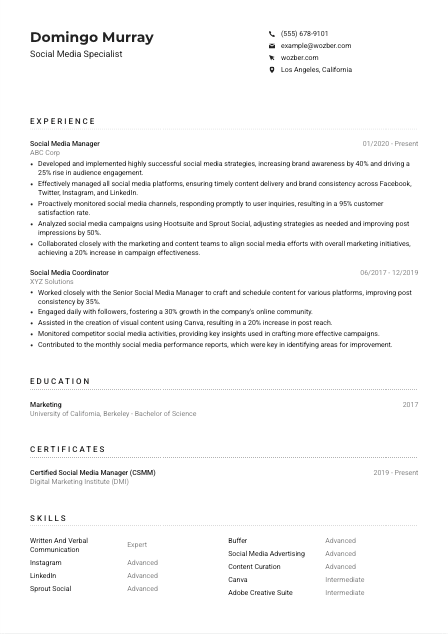
Some social roles are open to remote talent, but others need a local candidate for team collaboration, content shoots, or office-based planning. Here, listing "Los Angeles, California" directly addresses a stated requirement. Treat location as a tailoring point, not something to force into every resume if the job does not ask for it.
Include a LinkedIn profile, portfolio, or personal website if it shows campaign work, content samples, platform growth, or brand collaborations. For social media hiring, a link is useful when it extends the resume with proof of voice, visual consistency, or performance reporting. Make sure the page is updated and supports the same professional story as the resume.
This section should confirm that you are easy to contact, professionally presented, and aligned with any basic requirements such as location or job title. For a Social Media Specialist, that first impression should already reflect clean brand judgment.




Hiring teams for social media roles scan experience for two things very quickly: whether you have managed channels in a real business setting, and whether your work improved performance. Your bullets should show strategy, execution, reporting, and collaboration, not just posting activity.
Read the posting closely and mark the actions that define the role. For this one, that includes developing social strategy, managing multiple platforms, monitoring audience interactions, analyzing campaign metrics, and coordinating with marketing and content teams. Use those same ideas to shape your bullets so the overlap is obvious without copying the posting word for word.
Start with your most recent role and include job title, company, and dates for each position. In social media hiring, progression matters. A path from coordinator to manager to specialist-level ownership can show growing responsibility for planning calendars, handling community engagement, and interpreting performance data across channels.
Each bullet should show what you owned and what changed because of your work. Instead of saying you "posted on Instagram and LinkedIn," show how you managed platform content, maintained brand consistency, or improved engagement. The example resume does this well by tying work to outcomes such as stronger campaign effectiveness and more consistent posting across Facebook, Twitter, Instagram, and LinkedIn.
Social media is a metrics-driven function, so numbers carry real weight here. Use measures that fit the work, such as follower growth, engagement rate, impressions, response time, customer satisfaction, click-through rate, or campaign lift. Figures like a 40% increase in brand awareness, a 25% rise in audience engagement, or a 50% improvement in post impressions tell a hiring manager that you know how to move performance, not just maintain activity.
If you have broader marketing experience, keep the bullets that best support social media hiring. Content scheduling, community management, trend monitoring, analytics reporting, paid social support, and cross-functional coordination usually matter more here than unrelated general marketing duties. Shape the section around the responsibilities you want to be hired for.
Your experience section should show that you can plan content, manage active channels, respond to audiences, and improve results with data. When those points are clear, the hiring team can quickly picture you running their social presence.
Education is usually a supporting section for Social Media Specialists, but it still matters when the posting asks for a bachelor's degree in marketing, communications, or a related field. Present it clearly so the requirement is easy to confirm and move on.
If the role asks for a bachelor's degree, list your degree in a way that makes the field obvious. A Bachelor of Science in Marketing, like the example from the University of California, Berkeley, lines up directly with a posting that values marketing or communications training. If your degree is in a related area, the field name should still be easy to connect to the role.
Keep the entry simple: degree, field of study, school, and graduation year or date. Hiring managers are not looking for creative formatting here. They want to confirm the credential quickly and focus on your campaign work, platform management, and results.
A marketing, communications, journalism, or digital media background can strengthen your story because it connects naturally to audience messaging, brand voice, and channel strategy. You do not need to overexplain it. Just make the relevance visible through the degree title and field.
Most experienced candidates can keep this section lean. If you are earlier in your career, coursework in digital marketing, consumer behavior, analytics, content strategy, or visual communication can add useful context. Include it only when it fills a genuine experience gap or supports the target role.
Honors, leadership roles, or marketing-related campus work can be worth listing when they connect to social media practice, such as managing a student organization's channels or leading campaign projects. If you already have several years of direct professional experience, keep the focus on work results instead.
For this role, education mainly confirms your foundation in marketing or communications. Once that requirement is easy to spot, the rest of the resume can do the heavier work of proving platform skill and business impact.
Certifications are not always mandatory for social media hiring, but they can strengthen your resume when they show current platform knowledge, campaign strategy, analytics fluency, or continued learning in digital marketing. Choose the ones that add practical value.
Prioritize credentials that connect directly to the work, such as social media management, digital marketing, analytics, paid social, or content marketing. A certification such as "Certified Social Media Manager (CSMM)" works because it reinforces professional commitment in a field where tactics and platform features change quickly.
A short list of well-chosen certifications is more persuasive than a long list of loosely related courses. Pick the credentials that support the responsibilities in the job description, especially strategy development, channel management, performance analysis, and content execution.
Social platforms, ad products, and reporting tools evolve fast, so dates matter. Showing when a certification was earned, renewed, or remains active helps employers see that your training is current enough to support present-day platform work.
If your recent roles already show strong execution, certifications can still help you expand into adjacent areas such as paid social, short-form video strategy, influencer marketing, or advanced analytics. Use this section to show that your learning keeps pace with how brands actually use social channels.
Relevant certifications can strengthen your case when they support the kind of social media work the role requires. They are most useful when they add current strategic or technical depth to the experience already on your resume.
A Social Media Specialist skills section should read like the toolkit behind real campaign execution. Hiring managers want to see platform fluency, content capability, analytics tools, and communication strength presented in a way that matches the role they need filled.
Use the job description to identify the exact skills and tool categories the employer already values. In this case, that includes social media management, analytics tools, written and verbal communication, and platform-specific content work across channels such as Facebook, Instagram, LinkedIn, and Twitter. Mirroring that language improves ATS optimization and makes your relevance easier to spot.
Only list tools and abilities that show up naturally elsewhere on the resume. If you claim Hootsuite, Sprout Social, Buffer, Canva, Adobe Creative Suite, community management, or content curation, the experience section should give at least some proof of how you used them. The example resume does this by connecting Hootsuite and Sprout Social to campaign analysis and optimization.
Group related strengths when possible. For example, you might separate platform management, analytics and scheduling tools, content creation, and communication skills. That makes it easier for a recruiter or marketing lead to see whether you cover the full workflow from content planning to performance reporting.
Your skills list should show that you can handle the daily mechanics and strategic side of social media work, from platform management to reporting and content support. If the tools and abilities align cleanly with your experience, the section becomes much more credible.
Social media roles are built on tone, responsiveness, and audience connection, so language ability can matter more here than in many other marketing jobs. Present languages clearly, especially when the posting names one as required.
If English fluency is listed in the job description, make that easy to find. For a content and community role, this is not a minor detail. It directly affects copy quality, response handling, and brand voice across posts, comments, and direct messages.
Additional languages can strengthen your application when they support community engagement, regional audiences, or multicultural campaigns. Spanish, for example, can be valuable in many markets because it broadens your ability to communicate with followers and understand audience nuance.
Label each language with a clear level such as Native, Fluent, Advanced, or Conversational. Social media work often involves public-facing communication, so overrating your proficiency can create immediate problems if the role includes copywriting, moderation, or stakeholder communication in that language.
Language ability is useful not only for translation but also for tone, cultural context, and response quality. If your target roles involve diverse customer communities or regional campaigns, this section can quietly support your value in audience engagement work.
If languages are central to the position, give them proper visibility. If they are secondary, keep the section concise and factual. The point is to show communication range where it helps the employer understand your audience-facing capability, not to overstate it.
For a Social Media Specialist, languages matter when they improve copy quality, community interaction, or market reach. List them clearly so the hiring team can see how they support the audiences you can serve.
The summary sits near the top of the resume, so it should quickly tell the reader what kind of social media professional you are. Focus on your level, your core strengths, and the business results you tend to drive across channels.
Start with a direct professional identity, such as "Social Media Specialist with 5+ years of experience" or a close variation that fits your background. This gives immediate context and helps frame everything that follows, especially if your prior titles include manager, coordinator, or digital marketing roles.
Use the next lines to point to the work you do best, such as building social strategies, increasing brand awareness, improving engagement, managing multi-platform content, or using analytics to refine campaigns. The example summary works because it combines hands-on platform management with measurable growth and data-driven optimization.
Aim for three to five lines with concrete language. Avoid generic claims about being passionate, creative, or results-driven unless they are anchored to actual social media work like audience growth, campaign reporting, or brand consistency across channels.
Adjust the summary each time you apply so it reflects the employer's priorities. If a posting stresses analytics, content strategy, or cross-team collaboration, bring those themes forward using language that matches your real experience. This is one of the fastest places to show role alignment before a recruiter reaches the experience section.
A well-written summary should make it clear within seconds that you can manage social channels with intention, measure performance, and support broader marketing goals. That is the context the rest of the resume should now reinforce.
A Social Media Specialist resume works when it shows how you plan content, manage channels, respond to audiences, and improve results with data. Keep the language close to the job description, use metrics where they genuinely reflect your work, and make platform tools, collaboration, and brand consistency easy to find.
Wozber's free resume builder and ATS resume scanner can help you tailor each section, surface missing keywords, and present your background in an ATS-compliant resume that stays easy for hiring teams to review. The final version should make one thing clear right away: you can run social media with both creative judgment and performance discipline.




