




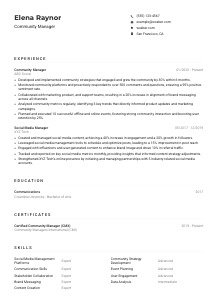
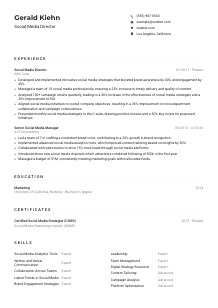
Use Wozber and land your dream job
Create Resume
No registration required
Crafting content that clicks, but your resume feels like a refresh button? Check out this Social Media Marketing Manager resume example, created with Wozber free resume builder. It shows how to present your online promotion prowess to match job criteria, keeping your career feed filled with engagement and career likes!
Social media marketing managers are hired to do more than keep channels active. They are expected to turn content, community activity, and platform changes into measurable business movement, whether that means stronger brand awareness, more referral traffic, higher engagement, or better lead flow. Your resume needs to show that you can plan, execute, and read performance data, not just post content.
A tailored resume quickly shows whether your experience lines up with the mix of strategy, analytics, and content leadership the role requires. Using Wozber's free resume builder helps you shape that experience into an ATS-compliant resume that reflects the language of the job description, making it easier for hiring teams to see your campaign results, channel ownership, and growth record.
For social media marketing roles, the header does more than identify you. It confirms basic hiring requirements fast, especially when a posting includes location, communication expectations, or digital profile links that support your brand and work history.
Your name should be the most visible line on the page, set in a clean, readable style. In a field built around brand presentation and audience attention, even this small detail should feel polished and intentional rather than decorative.
Place "Social Media Marketing Manager" directly under your name when that is the role you are applying for. Matching the posted title helps position you correctly in both ATS screening and human review, especially when employers are separating manager-level candidates from coordinators, content creators, or broader digital marketers.
Include a current phone number and a professional email address, ideally in a straightforward format such as firstname.lastname@email.com. This role depends on clear written communication, so sloppy contact details can undercut the impression you want to create before anyone reads your campaign results.
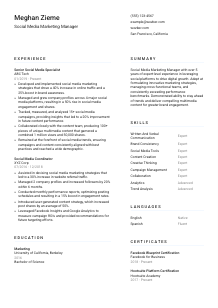
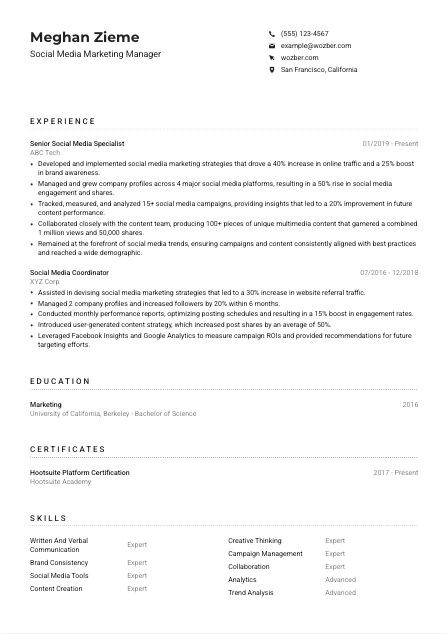
If the job requires you to be in a specific market or willing to relocate, reflect that in your header. Here, listing San Francisco, California directly supports a stated requirement and removes an avoidable point of uncertainty. Use location this way when it is relevant to the posting, not as a default rule for every application.
If you have a LinkedIn profile, portfolio, or personal site that shows campaign work, content examples, or platform results, include it. Make sure it matches your resume in titles, dates, and achievements. For a social media marketing manager, consistency across channels is part of your professional credibility.
Your header should confirm who you are, what role you are targeting, and any practical requirement such as location. Keep it concise, accurate, and aligned with the way this role is screened.




Experience is the section hiring teams read most closely for this profession. They want to see channel ownership, campaign execution, audience growth, content collaboration, and reporting that led to better decisions. Titles matter, but outcomes matter more.
Before editing your bullets, mark the main hiring themes in the job description. For this role, those include growing social presence, driving traffic and brand awareness, analyzing campaign performance, collaborating on multimedia content, and staying current with platform trends. These themes should shape which achievements you lead with and how you phrase them.
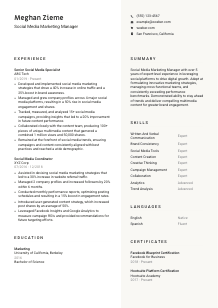
List your jobs in reverse chronological order with company name, title, and dates, then use bullets to show what you owned and what changed because of your work. In the sample resume, the recent role works because it pairs platform management with concrete gains like a 40% increase in online traffic and a 25% boost in brand awareness. That kind of framing makes manager-level impact easy to read.
Avoid generic lines such as "managed social media accounts" unless you follow them with reach, engagement, traffic, conversions, or audience growth. Better bullets show the business effect of your work, such as improving engagement rates, scaling shareable content, or refining campaign targeting based on analytics. If you collaborated with content, creative, or paid teams, say how that partnership improved performance.
Numbers give context to your decisions. Strong examples in this field include follower growth, engagement rate lift, referral traffic, campaign volume, share rate, video views, lead generation, content output, or ROI indicators. The sample resume does this well by tying campaign analysis to a 20% improvement in future content performance and multimedia production to 1 million views and 50,000 shares.
Prioritize experience that shows platform strategy, reporting, brand voice management, content planning, community engagement, and measurable growth. If you have earlier marketing work that is less relevant, shorten it or focus only on the parts tied to digital campaigns and audience development. The goal is to make your path toward social media leadership obvious.
The strongest experience sections show that you can own channels, shape content direction, and improve performance over time. If a hiring manager can quickly see growth, analysis, and execution in your bullets, this section is doing its job.
Education is usually a supporting section for social media marketing managers, but it still matters when a posting asks for a specific academic background. Keep it straightforward and let it confirm that you meet the degree requirement without taking attention away from your campaign results.
When a posting asks for a bachelor's degree in Marketing, Communications, or a related field, list your degree in a way that makes that connection obvious. A degree such as "Bachelor of Science in Marketing" directly supports the requirement and removes guesswork during screening.
Include your degree, field of study, school name, and graduation year or date. Social media hiring teams are not looking for elaborate formatting here. They want a quick confirmation that your academic background supports the role's expectations.
If your degree aligns closely with the role, let that speak for itself. In the provided example, a marketing degree from UC Berkeley reinforces a clear foundation in audience strategy, communications, and campaign thinking. Use that kind of alignment when it is true for you, without overexplaining it.
For early-career candidates, relevant coursework in digital marketing, brand communications, analytics, or content strategy can add useful context. For more experienced candidates, this is usually optional unless a project clearly connects to social campaigns, audience research, or multimedia content planning.
Honors, leadership roles, or student media and marketing projects can be worth adding if they show communication skill, campaign work, or audience development. Keep them brief and relevant. Once you have several years of professional results, education should stay in the background.
This section should quickly show that you meet the academic baseline for the role. Save most of your detail for the work that proves you can grow channels and run effective campaigns.
Certifications carry real weight in social media marketing when they reflect current platform knowledge or hands-on tool fluency. They are especially useful when a job description names specific credentials or when you want to show ongoing learning in a fast-changing channel environment.
If the employer mentions credentials such as Hootsuite Platform Certification or Facebook Blueprint Certification, place those prominently in this section. Doing that shows direct alignment with the role and confirms familiarity with tools and ecosystems commonly used for scheduling, publishing, advertising, and analytics.
List certifications that connect to social platform management, paid social, analytics, content strategy, or community growth before broader marketing credentials. Keep the section focused. A shorter list of highly relevant certifications is more persuasive than a long list with weak connection to day-to-day social media work.
Platform behavior, ad products, and reporting tools change quickly, so dates matter here. Show when you earned or renewed a certification. In the example, ongoing validity on Hootsuite and Facebook credentials supports the candidate's claim that they stay current with trends and platform changes.
If you are actively adding new credentials, include those that sharpen your profile for the specific role you want. Certifications in Meta advertising, social analytics, content marketing, or creator strategy can strengthen your resume when they reflect real working knowledge and not just passive course completion.
For social media marketing roles, certifications work best when they back up tool fluency and current platform knowledge. Choose the ones that strengthen your match for the job in front of you.
The skills section should echo how social media marketing managers actually work. That means a mix of platform execution, performance analysis, creative judgment, and cross-team coordination. Keep it targeted enough to match the role, not broad enough to describe any marketer.
Start with the abilities the employer has already signaled as important. For this posting, that includes social media tools, analytics, written and verbal communication, creativity, and campaign management. Mirroring that language helps with ATS optimization and makes your resume feel closely tailored to the role.
Choose skills that support the work you want to be hired for, such as social media strategy, content creation, community management, brand consistency, analytics, reporting, trend analysis, and collaboration with content teams. The example resume keeps this list focused on practical strengths instead of drifting into generic marketing terms.
Social media marketing managers need both analytical and creative range. Include hard skills like platform analytics, campaign tracking, or social media tools alongside softer but role-critical strengths like copywriting, brand voice, stakeholder collaboration, and creative thinking. That mix reflects the real demands of managing content performance across channels.
A focused skills section should read like a summary of how you operate across platforms, content, and reporting. If the list sounds specific to social media management, you are on the right track.
Language ability matters in social media work when it affects communication, content quality, community management, or market reach. This section does not need to be long, but it should be accurate and relevant to the posting and the audiences you may serve.
If the job requires fluent English, list it clearly with an honest proficiency level. For a role centered on copy, collaboration, community response, and brand voice, language fluency is part of day-to-day execution, not a minor detail.
Include additional languages that could support multilingual content, broader audience engagement, customer interaction, or regional campaign work. In the sample resume, Spanish is a useful secondary language because it may expand audience reach, even though English remains the required language for the role.
Terms like Native, Fluent, Intermediate, or Basic are enough. Avoid inflating your level. Social teams often move quickly, and if a language is relevant to content review or community management, your actual working ability will show up fast.
If your language skills support international audiences, bilingual campaigns, influencer partnerships, or community moderation across regions, they can add value beyond the requirement itself. Include them when they strengthen your professional story, not just to fill space.
For this profession, languages can support tone adaptation, audience nuance, and campaign reach across different communities. If that is part of your background, this section can quietly reinforce your versatility in social communication.
Keep this section honest and relevant. When language ability supports content, audience engagement, or market reach, it becomes a useful advantage rather than a side note.
Your summary sits at the top of the resume, so it should quickly frame the kind of social media marketer you are. Focus on experience level, strategic strengths, and the results you are known for delivering across channels.
Start with your title, years of experience, and the part of social media marketing you do best. That could be platform growth, content strategy, brand storytelling, analytics-driven optimization, or cross-functional campaign leadership. Make the first line immediately relevant to the manager-level role you are targeting.
Use the summary to reflect the employer's most important needs, such as growing social presence, driving traffic and brand awareness, measuring campaign performance, and producing strong content with creative teams. In the sample resume, the summary works because it combines digital growth, strategy, team collaboration, and performance benchmarks in a compact way.
Aim for three to five lines with specific language and no filler. This section should sound grounded in work you have actually done. Phrases tied to measurable results, channel growth, campaign performance, or audience engagement will carry more weight than broad claims about passion or motivation.
Before you finalize the summary, compare it to the job description. If the role leans more heavily toward analytics, brand growth, multimedia content, or lead generation, adjust your wording so that emphasis is visible at the top of the page. Wozber's AI resume builder can help align your phrasing with the posting while keeping the summary natural and ATS-friendly.
Your summary should tell a hiring team, within seconds, that you understand social media as a growth channel and can back that up with execution and results. Get that right, and the rest of the resume has a much easier job.
A strong Social Media Marketing Manager resume shows how you build audience attention into measurable outcomes. That means clear proof of platform growth, campaign analysis, content collaboration, and business impact, all framed in the language of the role you are targeting.
Wozber's free resume builder gives you an ATS-friendly resume format for organizing that experience, and its ATS resume scanner helps you align your wording with the job description section by section. When your resume is tailored this way, hiring teams can quickly judge whether you can lead channels, shape content strategy, and improve social performance from day one.




